
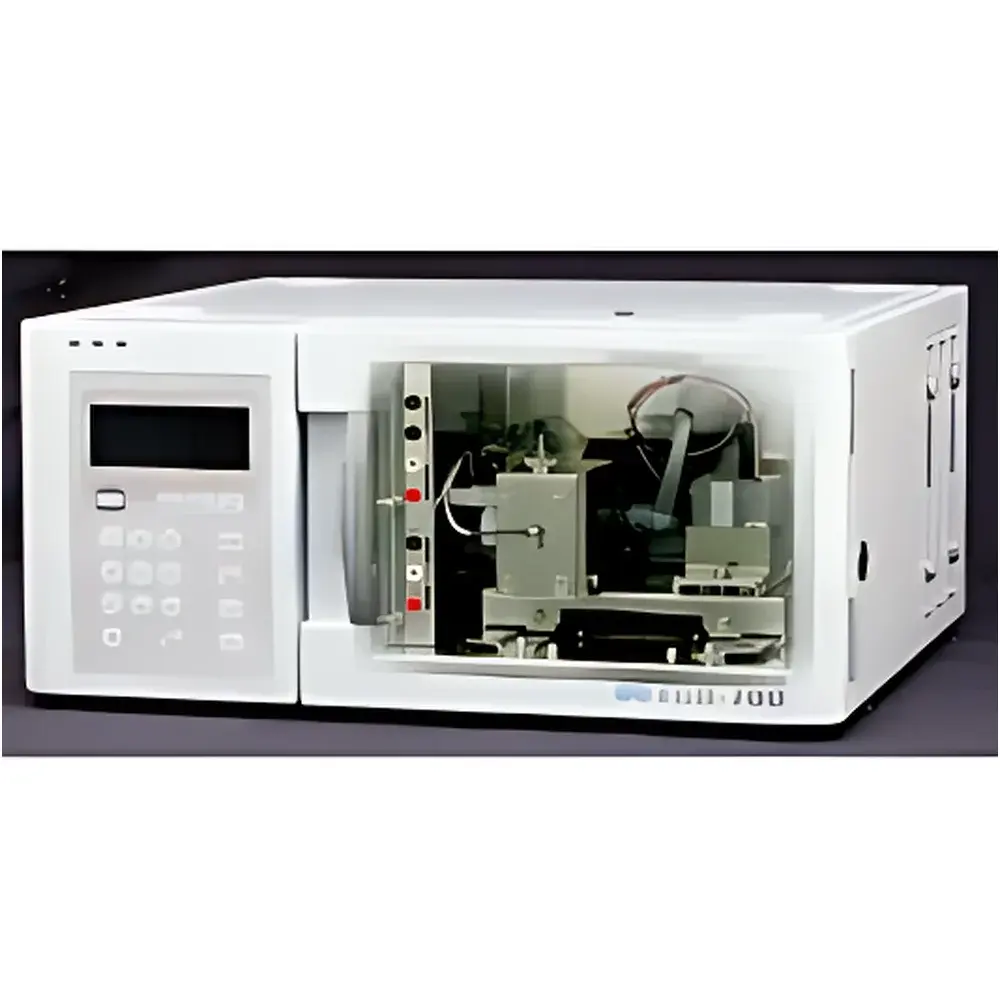
HPLC-ECD System 700 Series (Type III) – Eicom Integrated Electrochemical Detection Platform
| Brand | Eicom (Japan) |
|---|---|
| Manufacturer | RWD (Shenzhen, China) |
| Configuration | Modular HPLC with Dual-Electrode ECD-700 Detector, Pulse-Free EP-700 Pump, and ATC-700 Column Oven |
| Compliance | Designed for GLP/GMP-aligned neurochemical analysis workflows |
| Software Interface | Eicom PowerChrom v5.x (FDA 21 CFR Part 11–ready audit trail optional) |
| Detection Principle | Amperometric electrochemical detection in flow cell configuration |
| Electrode Configurability | Dual working electrode support (e.g., glassy carbon + platinum), independent potential control per channel |
| Sensitivity | ≤30 fg dopamine (S/N = 3, 10 µL injection, 3 mm electrode) |
| Flow Compatibility | 0.01–2.0 mL/min, compatible with analytical (2.1–4.6 mm ID) and microbore columns |
Overview
The HPLC-ECD System 700 Series (Type III) is a modular, high-fidelity electrochemical detection platform engineered for quantitative trace-level analysis of electroactive biomolecules—including monoamines (dopamine, serotonin, norepinephrine), metabolites (DOPAC, HVA), amino acids (cysteine, glutathione), and reactive oxygen species—in complex biological matrices. Unlike conventional UV or fluorescence-based HPLC systems, this platform employs amperometric detection via dual-channel potentiostatic control, enabling selective oxidation or reduction at precisely defined working electrode potentials. The system integrates three core modules: the ECD-700 dual-electrode electrochemical detector, the EP-700 pulse-free syringe pump (delivering stable flow without passive dampeners), and the ATC-700 precision column oven (±0.1 °C stability over 20–50 °C range). Its modular architecture supports both standalone operation and seamless integration with third-party HPLC components—including autosamplers, gradient mixers, and separation columns from Waters, Thermo Fisher, or Shimadzu—ensuring compatibility with existing laboratory infrastructure while maintaining full electrochemical signal integrity.
Key Features
- Pulse-free fluidic delivery: EP-700 syringe pump utilizes direct-drive stepper motor actuation and real-time pressure feedback to eliminate flow pulsation (<0.1% RSD), eliminating the need for mechanical pulse dampeners and preserving baseline stability during low-volume, high-sensitivity detection.
- Dual-electrode electrochemical detection: ECD-700 accommodates two independent flow cells with separately controllable working electrodes—enabling simultaneous dual-potential detection (e.g., oxidation at +0.65 V and reduction at −0.2 V), differential pulse amperometry (DPA), or internal reference calibration within a single chromatographic run.
- Thermal optimization: ATC-700 column oven features Peltier-based heating/cooling, uniform axial airflow, and PID-controlled temperature regulation—critical for reproducible retention time alignment across multi-day neurochemical studies under GLP conditions.
- Modular scalability: System supports expansion via additional EP-700 pumps (for binary gradient or post-column reagent delivery) or auxiliary ECD-700 units (for parallel column detection), without firmware or software reconfiguration.
- Robust electrode interface: Standard 3-electrode configuration (working, reference, counter) with gold- or glassy carbon–coated electrodes; all electrochemical parameters (potential sweep rate, filter frequency, gain) programmable via PowerChrom software with hardware-level digital filtering (16-bit ADC, 10 kHz sampling).
Sample Compatibility & Compliance
The 700 Series is validated for use with biological samples including cerebrospinal fluid (CSF), microdialysates, plasma, tissue homogenates, and cell culture supernatants—following standardized deproteinization (e.g., 0.1 M perchloric acid precipitation) and centrifugation protocols. It meets analytical requirements outlined in ISO/IEC 17025 for method validation of electrochemical assays and supports compliance with FDA 21 CFR Part 11 when configured with PowerChrom’s optional electronic signature and audit trail module. All hardware components are CE-marked and conform to IEC 61010-1 safety standards for laboratory equipment. Column compatibility spans reversed-phase C18, phenyl-hexyl, and polar-embedded phases (e.g., Waters Atlantis dC18), with mobile phase tolerance for aqueous buffers containing 0.1 mM sodium octanesulfonate, 0.1 M phosphate (pH 2.8–3.2), and 10–15% methanol or acetonitrile.
Software & Data Management
PowerChrom v5.x provides native instrument control, real-time amperometric signal visualization, peak integration using tangent skim and Gaussian deconvolution algorithms, and automated calibration curve generation (linear, quadratic, or weighted least-squares). Raw data are stored in vendor-neutral .chd binary format with embedded metadata (date/time, operator ID, method name, electrode potentials). Export options include CSV, ASCII, and .mzML-compatible chromatogram files. For regulated environments, optional 21 CFR Part 11 compliance package includes role-based user access, electronic signatures, immutable audit trails (with timestamped event logging for parameter changes, data exports, and method edits), and secure database backup to network-attached storage (NAS) or local RAID arrays.
Applications
This system is routinely deployed in preclinical neuroscience laboratories for longitudinal monitoring of neurotransmitter dynamics in awake, freely moving rodents via intracerebral microdialysis; in pharmaceutical development for stability-indicating assays of catecholamine-based therapeutics; and in clinical research laboratories for quantifying oxidative stress markers (e.g., ascorbic acid, uric acid) in human biofluids. Its dual-electrode capability enables ratiometric correction for drift (e.g., dopamine/HVA ratio), while its low-fg sensitivity supports detection in sub-microliter dialysate fractions—reducing animal usage in accordance with NIH Guide for the Care and Use of Laboratory Animals.
FAQ
Can the ECD-700 detector operate with non-Eicom HPLC pumps?
Yes—the ECD-700 accepts standard analog voltage input (0–1 V = 0–100 nA) and TTL synchronization signals; it is compatible with any pump delivering stable flow between 0.01–2.0 mL/min and providing 4–20 mA or 0–10 V output for flow rate telemetry.
Is dual-electrode operation limited to identical electrode materials?
No—each flow cell accepts independently replaceable electrodes (glassy carbon, platinum, gold, or boron-doped diamond); material selection is application-specific and does not require hardware modification.
Does the system support gradient elution?
Yes—when paired with an external low-dead-volume gradient mixer or dual EP-700 pumps, the system maintains electrochemical baseline stability across gradients up to 80% organic modifier, provided mobile phase conductivity remains within ±10% variation.
What validation documentation is supplied?
Each unit ships with Factory Acceptance Test (FAT) report, electrical safety certification, and electrochemical performance verification data (including noise floor <1 pA RMS, response time <100 ms, linearity R² ≥0.9999 over 0.1–100 nA range).
Is remote monitoring supported?
PowerChrom supports TCP/IP-based remote desktop access and SNMP-enabled system health alerts (e.g., column backpressure >300 bar, oven temperature deviation >0.5 °C) via enterprise IT infrastructure.





