
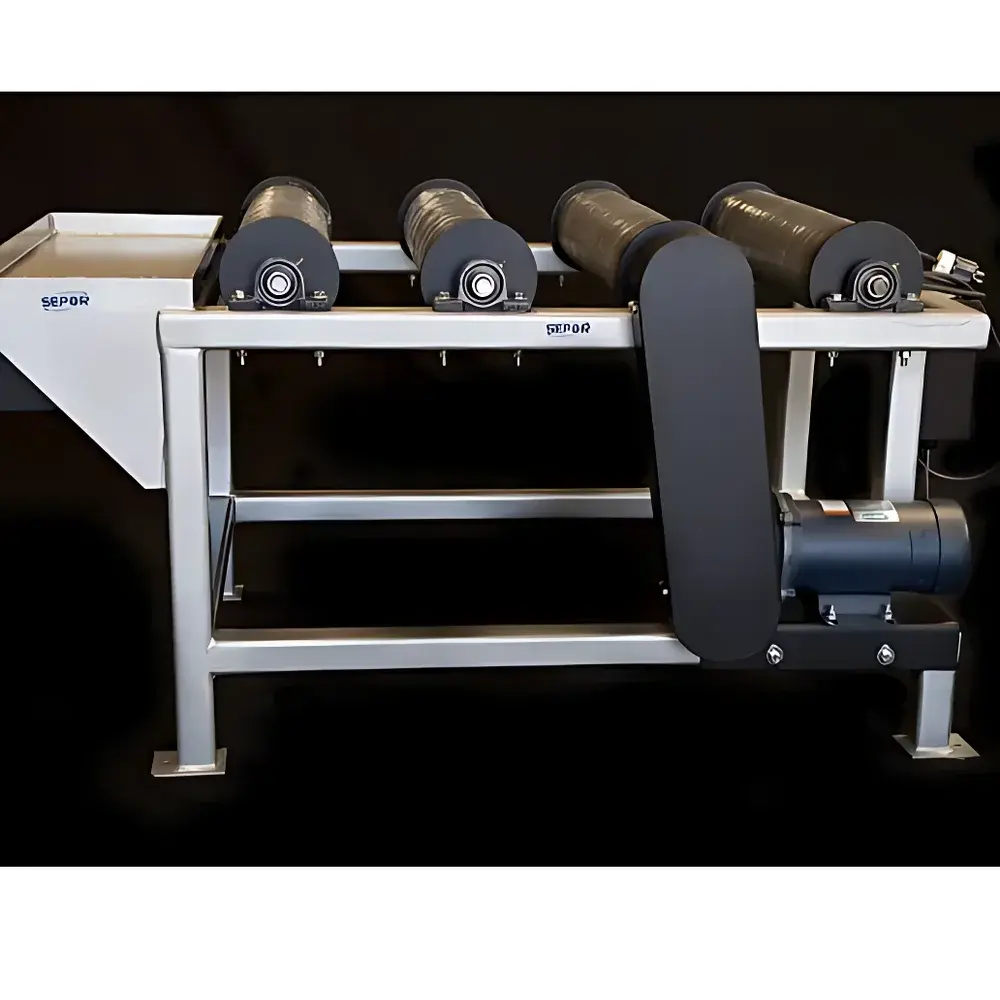
Sepor 5-Inch Batch Ball and Rod Mill Drive System
| Origin | USA |
|---|---|
| Supplier Type | Authorized Distributor |
| Origin Category | Imported |
| Model | 010E-001 / 010E-002 / 010E-003 |
| Pricing | Upon Request |
Overview
The Sepor 5-Inch Batch Ball and Rod Mill Drive System is a heavy-duty, precision-engineered mechanical drive unit designed for laboratory-scale and pilot-plant batch grinding applications. It operates on the principle of rotational tumbling—utilizing controlled cylindrical rotation to induce impact, attrition, and shear forces between grinding media (e.g., steel balls, ceramic rods, or high-density oxides) and solid feed material inside cylindrical vessels. This system is specifically configured to accommodate standard 5-gallon (18.9 L) grinding jars—whether stainless steel, carbon steel, porcelain, or rubber-lined—enabling both ball milling and rod milling modes within the same mechanical framework. The drive employs a 1/2 HP gearmotor with continuously variable speed control (40–230 RPM), allowing precise adjustment to match critical speed requirements across diverse jar diameters and media densities. Its robust construction—including 5-inch-diameter × 24-inch-long rubber-coated rollers with 10-inch center-to-center spacing—ensures stable torque transmission, minimal vibration, and long-term operational reliability under repeated loading cycles.
Key Features
- Heavy-duty 1/2 HP geared motor with analog speed control (40–230 RPM range) for consistent torque delivery across load variations
- 5-inch diameter × 24-inch length hardened steel rollers, fully covered with 70-durometer vulcanized rubber for enhanced grip and reduced slippage
- Modular three-point support frame with integrated workbench and built-in ball discharge grate at one end for safe, efficient media retrieval
- Configurable multi-roller configurations: dual-roll (010E-001), triple-roll (010E-002), and quad-roll (010E-003) variants to support parallel jar operation
- Universal voltage compatibility: 110 V / 1 Ph / 60 Hz and 220 V / 1 Ph / 50 Hz options—each model includes dual-voltage labeling and certified internal wiring
- Structural footprint: 43″ × 33″ × 30″ (L × W × H); shipping weights range from 250 lb (010E-001) to 350 lb (010E-003), reflecting reinforced steel chassis and roller assemblies
Sample Compatibility & Compliance
The drive system accommodates standard 5-gallon cylindrical grinding vessels made of stainless steel (304/316), carbon steel, porcelain, enamel-coated steel, or elastomer-lined configurations. Compatible grinding media include: steel balls (SG ≈ 7.7; ~40 lb/gal), alumina ceramics (SG ≈ 3.2; ~17.5 lb/gal), and porcelain spheres (SG ≈ 2.3; ~12.8 lb/gal). Optimal charge volume is empirically determined but typically falls between 20–50% of jar volume—corresponding to 30–40% void space in the media bed. Dry grinding loads are recommended at 25–50% jar volume; wet grinding slurries operate effectively at 30–50% solids volume with 30–60% w/w solids concentration. The system complies with general electrical safety standards per UL 508A (industrial control panels) and meets mechanical stability criteria outlined in ASTM E1155 for laboratory equipment foundations. While not intrinsically rated for hazardous locations, it may be integrated into Class I, Division 2 environments when installed per NEC Article 500 guidelines.
Software & Data Management
This is a manually operated electromechanical drive system with no embedded microprocessor, digital interface, or data logging capability. Speed is adjusted via calibrated potentiometer and verified using external tachometric measurement (e.g., handheld optical tachometer). For traceable process documentation, users are advised to record operational parameters—including voltage input, measured RPM, jar type, media mass, fill ratio, and grinding duration—in laboratory notebooks or LIMS-integrated electronic logs. The absence of firmware ensures immunity to software obsolescence, cyber vulnerabilities, or validation overhead associated with 21 CFR Part 11-compliant systems—making it suitable for GLP-aligned research where procedural consistency and auditability are prioritized over automation.
Applications
The Sepor 5-inch drive supports a broad spectrum of materials processing workflows, including mineral liberation studies (e.g., gold ore comminution, phosphate rock sizing), ceramic powder synthesis (e.g., zirconia dispersion, ferrite precursor homogenization), catalyst support preparation (e.g., alumina extrudate grinding), pharmaceutical excipient micronization (under dry conditions), and metallurgical assay sample reduction (per ASTM D346 and ISO 18283). It is widely deployed in academic geoscience labs, mining R&D centers, advanced ceramics development facilities, and environmental testing laboratories requiring reproducible, small-batch size reduction without solvent contamination risks.
FAQ
What is the maximum recommended jar diameter for this drive system?
The system is engineered for 5-gallon cylindrical jars with nominal diameters up to 11 inches (279 mm); optimal performance is achieved with jars matching the 5-inch roller pitch geometry.
Can this drive be used for continuous operation?
No—it is explicitly designed for intermittent, batch-mode operation. Duty cycle must include cooldown periods between runs to prevent gearmotor thermal overload.
Is the drive compatible with non-standard jar geometries (e.g., conical or hexagonal)?
Only cylindrical, symmetrically balanced jars are supported. Non-cylindrical vessels risk uneven loading, roller deflection, and premature bearing wear.
Does Sepor provide calibration certificates or metrological traceability for RPM output?
RPM calibration is user-verifiable using NIST-traceable tachometers; factory-certified speed verification is available as an optional service upon request.
What maintenance intervals are recommended for long-term reliability?
Gearmotor lubrication every 500 operating hours; visual inspection of roller rubber integrity and mounting bolt torque every 100 hours; annual bearing assessment recommended under daily use conditions.




