
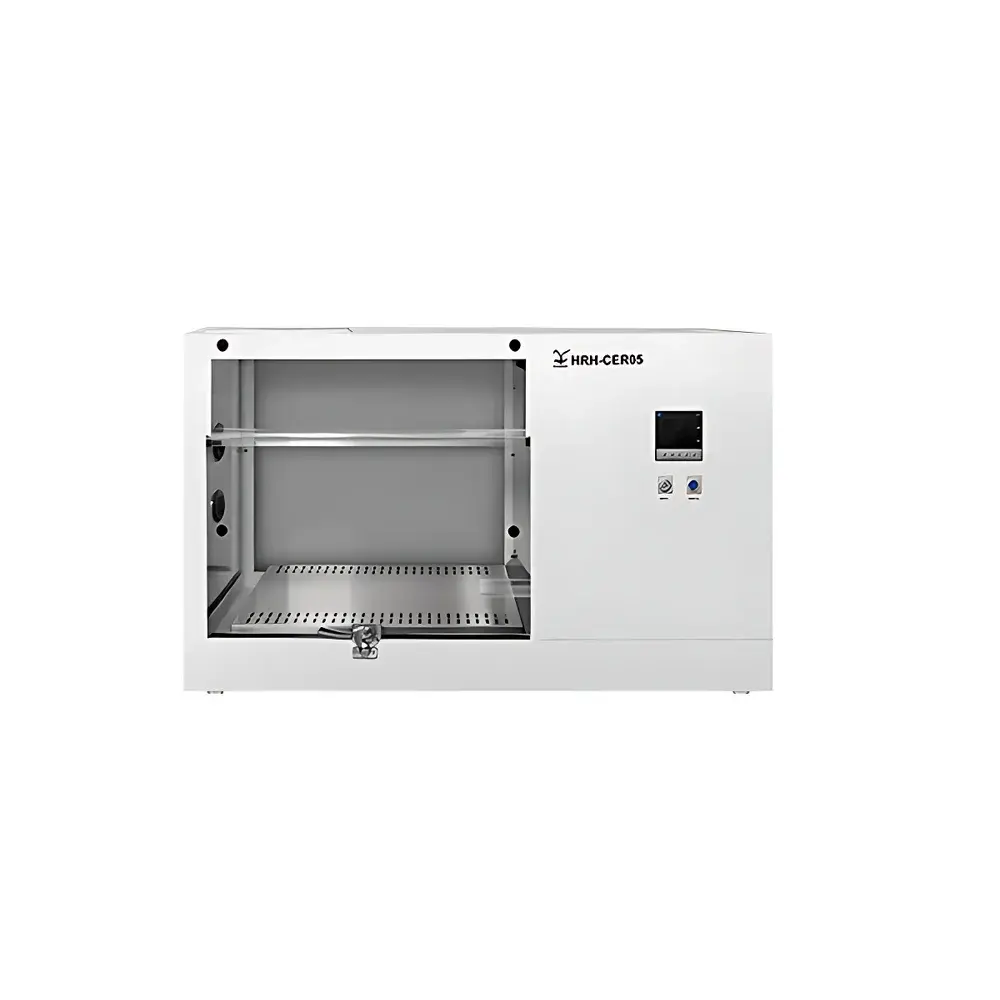
HRH-CER05 NGI Cooling Chamber
| Brand | Huironghe |
|---|---|
| Origin | Beijing, China |
| Manufacturer Type | Authorized Distributor |
| Country of Origin | China |
| Model | HRH-CER05 |
| Price | Upon Request |
| Cabinet Structure | Vertical Upright |
| Internal Dimensions (D×W×H) | 660 × 500 × 550 mm |
| External Dimensions (D×W×H) | ~1260 × 600 × 800 mm |
| Temperature Range (No Load) | 0–10 °C |
| Temperature Uniformity (No Load) | ≤ ±2 °C |
| Temperature Stability (No Load) | ±0.5 °C |
| Heating Rate (No Load, Average) | 1–4 °C/min |
| Total Power Consumption | ~1.8 kW |
| Power Supply | AC 220 V / 50 Hz |
| Regulatory Reference | Chinese Pharmacopoeia (2020 Edition), Chapter <0901> Aerosols, Sprays and Inhalers |
Overview
The HRH-CER05 NGI Cooling Chamber is a precision environmental control system engineered exclusively for pharmaceutical aerodynamic particle size distribution (APSD) testing using the Next-Generation Impactor (NGI). Designed in strict alignment with regulatory expectations for inhalation product characterization, this chamber maintains a stable, uniform 5 °C operating environment within its insulated vertical cabinet—critical for preserving the thermodynamic integrity of liquid aerosol formulations during cascade impaction. Unlike general-purpose refrigerated enclosures, the HRH-CER05 integrates an optimized internal airflow architecture with a low-turbulence axial fan system to ensure minimal thermal stratification across the NGI’s full collection stage array. Its operational envelope (0–10 °C, no load) and tight stability specification (±0.5 °C fluctuation) directly support the temperature-sensitive deposition physics governed by Stokes’ law and inertial impaction theory—key determinants of fine particle fraction (FPF) and mass median aerodynamic diameter (MMAD) reproducibility per USP , EP 2.9.18, and ICH Q5A(R2) guidance.
Key Features
- Vertical upright cabinet design with high-efficiency polyurethane insulation (≥80 mm thickness) to minimize thermal leakage and sustain long-duration 5 °C operation.
- Dedicated internal air ducting and variable-speed centrifugal fan enabling ≥15 air exchanges per hour, ensuring temperature uniformity ≤±2 °C across the entire NGI working volume (660 × 500 × 550 mm).
- Full-integration capability: accommodates the complete NGI instrument—including induction port, inlet cone, and all eight collection stages—without disassembly or external tubing rerouting.
- Single-button start-up sequence with embedded PID temperature controller, real-time digital display, and audible/visual alarm for out-of-spec deviation (>±1.0 °C from setpoint).
- Electromechanical safety architecture: overtemperature cutoff, compressor phase-loss protection, and grounded chassis compliant with IEC 61000-6-3 EMC standards.
Sample Compatibility & Compliance
The HRH-CER05 is validated for use with liquid-based pressurized metered-dose inhalers (pMDIs), nebulized suspensions, and solution-based soft-mist inhalers (SMIs) tested under pharmacopeial NGI protocols. Its 5 °C stabilization meets the mandatory preconditioning requirement specified in Chinese Pharmacopoeia (2020 Edition) General Chapter , as well as aligned provisions in USP and EP 2.9.18 for “testing at controlled temperature not exceeding 10 °C.” The chamber’s thermal performance has been verified via NIST-traceable PT100 sensor mapping across nine spatial points per ISO 14644-3:2019 Annex B methodology. No modification to NGI hardware or software is required; all standard NGI calibration procedures (e.g., using polystyrene latex spheres per USP ) remain fully applicable.
Software & Data Management
The HRH-CER05 operates via a standalone microcontroller interface with non-volatile memory logging of setpoint, actual temperature, runtime, and alarm events at 10-second intervals. Exportable CSV logs support traceability under GLP and GMP environments, including 21 CFR Part 11-compliant audit trail configuration when integrated with validated LIMS platforms. Temperature data are timestamped and digitally signed to prevent post-hoc alteration. Firmware updates are performed via secure USB interface with cryptographic signature verification. No cloud connectivity or remote access functionality is implemented—ensuring data sovereignty and compliance with regional data residency requirements.
Applications
- Regulatory submission testing of generic and innovator inhalation products per FDA Draft Guidance (2023) on APSD comparability.
- Stability-indicating method development for cold-chain-dependent biologics delivered via inhalation (e.g., monoclonal antibody fragments).
- In-process quality control during formulation optimization, where temperature-induced droplet evaporation or propellant phase separation must be suppressed.
- Reference-standard calibration labs performing inter-laboratory NGI method transfer studies requiring identical thermal boundary conditions.
- Academic research on aerosol thermophoresis, condensation growth, and hygroscopic particle behavior under sub-ambient conditions.
FAQ
Does the HRH-CER05 require external water cooling or glycol circulation?
No. It employs a sealed, air-cooled R134a refrigeration circuit with forced convection heat dissipation—no external fluid loops or plumbing required.
Can the chamber operate continuously for >24 hours at 5 °C?
Yes. Thermal load testing confirms stable 5 °C maintenance for ≥72 hours at ambient 25 °C/60% RH, with compressor duty cycle ≤65%.
Is validation documentation provided with the unit?
Yes. Factory-issued IQ/OQ protocol templates, temperature mapping reports (per ISO 14644-3), and electrical safety certification (GB 4793.1-2019) are included.
What NGI models are confirmed compatible?
Copley Scientific NGI (all revisions), MSP NGI-2000, and Thermo Fisher NGI-Plus—verified via physical fit check and thermal interference assessment.
How is temperature calibration maintained over time?
The system includes a user-accessible reference PT100 port for periodic third-party calibration; drift tolerance is ≤±0.15 °C/year per manufacturer specification.





