
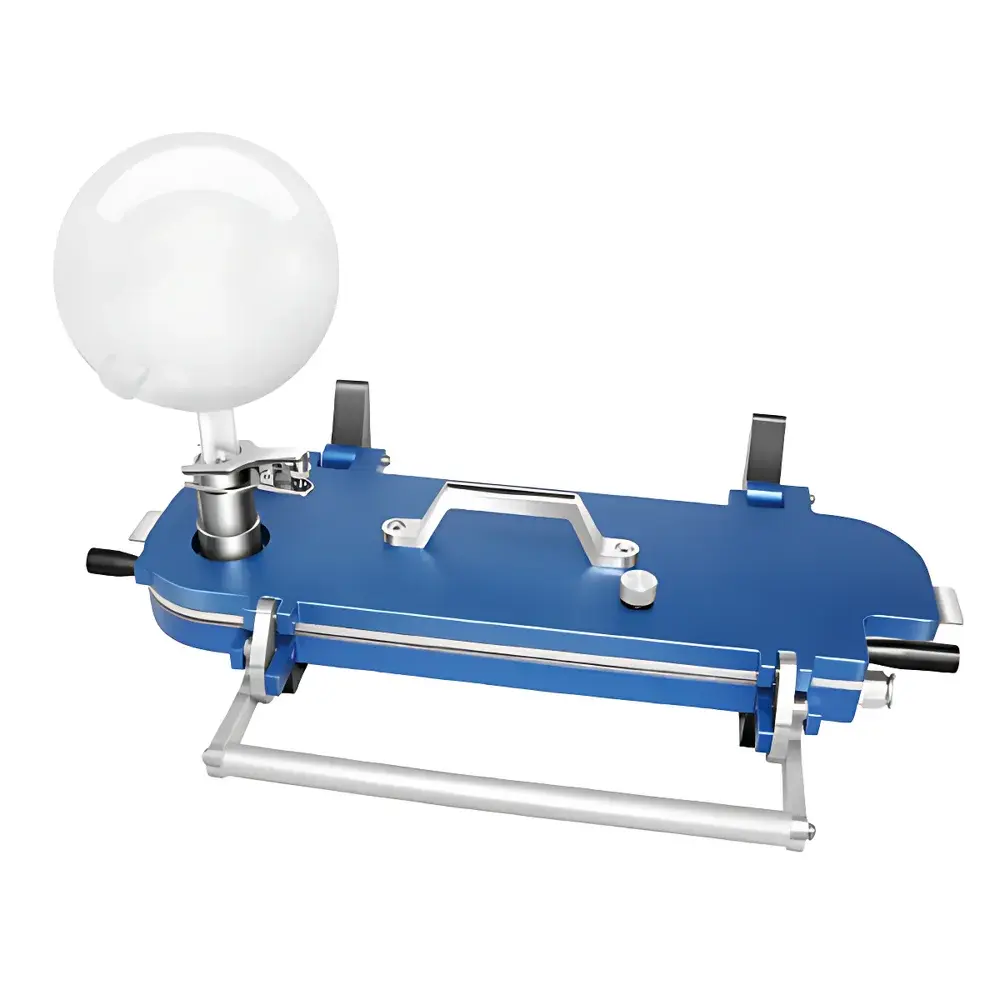
HRH-NGI Nasal Spray Fine Particle Dose (FPD) Testing System
| Brand | Huironghe |
|---|---|
| Origin | Beijing, China |
| Manufacturer Type | Authorized Distributor |
| Country of Origin | China |
| Model | HRH-Inhalation |
| Pricing | Available Upon Request |
| Cascade Impactor Compatibility | Next Generation Impactor (NGI) & Andersen Cascade Impactor (ACI) |
| Test Chamber Volumes | 1 L (for nasal aerosols), 2 L (for nasal sprays), 5 L (for high-velocity nasal sprays) |
| Regulatory Alignment | FDA Guidance for Industry (2002, 2003), Ph. Eur. 10.5 Monograph 0676 |
Overview
The HRH-NGI Nasal Spray Fine Particle Dose (FPD) Testing System is an engineered platform designed to quantify the aerodynamically respirable fraction of drug substance delivered by nasal spray and nasal aerosol products. It operates on the principle of inertial impaction, leveraging standardized cascade impactor technology—primarily the Next Generation Impactor (NGI) and Andersen Cascade Impactor (ACI)—to separate and collect particles according to their aerodynamic diameter. As specified in regulatory guidance documents including FDA’s Bioavailability and Bioequivalence Studies for Nasal Aerosols and Nasal Sprays for Local Action (2003) and the European Pharmacopoeia monograph Nasal Preparations (0676, 10.5 edition), FPD is defined as the mass of drug deposited on stages collecting particles with aerodynamic diameters ≤10 µm. This metric is critical for assessing local delivery efficiency, minimizing unintended lower respiratory tract exposure, and supporting bioequivalence justification during generic development.
Key Features
- Modular diffusion chamber design with three interchangeable volumes: 1 L (optimized for pressurized metered-dose nasal aerosols), 2 L (standard configuration for pump-driven aqueous nasal sprays), and 5 L (engineered for high-velocity or high-volume nasal spray actuations requiring full plume development).
- Integrated NGI/ACI interface compliant with USP & Ph. Eur. dimensional and flow-rate specifications, enabling direct coupling without flow-path disruption or particle loss at the inlet.
- Stainless steel construction with electropolished internal surfaces to minimize static charge accumulation and surface adsorption of low-dose APIs.
- Calibrated volumetric flow control system supporting standard test conditions (e.g., 60 L/min for NGI-based protocols) with traceable NIST-traceable flow meters and pressure sensors.
- Designed for reproducible actuation alignment: precision-machined nozzle holder with adjustable XYZ positioning and laser-guided centering to ensure consistent distance (typically 2–4 cm) and orientation relative to the impactor inlet.
Sample Compatibility & Compliance
The system accommodates all commercially available nasal dosage forms, including aqueous solutions, suspensions, emulsions, and hydrofluoroalkane (HFA)-based aerosols. It supports both single-actuation and multi-actuation testing protocols per ICH Q5C and FDA guidance. All chamber configurations meet the geometric and airflow requirements outlined in Ph. Eur. 10.5 (Monograph 0676) and are validated for use in GLP-compliant laboratories. Data generated using this platform satisfies regulatory submission requirements for ANDA, NDA, and MAA filings, particularly where demonstration of in vitro equivalence is mandated. The system is compatible with standard NGI collection substrates (e.g., stainless steel cups, glass fiber filters, and silicone-coated aluminum foils) and supports post-collection extraction and assay via HPLC, UPLC, or LC-MS/MS.
Software & Data Management
While the HRH-NGI system is hardware-centric and does not include proprietary embedded software, it is fully compatible with industry-standard data acquisition platforms used in regulated environments—including WinDaq, LabVIEW-based custom modules, and third-party CDS systems that support 21 CFR Part 11 compliance. Flow rate, temperature, and relative humidity are logged in real time with timestamped audit trails. All raw deposition data (mass per stage) can be exported in CSV or Excel format for downstream calculation of FPD, mass median aerodynamic diameter (MMAD), and geometric standard deviation (GSD) using validated spreadsheets aligned with USP & Ph. Eur. computational conventions. The system architecture permits integration into enterprise LIMS environments for automated result archival and electronic signature workflows.
Applications
- Quantification of fine particle dose (FPD ≤10 µm) for nasal spray formulation development and optimization.
- In vitro bioequivalence assessment of generic nasal products against reference listed drugs (RLDs).
- Stability-indicating evaluation of particle size distribution shifts under accelerated and long-term storage conditions.
- Comparative performance testing of different actuator designs, valve configurations, and formulation excipients.
- Supporting quality-by-design (QbD) initiatives through Design of Experiments (DoE) studies linking process parameters to aerodynamic output metrics.
- Regulatory batch release testing in accordance with pharmacopoeial monographs and internal SOPs aligned with ISO/IEC 17025 requirements.
FAQ
What regulatory standards does the HRH-NGI system comply with?
The system adheres to methodological requirements in FDA Guidance Documents (2002, 2003), European Pharmacopoeia Monograph 0676 (10.5), and USP General Chapters <601> and <1601> related to aerodynamic particle size distribution testing.
Can the system be used for both nasal sprays and nasal aerosols?
Yes—via selection of the appropriate diffusion chamber volume (1 L for aerosols, 2 L or 5 L for sprays) and calibration of actuation geometry and flow rate to match product-specific plume dynamics.
Is the system suitable for GLP or GMP environments?
The mechanical design, material traceability, and compatibility with 21 CFR Part 11–compliant data systems make it suitable for use in auditable quality control and R&D laboratories operating under GLP or GMP frameworks.
Does the system include impactor stages or require separate procurement?
The HRH-NGI system is a diffusion chamber and interface platform; NGI or ACI impactors must be sourced separately and validated independently per manufacturer specifications and pharmacopoeial requirements.
How is fine particle dose calculated from collected data?
FPD is calculated as the sum of drug mass recovered from all impactor stages with cut-off diameters ≤10 µm, normalized to the total emitted dose (TED), following equations defined in Ph. Eur. 10.5 and FDA guidance.






