
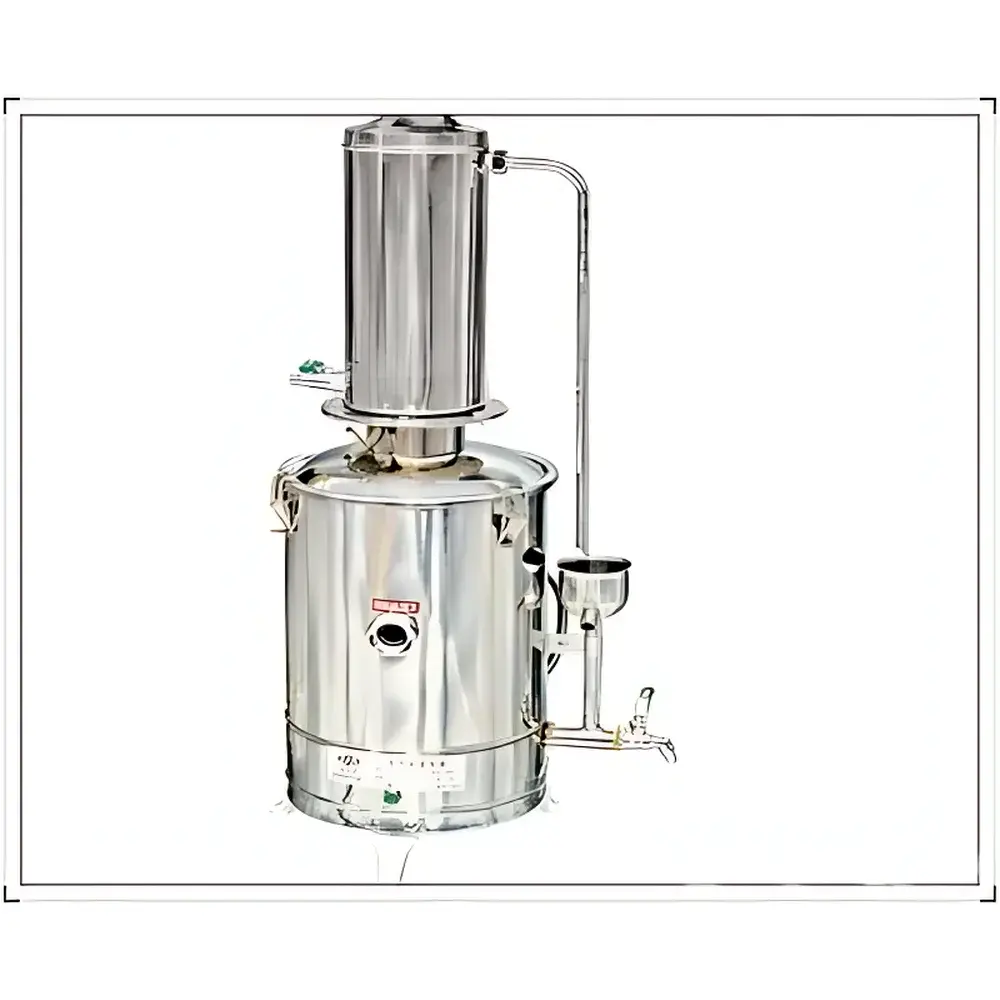
HS.Z68-10 Stainless Steel Electric Distillation Apparatus
| Origin | Beijing, China |
|---|---|
| Manufacturer Type | Authorized Distributor |
| Origin Category | Domestic (China) |
| Model | HS.Z68-10 |
| Power Rating | 7.5 kW, 380 V AC |
| Output Capacity | 10 L/h |
| Construction Material | AISI 304 Stainless Steel |
| Safety Features | Automatic dry-run protection with audible alarm and auto-refill restart |
| Indicators | LED status indicators for power, heating, and low-water condition |
| Compliance | Designed to meet general laboratory safety and electrical standards per GB/T 12801–2022 (Basic Requirements for Safety in Production Processes) and IEC 61010-1:2010 (Safety Requirements for Electrical Equipment for Measurement, Control, and Laboratory Use) |
Overview
The HS.Z68-10 Stainless Steel Electric Distillation Apparatus is a benchtop-to-floor-standing laboratory-grade water purification system engineered for continuous, reliable production of Type III purified water (as defined by ASTM D1193–20) via thermal distillation. It operates on the principle of phase separation—boiling feed water (typically tap or deionized water) in a stainless steel evaporator chamber, condensing the resulting steam in a cooled double-wall condenser, and collecting the condensed distillate free of non-volatile impurities, ions, organic contaminants, and microorganisms. This apparatus delivers consistent 10 liters per hour of high-purity distilled water suitable for routine analytical preparation, buffer formulation, media sterilization support, glassware rinsing, and calibration standard dilution in environments where ultra-high purity (e.g., Type I) is not mandated but reproducible chemical inertness and low conductivity (< 5 µS/cm) are essential.
Key Features
- Robust AISI 304 stainless steel construction throughout the evaporator, condenser, and collection reservoir—resistant to chloride-induced pitting, thermal cycling fatigue, and long-term exposure to mineral-laden feed water.
- Integrated dry-run protection circuitry: automatically cuts power to the heating element when water level falls below the minimum operational threshold, triggers an audible alarm, and initiates automatic refill from an external reservoir (when connected), resuming distillation without manual intervention.
- Dedicated LED indicator array: discrete visual feedback for mains power status, active heating phase, and low-water condition—enabling rapid operational verification without opening panels or accessing internal diagnostics.
- Optimized thermal efficiency design: vertically oriented condenser with dual-wall cooling jacket ensures >92% steam-to-distillate conversion efficiency under nominal load, minimizing energy waste and reducing ambient heat dissipation in temperature-sensitive lab spaces.
- Modular service architecture: evaporator chamber and condenser assembly are accessible via front-panel fasteners; no specialized tools required for routine descaling or gasket replacement—supporting GLP-aligned maintenance logging and downtime minimization.
Sample Compatibility & Compliance
The HS.Z68-10 accepts municipal tap water, softened water, or pre-treated deionized water as feedstock. It is not intended for direct use with seawater, brackish water, or highly turbid industrial effluents without upstream pretreatment (e.g., sedimentation, activated carbon filtration). While not certified to ISO 3696:1987 (Water for Analytical Laboratory Use) for Type I or II designation, its output meets or exceeds the conductivity, silica, and sodium ion limits specified for Type III water. The unit complies with IEC 61010-1:2010 for electrical safety and incorporates grounding continuity verification per GB/T 16895.21–2020. Its mechanical design adheres to GB/T 12801–2022 requirements for hazard control in equipment used in research laboratories.
Software & Data Management
This apparatus operates as a standalone analog-electronic system with no embedded microprocessor, firmware, or digital interface. All operational parameters—including heating cycle timing, alarm thresholds, and refill initiation logic—are hardwired into the control board. Consequently, it generates no electronic records, audit trails, or timestamped event logs. For laboratories operating under FDA 21 CFR Part 11 or EU Annex 11 requirements, usage must be documented manually in bound logbooks or integrated into broader facility-level water system validation protocols. No software licensing, updates, or cybersecurity considerations apply.
Applications
- Routine preparation of distilled water for reagent dilution, pH electrode storage, and volumetric flask rinsing in QC/QA labs across pharmaceutical, food testing, and environmental monitoring sectors.
- Supporting autoclave feed water in biosafety Level 1/2 facilities where pyrogen-free water is not required but mineral-free steam generation improves chamber longevity.
- Providing stable, low-conductivity water for electrochemical cell filling, spectrophotometer blanking, and HPLC mobile phase preparation where trace metal contamination must be minimized.
- Educational use in undergraduate chemistry and biology laboratories for demonstrating phase-change purification principles and conducting comparative conductivity assays.
FAQ
What feed water quality is recommended for optimal performance and reduced scaling?
Tap water with total hardness < 250 mg/L CaCO₃-equivalent is advised. Pre-filtration through a 5-µm sediment filter and optional softening significantly extends cleaning intervals.
Can this unit be integrated into a centralized lab water system?
No—it is a self-contained, single-point distillation unit with no pressure-rated inlet/outlet ports or flow-control valves. Integration requires external booster pumps, level-controlled reservoirs, and independent piping.
How often does descaling require maintenance?
Under typical municipal water conditions (hardness ~150 mg/L), descaling every 3–4 weeks using 5% citric acid solution is sufficient. Frequency increases proportionally with feed water hardness.
Is the distillate suitable for cell culture applications?
No—this apparatus does not remove volatile organics (e.g., chloramines, acetone) or provide endotoxin reduction. It is not validated for sterile or pyrogen-free water production.
Does the unit include a built-in water storage tank?
No—distillate flows continuously into an externally supplied collection vessel. Users must provide a compatible, chemically resistant container (e.g., polypropylene or borosilicate glass) rated for hot liquid handling.



