
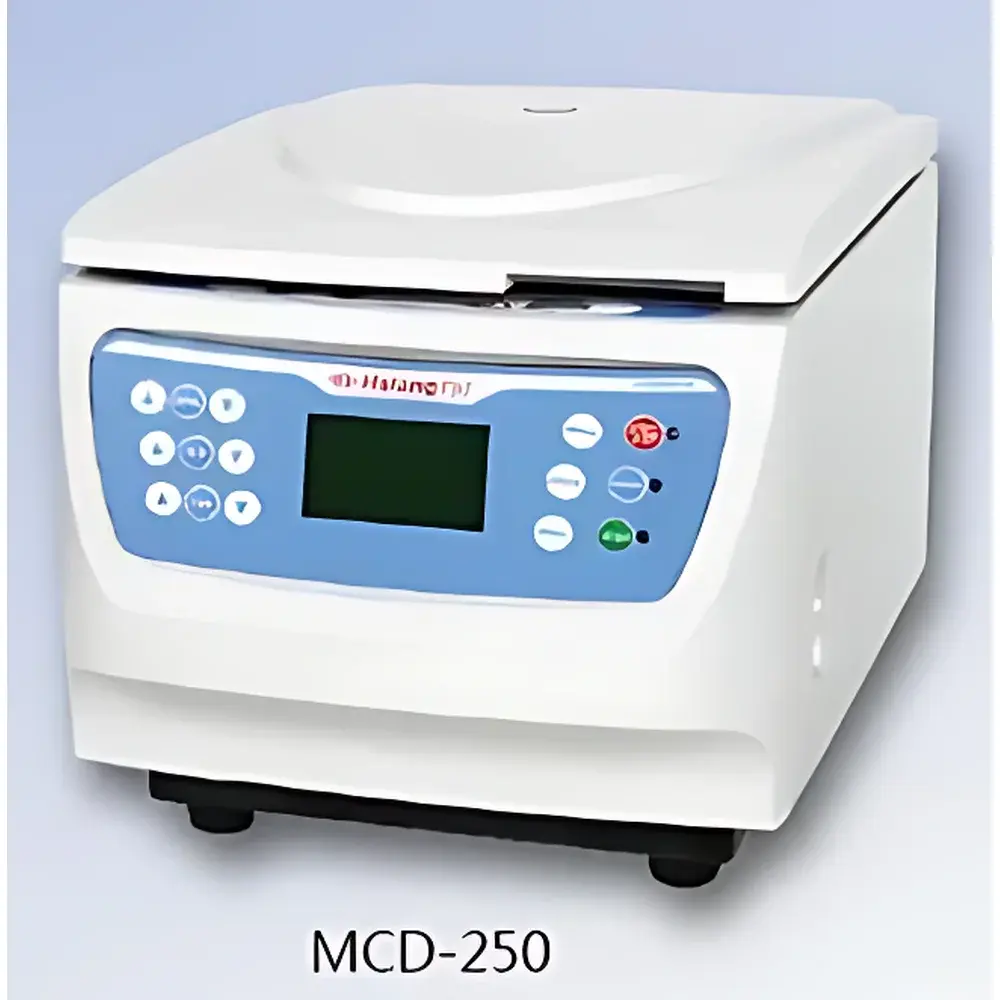
HsiangTai MCD-250 Benchtop Microcentrifuge
| Brand | HsiangTai |
|---|---|
| Origin | Taiwan |
| Model | MCD-250 |
| Type | Benchtop Microcentrifuge |
| Max. Speed | 14,000 rpm |
| Max. RCF | 17,750 × g |
| Max. Capacity | 24 × 1.5 mL tubes |
| Dimensions (W×D×H) | 290 × 420 × 280 mm |
| Power Supply | AC 220 V, 50/60 Hz |
| Temperature Range (MCD-250R variants only) | 0–40 °C |
| Programmable Protocols | 10 |
| Rotor Type | Fixed-angle |
| Motor | Brushless DC |
| Safety Features | Automatic lid interlock, imbalance detection, rotor recognition (via mechanical coding), auto-braking, power-fail recovery |
Overview
The HsiangTai MCD-250 is a high-performance benchtop microcentrifuge engineered for precision separation of small-volume biological and chemical samples in research, clinical, and quality control laboratories. Utilizing brushless DC motor technology, it delivers stable rotational dynamics across its full speed range (1,000–14,000 rpm), enabling reproducible sedimentation of macromolecules, cellular organelles, precipitated nucleic acids, and particulate suspensions. Its compact footprint and optimized thermal management support routine use in biosafety cabinets and shared instrumentation spaces. Unlike general-purpose centrifuges, the MCD-250 series is specifically calibrated for microvolume applications—particularly 0.2–2.0 mL tube formats—ensuring minimal sample loss and maximal recovery efficiency under controlled acceleration profiles.
Key Features
- Brushless DC motor with extended service life (>20,000 h), low electromagnetic interference, and zero carbon dust generation—critical for cleanroom and GLP-compliant environments.
- Digital interface with simultaneous real-time display of speed (rpm), relative centrifugal force (×g), elapsed time, and remaining runtime; intuitive rotary encoder for parameter entry.
- Programmable memory for up to 10 user-defined protocols, including ramp-up/down profiles, hold times, and automatic brake engagement—supporting method standardization across shifts and operators.
- Integrated safety architecture: automatic lid lock with mechanical interlock, dynamic imbalance detection (<±2 g mass differential), rotor overspeed cutoff, and emergency deceleration (<12 s from 14,000 rpm).
- Fixed-angle rotor compatibility with standardized HsiangTai REAC-series rotors (e.g., REAC-1524 for 24 × 1.5/2.0 mL tubes), featuring precision-machined aluminum alloy construction and autoclavable design (121 °C, 20 min).
- Robust chassis with vibration-dampening feet and balanced base geometry—measured noise level ≤58 dB(A) at 1 m distance during operation at maximum speed.
Sample Compatibility & Compliance
The MCD-250 accommodates standard microcentrifuge tube formats including polypropylene (PP) and polyethylene (PE) tubes (0.2 mL PCR strips, 0.4 mL, 0.5 mL, 1.5 mL, and 2.0 mL). It supports common laboratory workflows such as plasmid DNA purification, RNA pellet recovery, protein precipitation, and cell lysate clarification. All rotors comply with ISO 15197:2013 (in vitro diagnostic devices) mechanical integrity requirements and are validated per IEC 61010-2-020 (safety requirements for laboratory centrifuges). The instrument meets CE marking criteria under Directive 2014/30/EU (EMC) and 2014/35/EU (LVD); documentation includes factory calibration certificates traceable to NIST standards.
Software & Data Management
While the MCD-250 operates as a standalone instrument without external PC connectivity, its embedded firmware supports audit-ready operational logging—including start/stop timestamps, final speed achieved, actual RCF delivered, rotor ID (mechanically encoded), and fault event codes (e.g., E03 = lid open during run, E07 = imbalance detected). These logs are retained in non-volatile memory for ≥1,000 cycles and can be manually reviewed via the front panel. For laboratories operating under FDA 21 CFR Part 11 or ISO/IEC 17025, optional external data capture is achievable using RS-232 serial output (available on MCD-250R variants) paired with validated third-party LIMS interfaces.
Applications
- Nucleic acid isolation workflows requiring rapid pelleting of silica-membrane columns or ethanol-precipitated DNA/RNA.
- Preparative centrifugation of bacterial and yeast lysates prior to SDS-PAGE or Western blot analysis.
- Clarification of viscous reagent solutions (e.g., restriction enzyme master mixes, PCR reaction buffers) to eliminate undissolved aggregates.
- High-throughput sample preparation for LC-MS and MALDI-TOF MS, where consistent pellet compaction minimizes carryover between injections.
- Stability testing of nanoparticle dispersions and liposomal formulations under accelerated centrifugal stress (ASTM D7703-22).
FAQ
What rotor configurations are supported by the MCD-250?
The MCD-250 accepts fixed-angle rotors only, including REAC-1518 (18-place), REAC-1524 (24-place), and REAC-0232 (32-place PCR rotor), all rated for 14,000 rpm and compatible with standard microtubes.
Is the MCD-250 suitable for use with infectious or hazardous samples?
Yes—when operated with sealed tube caps and appropriate rotor lids, it complies with WHO Laboratory Biosafety Manual (4th ed.) Level 2 containment requirements. Optional biocontainment rotors with O-ring seals are available upon request.
Does the MCD-250 require periodic recalibration?
Per ISO/IEC 17025:2017 Clause 6.5.2, speed and timer accuracy should be verified annually using an accredited tachometer and stopwatch; HsiangTai provides certified calibration services and traceable adjustment reports.
Can the MCD-250 operate continuously for extended periods?
Yes—the brushless motor and thermally optimized housing permit uninterrupted operation up to 8 hours at ≤12,000 rpm, with built-in thermal cutout protection activating only above 55 °C internal temperature.
How does the auto-balance function work?
The system dynamically monitors radial vibration amplitude during acceleration; if asymmetry exceeds ±2 g equivalent mass offset, it halts acceleration and displays “BAL” error—preventing mechanical resonance and bearing wear before reaching operational speed.



