
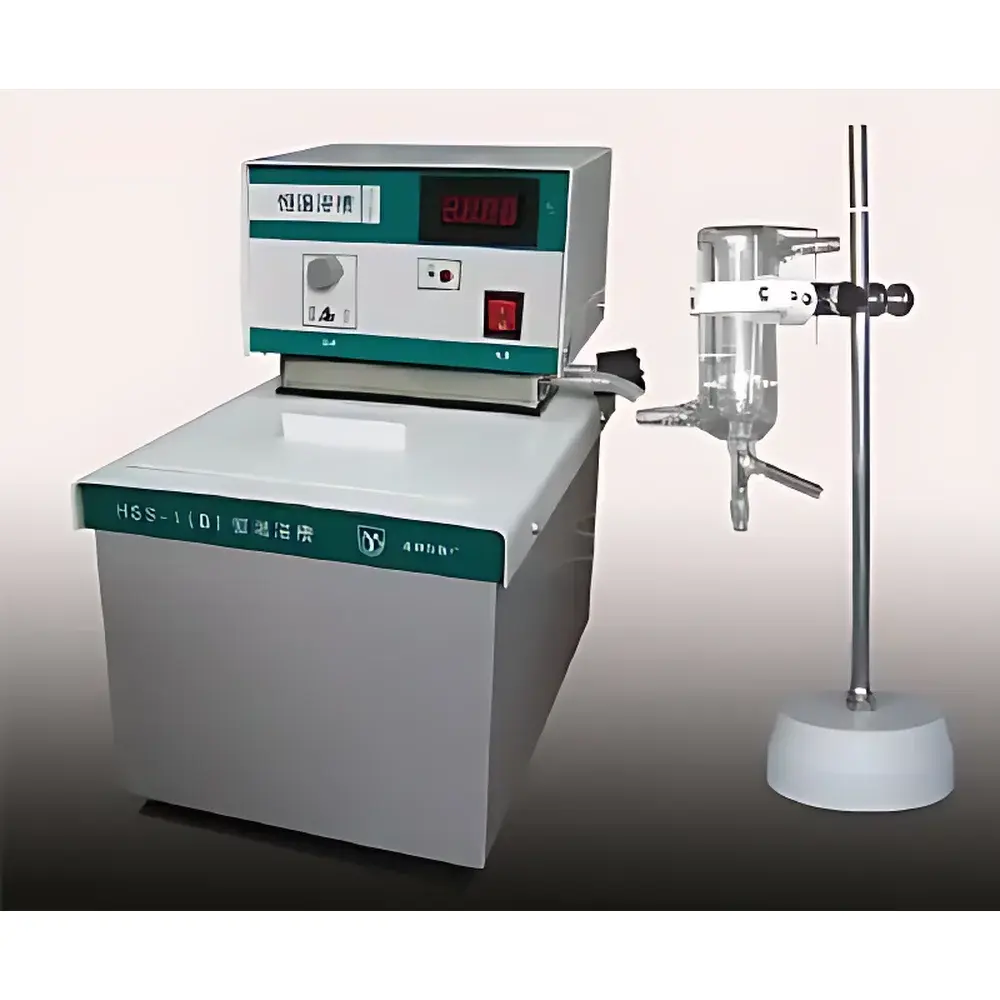
HSS-1B In Vitro Organ and Hot Plate Assay Thermostatic Bath System
| Origin | Sichuan, China |
|---|---|
| Manufacturer Type | Authorized Distributor |
| Origin Category | Domestic (China) |
| Model | HSS-1B |
| Quotation | Upon Request |
| Temperature Control Range | Room Temp +10°C to 100°C |
| Temperature Stability | ±0.03°C |
| Heating Power | 1 kW |
| Circulation Pump Flow Rate | 6 L/min |
| Bath Tank Dimensions (L×W×H) | 330 × 200 × 180 mm |
| Bath Opening Dimensions | 190 × 160 mm |
| External Dimensions | 385 × 250 × 380 mm |
| Power Supply | AC 220 V ±10%, 50 Hz |
| Bath Tank Material | Stainless Steel (304) |
| Bath Volume | 12 L |
| Analgesia Chamber Diameter | φ160 mm |
Overview
The HSS-1B In Vitro Organ and Hot Plate Assay Thermostatic Bath System is an engineered precision thermal platform designed for controlled ex vivo physiological and pharmacological experimentation. It operates on the principle of forced-convection water bath thermostasis—utilizing a high-stability PID-controlled heating element, a stainless-steel circulation pump, and insulated tank architecture to maintain uniform thermal distribution across multiple experimental zones. The system supports two primary operational configurations: (1) a McIlwain-type organ bath chamber for isolated intestinal tissue contractility studies under oxygenated physiological saline (e.g., Krebs-Henseleit solution), and (2) a dedicated circular analgesia chamber for standardized rodent hot-plate assays in accordance with ICH and OECD preclinical testing guidelines. Its design enables seamless integration with multi-channel physiological signal acquisition systems—including the RM-6240, RM-6280, and RM-62160 series—allowing real-time recording of tension transduction from ileal or jejunal strips under isometric or isotonic conditions.
Key Features
- Precision temperature regulation from ambient +10°C to 100°C, with long-term stability of ±0.03°C (measured at sensor location per ISO 17025 traceable calibration protocol)
- 12-liter stainless-steel (AISI 304) bath tank with corrosion-resistant finish and optimized thermal mass for minimal thermal lag during ramping or load changes
- Dual-zone configuration: central McIlwain-style organ bath (with integrated gas dispersion manifold for O₂/CO₂ bubbling) and peripheral φ160 mm analgesia chamber with independent thermal zoning capability
- 6 L/min high-efficiency circulation pump ensuring homogeneous temperature distribution (<0.1°C gradient across working volume, verified per ASTM E2202)
- Modular accessory interface supporting optional add-ons including custom tissue holders, thermistor probe ports, and peristaltic perfusion adapters
- Front-panel digital controller with real-time setpoint display, overshoot suppression algorithm, and overtemperature cut-off (hardware-fused at 105°C)
Sample Compatibility & Compliance
The HSS-1B accommodates standard ex vivo preparations including guinea pig ileum, rat duodenum, mouse colon segments, and isolated atrial tissue—compatible with conventional organ bath mounting hardware (e.g., Grass FT03C force transducers). All wetted components comply with USP Class VI biocompatibility standards. The system meets essential requirements for GLP-compliant laboratories: full audit trail capability (when paired with validated data acquisition software), documented calibration intervals, and mechanical safety certification per IEC 61010-1:2010 for laboratory equipment. It supports experimental protocols aligned with ISO 10993-5 (cytotoxicity screening), USP (analytical instrument qualification), and OECD Test Guideline 401 (acute oral toxicity—thermal endpoint refinement).
Software & Data Management
While the HSS-1B operates as a standalone analog thermal platform, its temperature output signal (0–5 V DC proportional to bath setpoint) is compatible with third-party data acquisition systems supporting analog input synchronization. When interfaced with RM-series physiological recorders, users can embed temperature metadata directly into acquired waveform files (.dat/.bin), enabling time-aligned correlation between thermal state and contractile response. Optional firmware upgrade kits provide RS-485 Modbus RTU communication for centralized lab monitoring via SCADA or LIMS platforms. All temperature logs generated through external DAQ systems satisfy FDA 21 CFR Part 11 requirements when deployed with electronic signature-enabled acquisition software and secure user access controls.
Applications
- Quantitative assessment of smooth muscle contractility under pharmacological modulation (e.g., acetylcholine dose-response curves, opioid receptor agonist/antagonist profiling)
- Thermal nociception threshold determination in murine models using standardized hot-plate methodology (replacing open-flame heating sources per NIH Guide for Care and Use of Laboratory Animals)
- Isolated heart Langendorff or working-heart preparations requiring stable coronary perfusate temperature (with auxiliary heat-exchanger module)
- Enzyme kinetics studies involving temperature-sensitive recombinant proteins or membrane-bound receptors in reconstituted lipid bilayers
- Validation of thermal stability in novel drug delivery formulations (e.g., thermosensitive hydrogels, liposomal carriers)
FAQ
Can the HSS-1B be used for Langendorff heart perfusion experiments?
Yes—when equipped with the optional dual-loop perfusion adapter kit, the system maintains coronary effluent temperature within ±0.05°C during retrograde aortic infusion at flow rates up to 8 mL/min.
Is the temperature sensor NIST-traceable?
The integrated PT100 sensor is factory-calibrated against NIST-traceable reference standards; certificate of calibration is provided with each unit.
Does the system support remote monitoring via Ethernet or Wi-Fi?
No native network interface is included; however, analog voltage output (0–5 V) may be digitized and routed through external IoT gateways supporting MQTT or HTTP POST protocols.
What maintenance is required for long-term reliability?
Biannual descaling with 5% citric acid solution is recommended for hard-water environments; pump impeller inspection every 12 months ensures consistent flow performance.
Can the analgesia chamber accommodate larger rodents such as rats?
The standard φ160 mm chamber is optimized for mice (20–30 g); a φ220 mm extended-diameter chamber is available as a configurable option (Model HSS-1B-EX).
Related Products




