
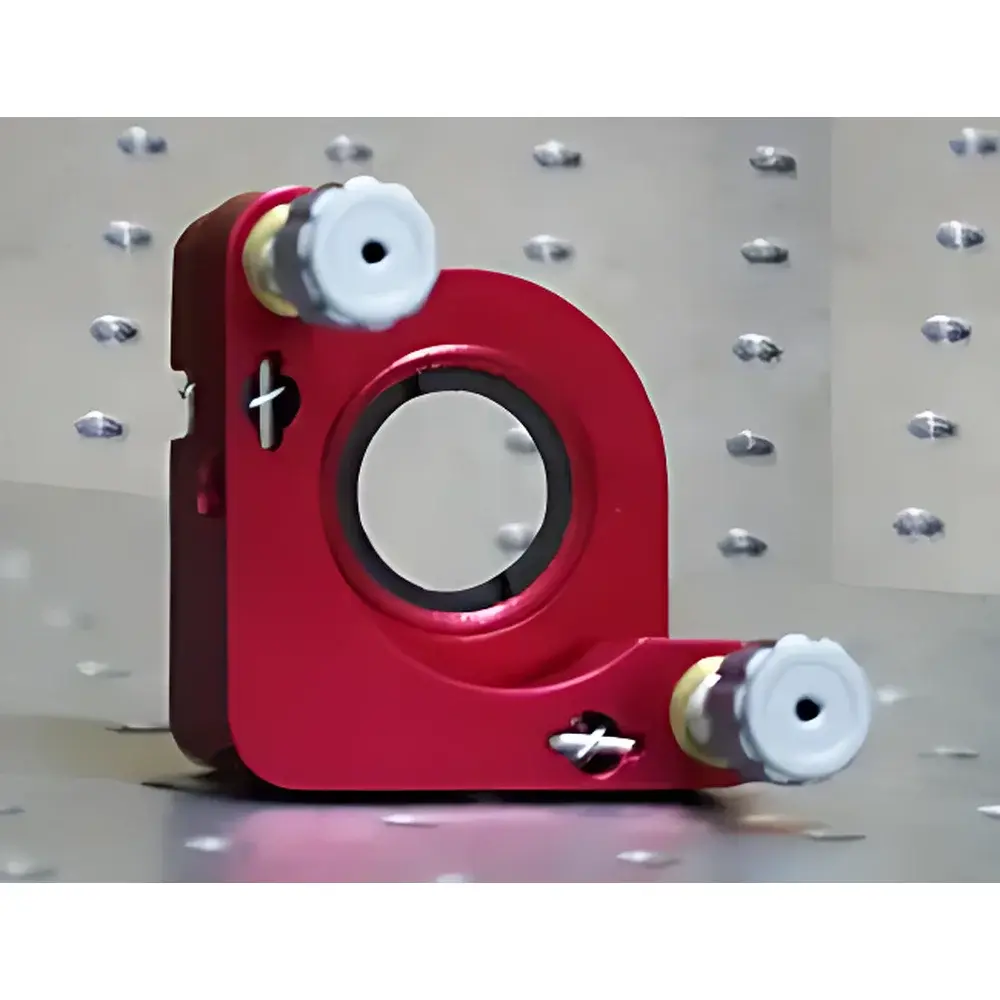
HTMM20-L Precision Two-Axis Kinematic Mirror Mount with Compression Ring for 20 mm Optics
| Brand | HT (Handing) |
|---|---|
| Model | HTMM20-L |
| Mount Type | Kinematic, Two-Axis Tip/Tilt Adjuster |
| Optical Aperture Compatibility | Ø20 mm |
| Retention Mechanism | Spring-Loaded Compression Ring |
| Material | Anodized Aluminum 6061-T6 |
| Adjustment Resolution | <5 arcsec per division (with 100 TPI micrometers) |
| Load Capacity | ≤300 g |
| Thermal Stability | ΔL/L < 2.3 × 10⁻⁵ /°C |
| Surface Finish | Hard-anodized black, non-reflective |
| Compliance | ISO 9001–certified manufacturing |
Overview
The HTMM20-L is a high-stability, two-axis kinematic mirror mount engineered for precision optical alignment in demanding research and industrial metrology environments. Designed around the Couette–Taylor principle of mechanical constraint—where optical elements are secured via uniform radial compression rather than clamping or adhesive bonding—the mount eliminates stress-induced birefringence and surface distortion commonly observed in conventional set-screw-based fixtures. Its dual orthogonal micrometer-driven adjustment axes enable independent, sub-arcsecond control of tip and tilt for Ø20 mm optics (e.g., dielectric mirrors, laser cavity end mirrors, or beam-steering substrates), making it suitable for interferometric setups, ultrafast laser cavity alignment, and collimated beam steering applications requiring long-term positional repeatability (<±0.5 arcsec over 72 h under thermal cycling from 20–25 °C).
Key Features
- Compression-ring retention system: Applies symmetrical, low-stress radial force (≤1.2 N) to Ø20 mm optics—preserving wavefront fidelity and minimizing substrate deformation.
- Two-axis kinematic design: Dual 100 TPI stainless-steel micrometers with engraved scales and locking thumbscrews provide calibrated tip/tilt resolution of <5 arcsec/division and hysteresis <2 arcsec.
- Thermally stable architecture: 6061-T6 aluminum body with hard-anodized black finish ensures coefficient of thermal expansion (CTE) matching within ±10% of common fused silica and BK7 substrates.
- Modular integration: Standard 1/4″-20 (M6) base-mounting holes and 8-32 (M4) top-plate threads enable direct compatibility with Thorlabs, Newport, and Standa optical tables and breadboards.
- Passive stability validation: Verified per ISO 10110-7 for residual angular drift (<0.8 arcsec/h) under static load (200 g) at ambient vibration levels ≤0.05 g RMS (10–100 Hz).
Sample Compatibility & Compliance
The HTMM20-L accommodates plano and weakly curved optics up to 6 mm thickness and refractive index range n = 1.45–1.78 (e.g., BK7, fused silica, CaF₂, and coated Si substrates). It is compatible with vacuum environments up to 10⁻⁴ mbar (non-outgassing configuration available upon request). All materials comply with RoHS Directive 2011/65/EU and REACH Regulation (EC) No. 1907/2006. Manufacturing adheres to ISO 9001:2015 quality management standards; calibration documentation includes traceable metrology reports aligned with NIST-traceable interferometric verification protocols.
Software & Data Management
While the HTMM20-L is a purely manual, non-motorized mount, its mechanical interface supports third-party motorization via optional stepper-motor adapters (e.g., Thorlabs K10CR1-compatible kits). For automated alignment workflows, the mount integrates seamlessly with LabVIEW™, MATLAB® Instrument Control Toolbox, and Python-based PyVISA drivers when paired with compatible motion controllers. Audit trails for manual adjustments are supported through GLP-compliant lab notebooks referencing ISO/IEC 17025:2017 Section 7.7 (recording of equipment settings), and all mechanical specifications are documented in accordance with ASTM E29–22 for significant digit reporting.
Applications
- Laser cavity alignment in Ti:sapphire, fiber, and diode-pumped solid-state (DPSS) systems where thermal drift must remain below 1 µrad over 8-hour continuous operation.
- Interferometric beam combiners in gravitational-wave detector prototype benches (e.g., Michelson or Sagnac configurations requiring <λ/100 wavefront error stability).
- Optical coherence tomography (OCT) reference arm stabilization where axial scan repeatability depends on mirror angular stability.
- Quantum optics experiments involving polarization-sensitive components (e.g., half-wave plates or polarizing beam splitters) mounted on Ø20 mm substrates.
- Calibration of high-resolution spectrometers and monochromators requiring repeatable grating/mirror orientation across wavelength sweeps.
FAQ
Is the HTMM20-L compatible with vacuum environments?
Yes—standard units operate up to 10⁻⁴ mbar; UHV-rated versions with vacuum-compatible lubricants and vented bodies are available under custom order (lead time: 6–8 weeks).
Can I mount optics thicker than 6 mm?
Mounting optics >6 mm requires verification of center-of-gravity clearance relative to the compression ring’s axial travel limit (max. 1.8 mm); contact technical support for dimensional analysis.
Does the mount include calibration certificates?
Standard units ship with factory verification reports; NIST-traceable calibration certificates (per ISO/IEC 17025) are available as an add-on service.
What is the maximum recommended optic weight?
Static load capacity is rated at 300 g; sustained loads >200 g require mounting on vibration-isolated optical tables per ANSI/EIA-749-B guidelines.
Are replacement compression rings available for different diameters?
HT offers Ø12.7 mm, Ø25.4 mm, and Ø30 mm variants (models HTMM12-L, HTMM25-L, HTMM30-L) with identical kinematic architecture and adjustment performance.




