
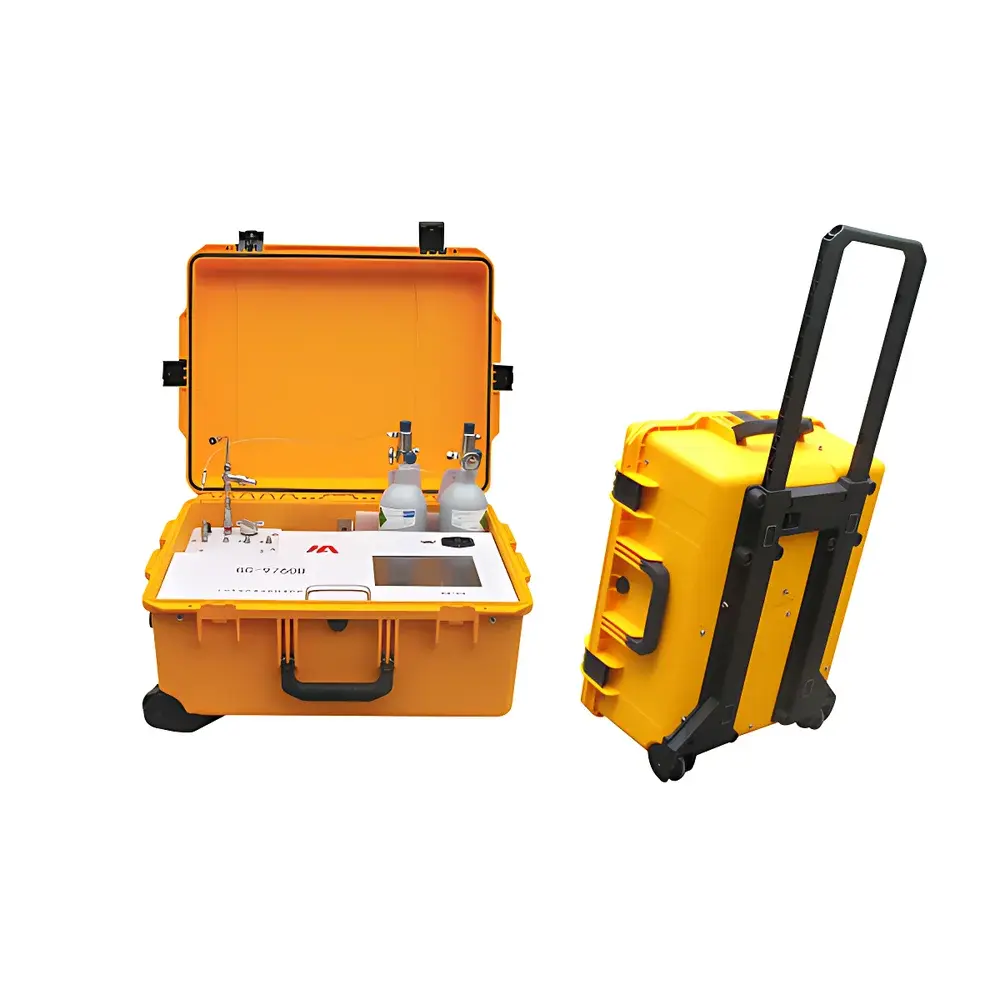
HuaiAi GC-9760B Portable Gas Chromatograph for SF₆ Decomposition Analysis
| Brand | HuaiAi |
|---|---|
| Origin | Shanghai, China |
| Manufacturer Type | Direct Manufacturer |
| Regional Origin | Domestic (China) |
| Model | GC-9760B |
| Price Range | USD 42,000 – 70,000 |
| Analysis Cycle | <20 min |
| Measurement Error | <3% |
| Thermal Stabilization Time | <30 min |
| Operating Ambient Temperature | −10 °C to +50 °C |
| Oven Temperature Range | 8 °C above ambient to 399 °C |
| Oven Temperature Accuracy | ±0.1 °C |
| Detector Temperature Range | 8 °C above ambient to 399 °C |
| Detector Temperature Accuracy | ±0.1 °C |
| Dimensions | 380 × 450 × 180 mm |
| Weight | <15 kg |
| Power Supply | 220 V ± 22 V, 50 Hz |
| Max. Power Consumption | ≤2 kW |
Overview
The HuaiAi GC-9760B is a purpose-engineered portable gas chromatograph designed exclusively for on-site qualitative and quantitative analysis of SF₆ decomposition products in high-voltage electrical equipment—particularly gas-insulated switchgear (GIS), circuit breakers, and transformers. Leveraging capillary column separation coupled with highly selective thermal conductivity detection (TCD) and/or flame ionization detection (FID), the system enables rapid, field-deployable identification and quantification of 15 critical gaseous species: H₂, O₂, N₂, CH₄, CF₄, CO, CO₂, C₂F₆, C₃F₈, SO₂F₂, SOF₂, SO₂, H₂S, COS, and CS₂. Its compact architecture and thermally robust oven design ensure consistent retention time stability and peak resolution under variable environmental conditions—essential for diagnostic reliability during preventive maintenance or emergency fault investigation.
Key Features
- Field-optimized portability: Integrated battery-ready power management (with optional external DC input support) and ruggedized chassis enable operation at substations, remote transmission corridors, and indoor switch rooms without reliance on fixed infrastructure.
- Dual-zone precision temperature control: Independently programmable oven and detector zones maintain ±0.1 °C thermal accuracy across the full 8 °C–399 °C range, minimizing baseline drift and ensuring reproducible retention times—even after rapid ambient shifts between −10 °C and +50 °C.
- Sub-20-minute analytical cycle: Pre-configured method packages for SF₆ decomposition profiling deliver complete chromatographic separation and integration within <20 minutes, supporting high-throughput screening of multiple GIS bays per shift.
- Calibration traceability: Factory-calibrated with certified standard gas mixtures (NIST-traceable where applicable); supports user-defined calibration curves with multi-point linear/non-linear fitting and internal standard correction.
- Robust gas handling: Integrated pressure-controlled sample introduction with dual-stage filtration (particulate + moisture) minimizes column contamination and extends consumable lifetime in real-world field environments.
Sample Compatibility & Compliance
The GC-9760B accepts direct injection of pressurized SF₆ gas samples (1–5 mL, 0.1–0.8 MPa) via standardized stainless-steel sampling valves. It complies with key technical requirements outlined in IEC 60480 (Guidelines for the checking and treatment of sulfur hexafluoride taken from electrical equipment), DL/T 919–2016 (Chinese industry standard for SF₆ gas testing in power systems), and aligns with data integrity expectations under ISO/IEC 17025:2017 for testing laboratories. While not inherently 21 CFR Part 11 compliant, its audit-ready data logging (timestamped raw chromatograms, method parameters, operator ID) supports GLP-aligned workflows when deployed in utility QA/QC programs.
Software & Data Management
The instrument is operated via HuaiAi ChromoView™ v3.x—a Windows-based acquisition and analysis platform supporting method development, automated sequence execution, peak integration using valley-to-valley and tangent skim algorithms, and customizable reporting templates. All chromatographic data—including raw ADC signals, processed results, and metadata—are stored in open-format .csv and .chd files for third-party statistical analysis or integration into enterprise asset management (EAM) systems. Optional network-enabled remote monitoring allows centralized fleet diagnostics and firmware updates via secure HTTPS endpoints.
Applications
- Early-stage fault diagnosis in GIS: Correlation of SO₂/H₂S/COS ratios with partial discharge severity; differentiation of thermal faults (e.g., overheated contacts) vs. electrical faults (e.g., arcing) based on CF₄/C₂F₆/C₃F₈ profiles.
- Post-fault forensic analysis: Quantitative assessment of SOF₂/SO₂F₂ hydrolysis kinetics to estimate moisture ingress history and insulation degradation rate.
- Commissioning verification: Baseline SF₆ purity and decomposition product screening prior to energization of new installations.
- Regulatory compliance monitoring: Periodic testing aligned with national grid maintenance schedules (e.g., State Grid Corporation of China’s Q/GDW 1168–2013).
FAQ
What carrier gases are compatible with the GC-9760B?
Helium (He) and hydrogen (H₂) are supported as primary carrier gases; nitrogen (N₂) may be used for specific TCD applications with reduced resolution trade-offs.
Is method validation documentation provided?
Yes—each unit ships with a Certificate of Conformance including system suitability test (SST) results (retention time RSD ≤0.2%, peak area RSD ≤1.5% for 5 injections), linearity (R² ≥0.999 over 0.1–100 ppm), and limit of detection (LOD) data per analyte.
Can the GC-9760B interface with existing SCADA or DMS platforms?
Via optional OPC UA or Modbus TCP gateway modules, enabling real-time transmission of pass/fail status, concentration values, and alarm thresholds to supervisory control systems.
What maintenance intervals are recommended for field use?
Column reconditioning every 200 injections; detector filament replacement every 12 months under typical usage; annual factory recalibration recommended for metrological continuity.
Does the system support unattended operation?
Yes—equipped with auto-shutdown, leak detection interlock, and event-triggered data archiving; up to 99 sample sequences can be queued with programmable delay intervals.
Related Products






