
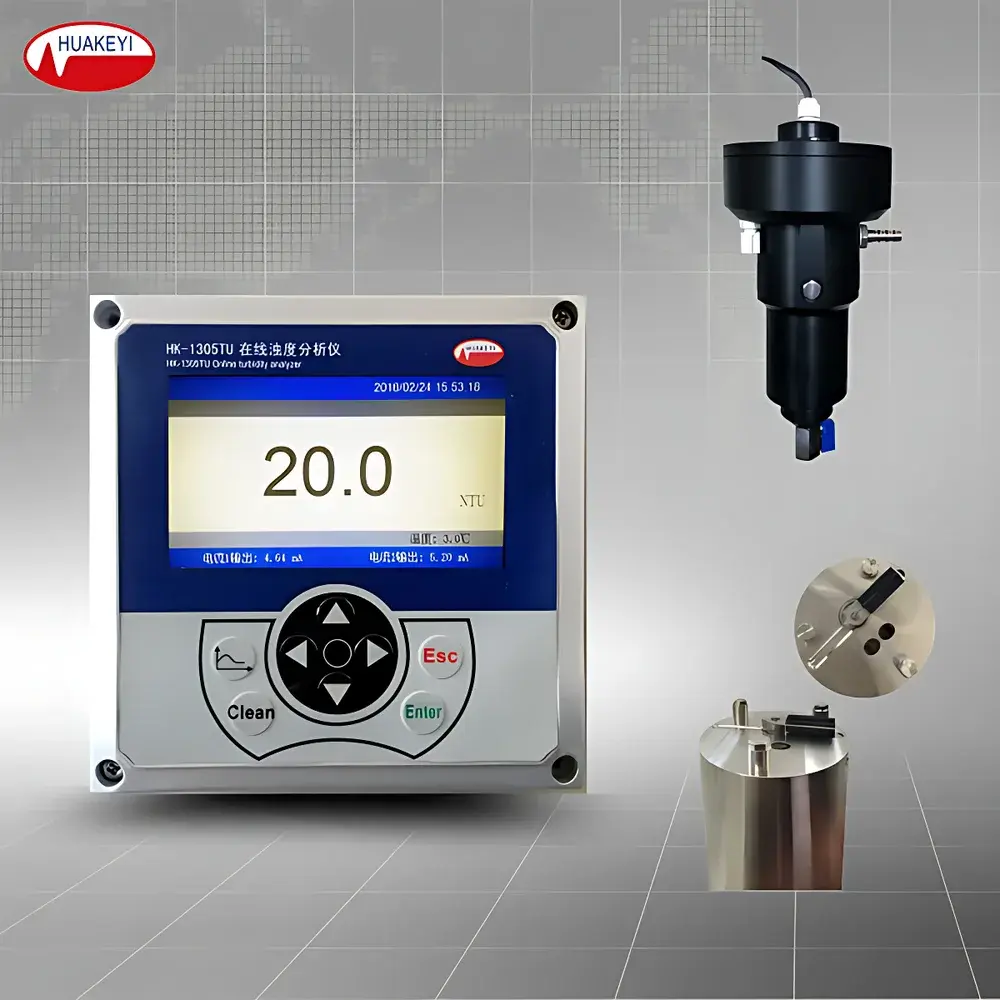
Huake Instrument HK-1305TU Online Turbidity Analyzer
| Brand | Huake Instrument |
|---|---|
| Origin | Beijing, China |
| Manufacturer Type | Authorized Distributor |
| Country of Origin | China |
| Model | HK-1305TU |
| Instrument Type | Online Water Quality Analyzer |
| Measured Parameter | Turbidity |
| Measurement Range | (0.00–19.99) NTU and (20.0–500.0) NTU |
| Resolution | 0.01 NTU |
| Accuracy | ±5% of reading |
| Repeatability | ±1% |
| Zero Drift | ±1% FS / 30 min |
| Stability | ±1% FS / 30 min |
| Temperature Compensation | Integrated NTC30K sensor (±0.5 °C accuracy, 0.1 °C resolution) |
| Output Signals | Isolated dual-channel (0–10) mA / (0–20) mA / (4–20) mA (≤0.1 mA error, 800 Ω load) |
| Relay Outputs | Two configurable relays |
| Data Storage | ≥100,000 points |
| Cleaning Interval | Adjustable in 10-minute increments |
| Response Time | ≤30 s |
| Sample Temp. Range | 0–40 °C |
| Flow Rate | 6–20 L/h |
| Max. Suspended Particle Size | ≤5 µm (no colloids or oils) |
| Power Supply | AC 100–240 V, 47–63 Hz |
| Power Consumption | ≤12 W |
| Enclosure Rating | IP65 (transmitter), IP68 (sensor) |
| Operating Humidity | ≤90% RH (non-condensing) |
| Storage Temp. | −20 to +55 °C |
| Safety Compliance | IEC 61010-1, leakage current ≤3.5 mA, grounding resistance ≤0.5 Ω, insulation resistance ≥40 MΩ, dielectric strength: AC 1500 V / 1 min |
| Display | 480×272 dot-matrix LCD (Chinese/English switchable) |
| Mounting Options | Panel-mount, wall-mount, pipe-clamp |
| Dimensions (Transmitter) | 146 mm × 146 mm |
| Dimensions (Sensor) | 302 mm × 155 mm |
| Sensor Cable Length | 10 m |
| Weight | 6 kg |
Overview
The Huake Instrument HK-1305TU Online Turbidity Analyzer is a robust, industrial-grade turbidity monitoring system engineered for continuous, real-time measurement in municipal drinking water treatment plants, wastewater treatment facilities, pulp and paper mills, chemical process streams, and livestock effluent management systems. It operates on the principle of 90° side-scattered light detection, calibrated against Formazin Standard Suspension (FNU/NTU traceability), ensuring compliance with ISO 7027-1:2016 and EPA Method 180.1. The optical path utilizes a vertical-flow measurement cell designed to minimize bubble entrapment and particulate settling—critical for long-term stability in unattended operation. Sample introduction follows a pressure-relief and oscillatory flow path that promotes degassing through controlled hydrodynamic turbulence and interlayer mixing, followed by laminar delivery into the optical chamber via dual angled inlets. This integrated sample conditioning architecture delivers representative, bubble-free liquid to the sensing zone without requiring external air elimination devices or pressurized filtration.
Key Features
- High-stability optical design: Sapphire optical windows (Mohs hardness 9) provide exceptional scratch resistance and minimal light attenuation across the 860 nm LED emission band, ensuring long-term photometric consistency.
- Automated maintenance cycle: A motor-driven cleaning brush actuates every 10 minutes (user-configurable) to remove surface deposits and micro-bubbles from the sapphire interface—eliminating manual wiping and reducing calibration drift.
- Integrated anti-condensation system: Sensor housing incorporates both temperature-compensated NTC30K thermistor and internal desiccant-assisted drying module, suppressing moisture-induced signal drift and eliminating need for field recalibration due to ambient humidity fluctuations.
- Self-cleaning flow cell: Reverse-flush capability enables periodic backwashing of the optical chamber using process water—reducing fouling accumulation and extending maintenance intervals beyond 6 months under typical municipal influent conditions.
- Dual-isolated analog outputs: Two independently galvanically isolated 4–20 mA channels support simultaneous transmission of turbidity and temperature data to DCS/SCADA systems, each compliant with NAMUR NE43 fault signaling standards.
- IEC 61508-compliant relay logic: Programmable dual relays support alarm latching, pump control, or sample diversion based on user-defined turbidity thresholds and hysteresis settings.
Sample Compatibility & Compliance
The HK-1305TU is validated for use with low-viscosity aqueous streams containing suspended solids ≤5 µm in diameter, excluding colloidal suspensions, emulsified oils, or viscous biofilms. Its flow cell design accommodates nominal flow rates between 6–20 L/h at inlet pressures up to 0.6 MPa, with built-in static pressure dissipation and oscillatory degassing ensuring reliable performance even in high-dissolved-gas applications (e.g., groundwater abstraction or ozone-treated effluent). All wetted materials—including fluoropolymer-lined flow paths, PEEK structural components, and sapphire optics—meet USP Class VI and FDA 21 CFR Part 177 requirements for indirect food contact. Electrical safety conforms to IEC 61010-1:2010 (Measurement Category II, Pollution Degree 2), while electromagnetic compatibility satisfies IEC 61326-1:2020 (industrial environment). Data integrity features—including time-stamped event logging, audit trail-enabled configuration changes, and non-volatile memory retention—support GLP/GMP-aligned operational qualification protocols.
Software & Data Management
The analyzer’s embedded firmware supports local configuration via an 8-key membrane keypad and bilingual (English/Chinese) 480×272 pixel LCD interface. All operational parameters—including calibration coefficients, alarm setpoints, cleaning schedules, and relay logic states—are stored in write-protected EEPROM with CRC-32 validation. Internal data logging records ≥100,000 timestamped turbidity and temperature readings at user-selectable intervals (1 s to 24 h), retained for ≥12 months under power-fail conditions. Optional Modbus RTU (RS-485) or optional Ethernet/IP communication modules enable integration with supervisory control systems. Firmware updates are performed via USB flash drive following secure SHA-256 signature verification—ensuring traceability and preventing unauthorized modification per IEC 62443-3-3 Annex A.5 requirements.
Applications
- Real-time monitoring of clarified water quality at sedimentation basin effluent points in drinking water treatment plants
- Process control of coagulant dosing in rapid sand filters and dissolved air flotation units
- Effluent compliance verification at municipal wastewater treatment plant discharge outfalls (per ISO 10707 or EN 872)
- Quality assurance in pharmaceutical purified water distribution loops (PW/DI water), meeting USP and EP 2.2.2 guidelines
- In-line turbidity surveillance in pulp stock preparation lines to prevent fiber agglomeration defects
- Pre-treatment screening in reverse osmosis feed systems to protect membrane integrity
FAQ
What calibration standards are supported?
The HK-1305TU accepts Formazin-based primary standards (0.02–400 NTU) and allows multi-point calibration using certified reference materials traceable to NIST SRM 2134 series.
Can the instrument operate in sub-zero ambient environments?
The transmitter electronics are rated for −20 °C storage; however, continuous operation below 0 °C requires heated enclosure integration or inline sample temperature stabilization to maintain 0–40 °C inlet conditions.
Is remote diagnostics available?
Yes—via optional RS-485 Modbus RTU or TCP/IP interface, enabling remote readout of diagnostic codes, sensor health status, cleaning counter values, and real-time analog output diagnostics.
How often is verification required under regulatory frameworks?
Per ISO/IEC 17025 and EPA guidance, daily zero verification with deionized water and weekly span verification using 20 NTU standard are recommended for critical compliance applications.
Does the system meet cybersecurity requirements for OT networks?
The base unit has no network stack; optional Ethernet/IP modules implement TLS 1.2 encryption, role-based access control, and firmware signing—aligned with NIST SP 800-82 Rev. 2 for industrial control system hardening.
Related Products







