
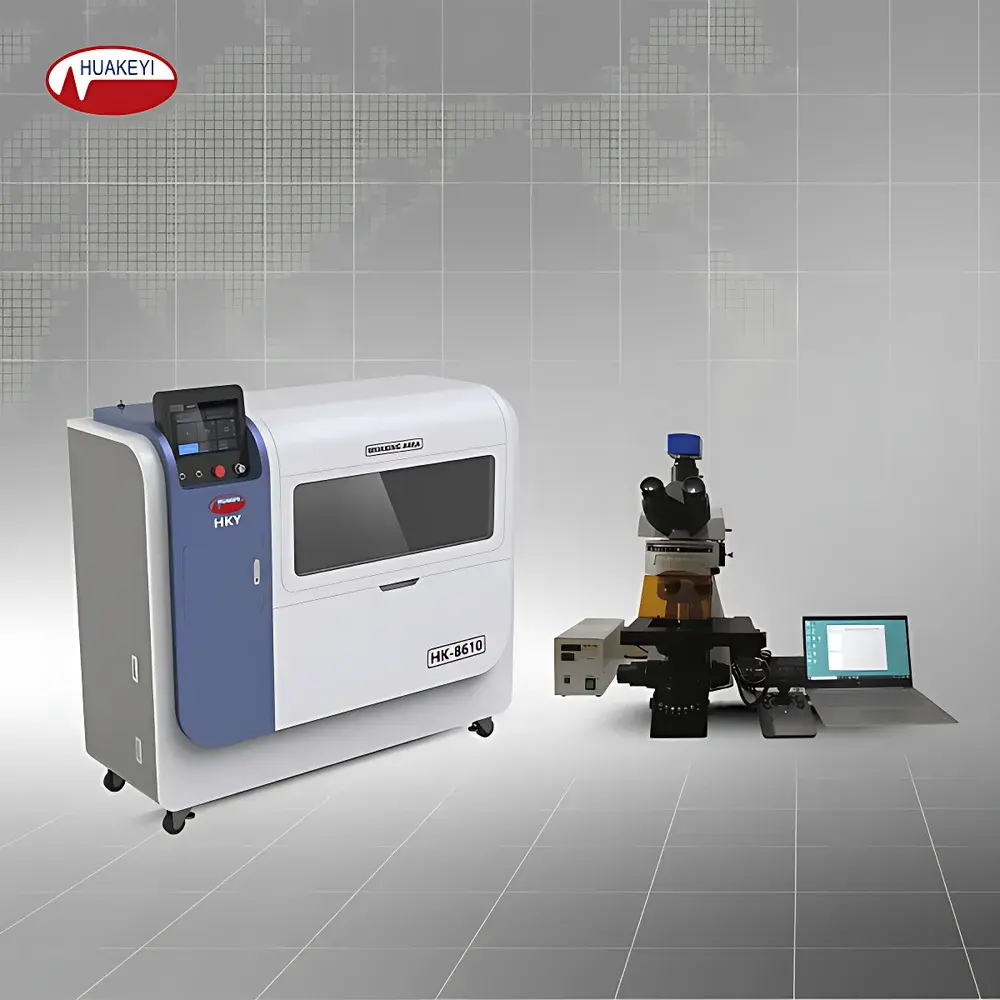
Huakeyi HK-8610 Multi-Channel *Giardia* & *Cryptosporidium* Integrated Preprocessing System with AI-Powered Automated Identification
| Brand | Huakeyi |
|---|---|
| Origin | Beijing, China |
| Manufacturer Type | Authorized Distributor |
| Country of Origin | China |
| Model | HK-8610 |
| Price | Upon Request |
| Dimensions (Single-Channel) | 760 × 670 × 753 mm |
| Dimensions (Multi-Channel) | 1540 × 560 × 1360 mm |
| Input Voltage | 220 VAC, 50 Hz |
| Power Consumption | ≤180 W (Single), ≤300 W (Multi) |
| Touchscreen | 7-inch (Single), 10-inch industrial HMI |
| Turbidity Sensor Range | 0–100 NTU |
| Pressure Sensor Range | 0–1.6 MPa |
| pH Sensor Range | 0–14 |
| Filtration Volume Setting Range | 0–9999 L |
| Filtration Pump Flow Rate | 1.2 L/min |
| Sedimentation Processing Time (excl. settling) | ≤15 min per 10 L sample |
| Vacuum Pump Speed | 0–12 L/min, Ultimate Vacuum: 24 kPa |
| Recovery Rate | ≥30% |
| Microscope Optical System | VIS60 Infinity-Corrected, Parfocal Distance ≥60 mm |
| Stage Travel | 125 × 75 mm, Minimum Step: 0.1 µm |
| Fine Focus Resolution | 1 µm |
| Camera Resolution | 2448 × 2048 grayscale |
| DIC Compatibility | Yes |
| Expandability | Darkfield, Phase Contrast, Polarization, Multi-user Viewing |
Overview
The Huakeyi HK-8610 Multi-Channel Giardia & Cryptosporidium Integrated Preprocessing System with AI-Powered Automated Identification is a purpose-built analytical platform engineered for regulatory-compliant detection of waterborne protozoan parasites in drinking water and environmental water matrices. It implements the U.S. EPA Method 1623.1 / ISO/IEC 17025-aligned “membrane filtration–density gradient separation–immunofluorescence assay” (MF-DG-IFA) workflow, integrating sample concentration, immunolabeling preparation, and digital morphological identification into a single cohesive architecture. Unlike conventional microbiological assays targeting bacteria or viruses, this system addresses the unique analytical challenges posed by environmentally persistent, chlorine-resistant oocysts and cysts—structures that require physical concentration, antibody-based specific labeling, and high-fidelity microscopic enumeration. The HK-8610 eliminates manual bottlenecks in both preanalytical processing and post-staining interpretation, reducing inter-operator variability and supporting traceable, auditable reporting under GLP and GMP frameworks.
Key Features
- Dual-path automated preprocessing: Simultaneous support for membrane filtration (with user-defined volume cutoff and auto-membrane switching at preset pressure thresholds) and calcium carbonate sedimentation (five parallel 10-L reactors, fully unattended operation)
- Integrated vacuum-assisted immunostaining environment: Built-in vacuum pump (0–12 L/min, 24 kPa ultimate vacuum) enables standardized, reproducible filter drying and antibody incubation
- Real-time turbidity-guided method selection: Onboard turbidity sensor (0–100 NTU) recommends optimal concentration pathway (filtration vs. sedimentation) based on raw water quality
- Film-dissolution chemistry: Proprietary reagent formulation fully dissolves cellulose ester membranes post-filtration—eliminating mechanical elution and preserving >30% recovery efficiency per EPA validation criteria
- AI-driven identification engine: Combines DBSCAN-based spatial clustering with convolutional neural networks (CNN) trained on >50,000 expert-annotated oocyst/cyst images to distinguish *Cryptosporidium* oocysts (4–6 µm, spherical, autofluorescent) from *Giardia* cysts (8–12 µm, oval, bilaterally symmetric) with quantifiable confidence scoring
- Regulatory-grade microscope automation: Motorized XYZ stage (125 × 75 mm travel, 0.1 µm step resolution), parfocal infinity-corrected optics (VIS60, ≥60 mm parfocal distance), and DIC-capable illumination ensure consistent focus, contrast, and metrological traceability across all scanning sessions
Sample Compatibility & Compliance
The HK-8610 accepts raw, filtered, or disinfected surface water, groundwater, finished drinking water, and wastewater effluent samples (1–10 L volume range). Its preprocessing module complies with the physical handling requirements of EPA Method 1623.1, ASTM D5942-22 (Standard Guide for Detection of Protozoan Parasites), and China’s GB/T 5750.12-2023 (Standard Examination Methods for Drinking Water – Microbiological Indicators). The AI identification subsystem meets data integrity prerequisites for 21 CFR Part 11 compliance: audit trails log all image acquisition events (timestamp, coordinate, objective lens, exposure parameters), user actions, and classification decisions—including confidence scores and rejection rationale for borderline objects. All software modules are validated per ICH GCP and ISO/IEC 17025 Annex A.2 guidelines for automated image analysis systems in environmental testing laboratories.
Software & Data Management
The embedded HMI runs a Linux-based real-time OS with deterministic I/O scheduling for synchronized pump control, vacuum regulation, and sensor polling. The AI identification software operates on a dual-layer architecture: a low-level image acquisition daemon captures full-slide Z-stack sequences (10× and 40× objectives), while a Docker-containerized inference engine performs pixel-wise segmentation and taxonomic classification using a ResNet-50 backbone fine-tuned on WHO-curated reference datasets. Output includes ISO/IEC 17025-compliant PDF reports containing enumerated counts, recovery rate calculations, photomicrographs with scale bars and coordinate metadata, and machine-readable JSON exports for LIMS integration. All image archives are stored with SHA-256 checksums and immutable timestamps; deletion requires dual-authorized electronic signatures logged in the audit trail.
Applications
This system serves as a primary analytical tool in national and provincial Centers for Disease Control and Prevention (CDC), municipal water utilities’ quality assurance laboratories, third-party environmental testing providers accredited to CNAS (China National Accreditation Service) and ILAC-MRA, ecological monitoring stations under the Ministry of Ecology and Environment, and academic research groups investigating protozoan persistence in distribution systems and climate-affected watersheds. It supports routine compliance monitoring, outbreak investigation response, source water vulnerability assessment, and validation of advanced oxidation or UV disinfection efficacy against resistant protozoan forms. Its multi-channel configuration enables batch processing of 50 L across five independent reactors—critical for high-throughput surveillance during seasonal contamination events or post-flooding emergency response.
FAQ
Does the HK-8610 meet U.S. EPA Method 1623.1 requirements for regulatory reporting?
Yes—the preprocessing hardware and protocol logic strictly adhere to the filtration, elution, immunomagnetic separation, and staining steps defined in EPA Method 1623.1 Rev. 2.0. Full validation documentation, including spike recovery studies and inter-laboratory comparison data, is available upon request.
Can the AI identification module be retrained with institution-specific image sets?
Yes—via secure remote access, authorized users may upload annotated training datasets to the on-premise inference server; model retraining follows ISO/IEC 17025 Clause 7.7.2 validation protocols before deployment.
Is the system compatible with existing LIMS platforms?
Yes—it supports HL7 v2.5.1 and ASTM E1384-compliant data export via SFTP or RESTful API, including structured enumeration results, instrument metadata, and digital slide thumbnails.
What maintenance is required for the vacuum and peristaltic pumping systems?
Vacuum pump oil replacement every 6 months (or 2000 operating hours); peristaltic tubing inspection every 100 cycles—both scheduled automatically in the HMI maintenance calendar with email alerts.
How does the system handle turbid or high-sediment samples?
The onboard turbidity sensor triggers automatic method selection: samples >20 NTU default to calcium carbonate sedimentation; <5 NTU trigger membrane filtration; 5–20 NTU prompts operator confirmation with recommended flow-rate adjustments.
Related Products







