
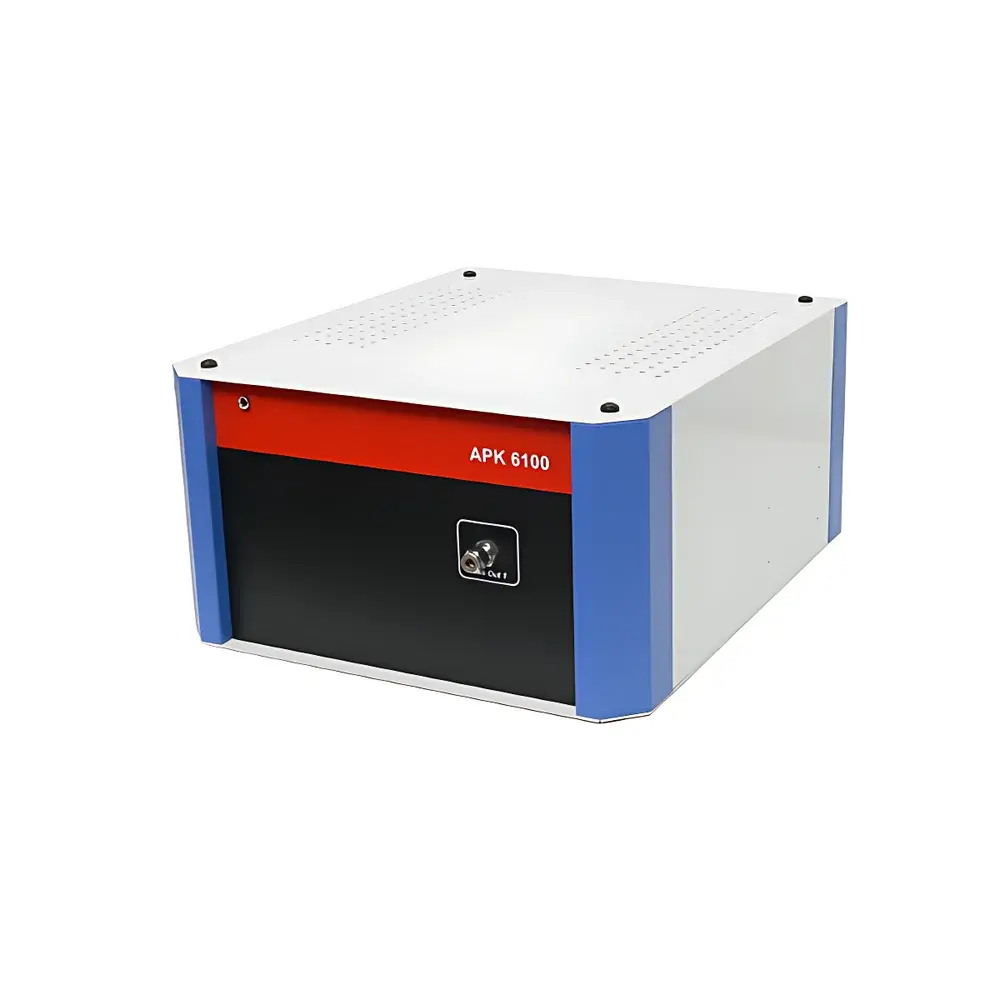
HUANKONG APK-6100 Standard Gas Dilution System
| Brand | HUANKONG |
|---|---|
| Origin | Shandong, China |
| Manufacturer Type | Direct Manufacturer |
| Model | APK-6100 |
| Dilution Ratio Range | 1:5 to 1:1500 |
| Flow Control | Triple High-Accuracy Mass Flow Controllers (MFCs) |
| Output Concentration Range | ppb–ppm level |
| Gas Path Material | Passivated Inert Surface (e.g., SilcoNert® or Sulfinert®-equivalent treatment) |
| Software Functionality | Automated Flow Calculation, Time-Based Volume Delivery, Method-Specific Protocol Storage |
| Compliance Readiness | ASTM D6196, ISO 6145-7, USP <621>, EPA TO-17 / TO-15 Support Framework |
Overview
The HUANKONG APK-6100 Standard Gas Dilution System is a precision-engineered, software-controlled gas mixing and dilution platform designed for trace-level calibration gas generation in environmental monitoring, analytical laboratory, and regulatory compliance applications. It operates on the principle of mass flow-based gas blending—utilizing three independently calibrated thermal mass flow controllers (MFCs) to meter and combine carrier (diluent) gas and certified standard gas streams with high volumetric accuracy and temporal stability. This architecture enables reproducible generation of reference gas mixtures across dynamic concentration ranges—from low ppm down to sub-ppb levels—without reliance on pressure-based or volumetric displacement methods. The system is purpose-built for laboratories requiring traceable, auditable, and repeatable calibration standards compliant with international method frameworks including EPA Compendium Method TO-15 (for VOC analysis), ASTM D6196 (for ambient air sampling), and ISO 6145-7 (gas mixtures by dynamic volumetric mixing). Its modular pneumatic design supports integration into automated GC/GC-MS workflows, dynamic calibrators, and continuous emission monitoring system (CEMS) verification protocols.
Key Features
- Triple-MFC architecture: First MFC regulates diluent (e.g., zero air or nitrogen) flow; second MFC precisely meters certified standard gas input; third MFC controls total output flow—enabling closed-loop concentration control and real-time stoichiometric balance.
- Dilution ratio programmability from 1:5 to 1:1500, with automatic flow recalculations based on user-defined target concentration and output duration.
- Inertized gas path construction using passivated stainless steel surfaces (e.g., SilcoNert®-grade treatment) to minimize adsorption, memory effects, and reactive loss—critical for polar, sulfur-containing, or reactive VOCs (e.g., formaldehyde, H₂S, NH₃).
- Embedded control software with intuitive GUI: supports method storage, time-based volume delivery (e.g., “deliver 500 mL at 1 ppb”), auto-scaling of MFC setpoints, and audit-ready operation logs.
- Stable thermal mass flow measurement with ≤±0.8% reading accuracy (typical), repeatability <±0.2% full scale, and response time <1 sec—ensuring robust performance under variable ambient conditions.
- Modular interface compatibility: direct connection to sorbent tubes (e.g., Tenax®, Carbopack™), Tedlar® bags, SUMMA canisters, and online analyzers via standardized 1/4″ VCR or Swagelok fittings.
Sample Compatibility & Compliance
The APK-6100 accommodates a broad spectrum of gaseous standards—including hydrocarbons (BTEX, alkanes), oxygenates (MTBE, ethanol), halogenated compounds (chloroform, PCE), and inorganics (CO, NO, SO₂, H₂S)—provided they are compatible with inertized stainless-steel flow paths. It meets functional requirements outlined in EPA Method TO-17 (sorbent tube desorption calibration), TO-15 (canister-based VOC calibration), and ASTM D6196 (ambient air calibration standard preparation). While not pre-certified to ISO/IEC 17025, its MFC calibration traceability (NIST-traceable certificates available upon request), data logging capability, and configurable audit trail support GLP and GMP-aligned laboratory quality systems. Optional 21 CFR Part 11-compliant software module provides electronic signatures, role-based access control, and immutable operation records for regulated environments.
Software & Data Management
The embedded Windows-based control application provides full operational autonomy without external PC dependency. It stores up to 100 user-defined methods—each specifying standard gas identity, target concentration, dilution ratio, output flow rate, and delivery duration. All parameter changes are timestamped and logged with operator ID (if network-authenticated). Export options include CSV-formatted logs (flow vs. time, concentration history) and PDF calibration reports containing MFC serial numbers, calibration dates, and uncertainty statements. Remote monitoring via Ethernet (TCP/IP) allows integration into LIMS or centralized instrument management platforms. Firmware updates are delivered via secure USB or network push, maintaining version control and change documentation per ISO 9001 requirements.
Applications
- Preparation of multi-level calibration standards for GC-FID, GC-ECD, GC-MS, and PTR-MS instrumentation.
- Dynamic spiking of sorbent tubes and canisters for method validation and recovery studies (per ISO 16000-6, ASTM D5197).
- Generation of ultra-low-concentration challenge gases for sensor drift testing and zero/span verification in CEMS and portable analyzers.
- On-demand synthesis of stable, matrix-matched reference gases for field-deployable QA/QC kits.
- Time-resolved dilution for kinetic studies involving reactive gas-phase species (e.g., ozone-alkene reactions).
FAQ
What calibration standards are required for MFC verification?
NIST-traceable calibration certificates for each MFC are provided at time of shipment. Annual recalibration against primary standards (e.g., bubble meters or gravimetric standards) is recommended per ISO/IEC 17025 Clause 6.6.
Can the APK-6100 dilute liquefied petroleum gas (LPG) or other condensable standards?
No—it is configured exclusively for permanent gases and volatile organic compounds with vapor pressures >10 kPa at 25°C. Condensables require heated lines and phase-stable delivery modules not included in base configuration.
Is the system compatible with humidified carrier gas?
Yes—when equipped with optional integrated humidity generator (model HUM-APK), it supports RH-controlled dilutions up to 80% RH at 25°C, critical for atmospheric chemistry simulation.
How is leak integrity verified during operation?
Built-in pressure decay test function performs automated 5-minute hold-and-monitor cycles at 150 kPa gauge; pass/fail threshold configurable per ISO 15848-1.
Does the software support automated report generation for ISO 17025 audits?
Yes—the reporting engine exports calibration records with metadata (operator, instrument ID, environmental conditions, uncertainty budget) in formats accepted by major accreditation bodies.
Related Products







