
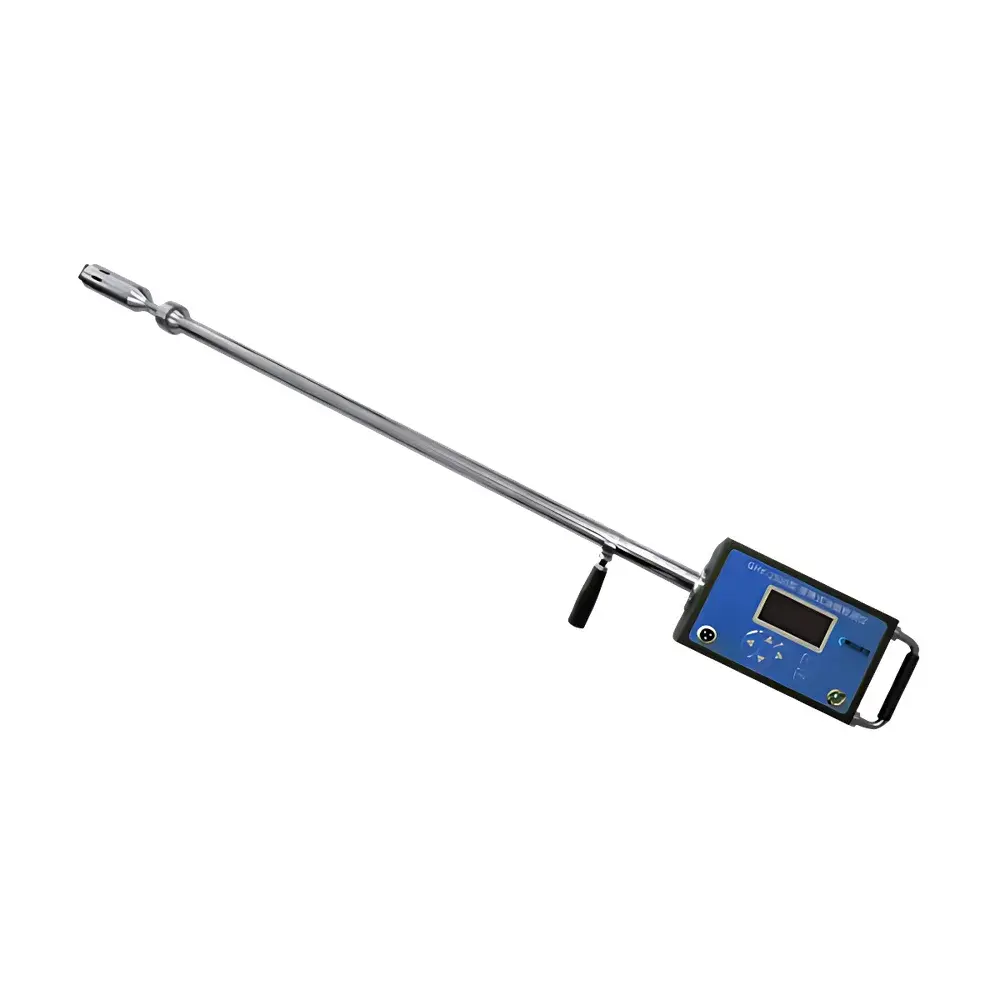
HUANKONG GHK-2500 Portable Cooking Oil Fume Analyzer
| Brand | HUANKONG |
|---|---|
| Origin | Shandong, China |
| Manufacturer Type | Direct Manufacturer |
| Country of Origin | China |
| Model | GHK-2500 |
| Portability | Portable |
| Detection Principle | Electrochemical & Light Scattering Hybrid Sensing (Compliant with HJ 2526–2012) |
| Application Scope | Universal for Food Service Emission Monitoring |
| Standards Compliance | HJ 2526–2012, GB 18483–2001, DB11/1488, SZDB/Z 254–2017, GB/T 16157–1996 |
Overview
The HUANKONG GHK-2500 Portable Cooking Oil Fume Analyzer is a field-deployable, integrated emission measurement instrument engineered for regulatory-grade quantification of cooking oil fume concentration and associated flue gas parameters in real time. Unlike generic particulate or VOC detectors, the GHK-2500 implements a hybrid sensing architecture combining electrochemical detection for volatile organic compounds (VOCs) and calibrated light-scattering photometry for fine aerosol mass concentration—specifically targeting the 0.1–10 µm particle size range characteristic of thermally generated cooking oil aerosols. Its design adheres strictly to the metrological requirements defined in HJ 2526–2012, the Chinese national technical specification for portable cooking fume analyzers, ensuring traceability, repeatability, and thermal stability across ambient temperatures from –10 °C to 50 °C. The instrument is not intended for ambient air quality monitoring but rather for source-directed compliance verification at exhaust ducts, hoods, and stack outlets in commercial food preparation facilities.
Key Features
- Hybrid dual-sensor module: Simultaneous measurement of oil fume mass concentration (mg/m³) and total volatile organic compound (TVOC) concentration (ppm), both temperature- and pressure-compensated in real time using integrated Pt100 and piezoresistive micro-differential pressure sensors.
- Real-time parametric computation: Automatic derivation of average flue gas velocity (m/s), static/dynamic pressure (Pa), volumetric flow rate (m³/h), and normalized emission concentration (mg/m³ @ standard conditions) per GB/T 16157–1996 methodology.
- Onboard calibration suite: Software-enabled zero-point auto-correction and two-point span calibration; supports user-defined calibration curves compliant with laboratory reference standards.
- Ruggedized field architecture: IP54-rated enclosure with corrosion-resistant stainless-steel probe tip and PTFE-lined sampling path; operational within –10 °C to 50 °C ambient range and up to 95% RH non-condensing.
- Intelligent duct mapping: Integrated smoke duct survey mode calculates optimal probe insertion points based on duct cross-sectional geometry, Reynolds number estimation, and ISO 16000-22–aligned sampling grid recommendations.
- High-brightness, wide-temperature LCD: 5.7-inch TFT display with 800×480 resolution, readable under direct sunlight and down to –20 °C after cold soak.
- Extended field autonomy: Rechargeable lithium-ion battery pack delivering ≥4 hours of continuous operation at full sensor duty cycle; hot-swappable battery option available.
Sample Compatibility & Compliance
The GHK-2500 is validated for use with exhaust streams from frying, grilling, steaming, and wok-based cooking processes where oil fume aerosols dominate the particulate phase. It excludes applicability to diesel soot, industrial metal fumes, or biomass combustion aerosols due to differing refractive index and volatility profiles. Regulatory alignment includes mandatory conformance with HJ 2526–2012 (type approval testing protocol), GB 18483–2001 (emission limit enforcement), and regional statutes such as DB11/1488 (Beijing) and SZDB/Z 254–2017 (Shenzhen). All firmware and data logging routines comply with GLP audit-trail requirements: timestamps are hardware-secured, calibration events are immutable, and raw sensor outputs are retained without post-processing interpolation.
Software & Data Management
Data acquisition and reporting are managed via the embedded HUANKONG FieldLink v3.2 firmware, supporting USB-C bulk export (CSV/Excel-compatible), Bluetooth 5.0 wireless transmission to Android/iOS tablets, and optional pairing with certified thermal printers (e.g., Bixolon SPP-R200IV). Raw datasets include synchronized timestamped records of oil fume concentration (mg/m³), TVOC (ppm), flue gas temperature (°C), static pressure (Pa), differential pressure (Pa), calculated velocity (m/s), and volumetric flow (m³/h). Exported files embed metadata headers indicating instrument ID, calibration due date, operator ID, and measurement location GPS coordinates (when paired with external GNSS module). No cloud dependency: all processing occurs locally to ensure data sovereignty and compliance with China’s PIPL and environmental data governance directives.
Applications
- Regulatory enforcement: Routine inspections by municipal ecological environment bureaus and urban comprehensive law enforcement teams verifying compliance against GB 18483–2001 limits (≤2.0 mg/m³).
- Facility self-monitoring: Real-time emission trending for restaurant chains, university dining services, and hospital catering departments seeking ISO 14001-aligned environmental performance documentation.
- Engineering validation: Pre- and post-installation assessment of油烟净化设备 (oil fume purifiers), including efficiency calculation (η = (Cin − Cout) / Cin × 100%) per HJ 2526–2012 Annex D.
- Research & method development: Controlled lab studies on cooking oil volatility, thermal degradation kinetics, and aerosol nucleation behavior under varying exhaust temperatures and residence times.
FAQ
What measurement principle does the GHK-2500 employ?
It utilizes a hybrid approach: optical light scattering (at 650 nm wavelength) for aerosol mass concentration, coupled with electrochemical sensing for volatile organic compounds—both corrected for temperature and pressure per HJ 2526–2012.
Is the device certified for legal metrology in China?
Yes—it meets the type evaluation requirements of HJ 2526–2012 and is registered with provincial-level market regulation authorities for use in statutory environmental inspections.
Can it measure emissions from charcoal grills or wood-fired ovens?
No. Its calibration and algorithmic model are specific to edible oil pyrolysis aerosols (e.g., soybean, rapeseed, palm oils); it is not validated for polycyclic aromatic hydrocarbon (PAH)-dominant combustion aerosols.
Does the GHK-2500 support remote data upload to municipal environmental platforms?
Not natively. Data must be manually exported and submitted via authorized provincial environmental monitoring information systems (e.g., China’s National Environmental Monitoring Platform); no built-in MQTT or API interface is provided.
What is the recommended recalibration interval?
Every 6 months under routine use, or after 200 hours of cumulative field operation—whichever occurs first—as stipulated in HJ 2526–2012 Section 7.3.







