
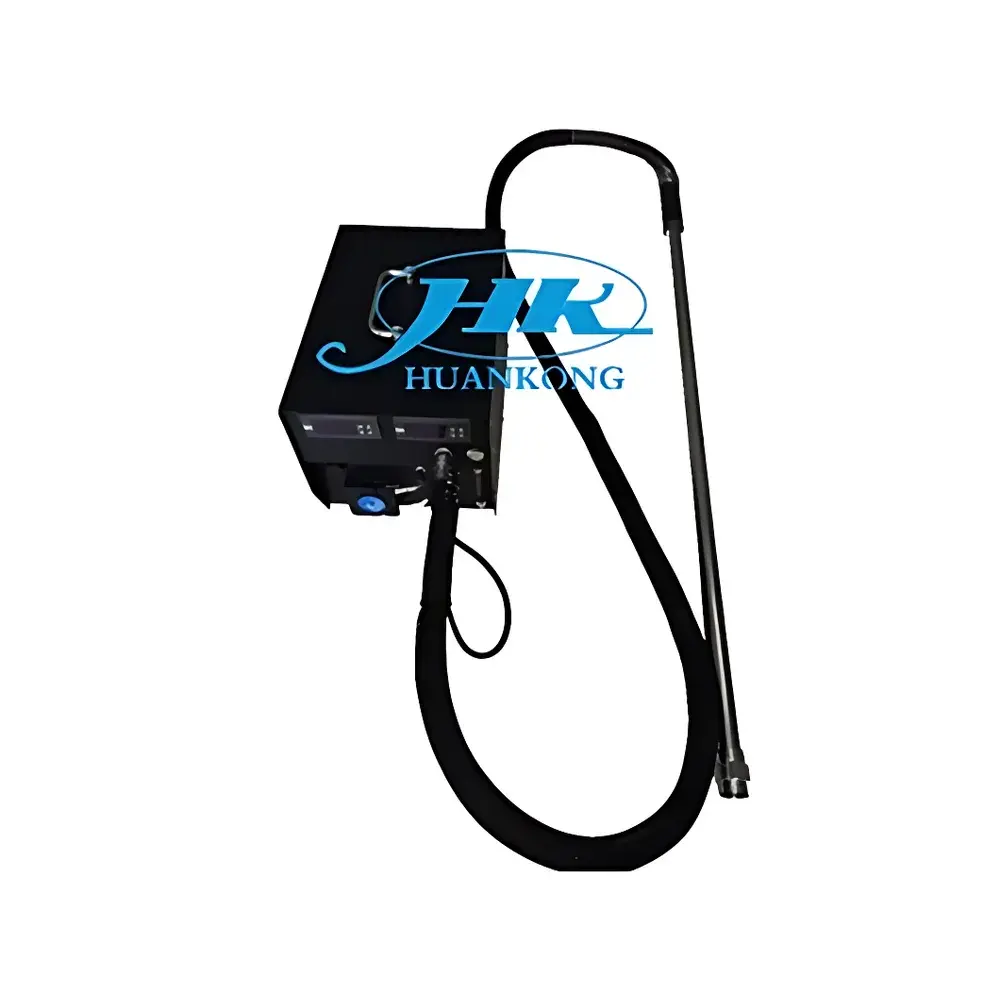
HUANKONG GHK1052 Portable Flue Gas Preconditioning System
| Brand | HUANKONG |
|---|---|
| Origin | Shandong, China |
| Manufacturer Type | Direct Manufacturer |
| Country of Origin | China |
| Model | GHK1052 |
| Instrument Type | Flue Gas Sampling System |
| Target Analytes | SO₂, NOₓ, and other combustion gases |
| Flow Accuracy | ±1% FS |
| Sampling Flow Rate | 1.5 L/min |
| Flue Gas Throughput Capacity | >2 L/min |
| Moisture Removal Efficiency | ≤4 °C dew point output (at 25 °C ambient, 1 L/min gas flow) |
| Heating Gun Setpoint Range | 20–120 °C (adjustable, 0.1 °C resolution, ±2 °C accuracy) |
| Refrigeration Setpoint Range | 0–10 °C (adjustable, 0.1 °C resolution, ±2 °C accuracy) |
| Inlet Gas Temperature Limit | ≤150 °C |
| Compressor Cooling Capacity | 470 W |
| Heating Time (20→120 °C) | ≤6 min |
| Cooling Time (25→2 °C) | ≤6 min |
| Sample Probe Length | 1 m (customizable) |
| Heated Tubing Length | 2 m (customizable) |
| Probe Material | 304 stainless steel |
| Filtration | Removable 0.1 µm PTFE filter |
| Gas Path Material | Entirely PTFE (no metal contact) |
| Power Supply | AC 220 V ±10%, 50 Hz |
| Power Consumption | ≤300 W |
| Operating Ambient Temperature | −20 to +55 °C |
| Host Dimensions (L×W×H) | 32 × 21 × 20 cm |
| Host Weight | <6.5 kg |
| Noise Level | ≤55 dB(A) |
Overview
The HUANKONG GHK1052 Portable Flue Gas Preconditioning System is an engineered solution for accurate, field-deployable flue gas sampling under high-humidity industrial conditions. Designed in strict compliance with HJ/T 47–1999 “Technical Specifications for Flue Gas Samplers”, the system integrates thermoelectrically assisted heating and high-capacity compressor-based refrigeration to achieve precise moisture removal while preserving analyte integrity. Its core function is to condition hot, wet flue gas—commonly emitted from coal-fired boilers, waste incinerators, cement kilns, and biomass combustion units—prior to analysis by downstream analyzers (e.g., UV-DOAS, NDIR, or electrochemical sensors). The system operates on the principle of controlled condensation: flue gas passes through a heated probe and PTFE-lined heated tubing to prevent water condensation upstream, then enters a rapid-exchange condenser where vapor is condensed at ≤4 °C dew point, followed by mechanical separation via an external peristaltic drain pump. This dual-stage thermal management ensures minimal analyte loss, negligible adsorption, and high reproducibility across repeated field campaigns.
Key Features
- High-efficiency compressor refrigeration (470 W cooling capacity) enables stable dew point control ≤4 °C under continuous flow (>2 L/min), significantly reducing spectral interference and sensor drift caused by water vapor.
- Full PTFE gas pathway—from 304 stainless steel heated probe tip through heated tubing and condenser chamber—eliminates catalytic or adsorptive interactions with SO₂, NO, NO₂, and other reactive species.
- Integrated heated probe (DC 36 V, max 120 °C) and self-regulating heated tubing (2 m standard) maintain wall temperature above dew point throughout transport, preventing re-condensation.
- Removable 0.1 µm hydrophobic PTFE particulate filter protects downstream analyzers from ash, soot, and condensate carryover without introducing pressure drop variability.
- Externally mounted peristaltic drain pump allows real-time visual monitoring of condensate volume and rapid tubing replacement—critical for unattended or extended-duration sampling.
- Modular quick-connect fittings for both pneumatic and electrical interfaces reduce setup time and minimize leak risk during field deployment.
- Compact host unit (<6.5 kg, 32×21×20 cm) meets ISO 5801 and EN 15267-3 portability requirements for stack access platforms and mobile emission testing labs.
Sample Compatibility & Compliance
The GHK1052 is validated for conditioning flue gases containing SO₂, NOₓ (NO/NO₂), CO, CO₂, O₂, HCl, and HF—provided inlet temperature remains ≤150 °C and particulate loading is within ISO 9001-certified filtration limits. It complies with national Chinese emission monitoring standards (HJ/T 47–1999, HJ 75–2017, HJ 76–2017) and aligns with key international frameworks including EPA Method 6C, EN 14792 (determination of SO₂ and NOₓ), and ISO 12141 (portable flue gas analyzers). All temperature control circuits include NIST-traceable calibration certificates; flow accuracy (±1% FS) is verified per ISO 5801 Annex B. The system supports GLP-compliant data integrity when paired with certified data loggers meeting FDA 21 CFR Part 11 audit trail requirements.
Software & Data Management
While the GHK1052 operates as a hardware preconditioning module (no embedded display or onboard software), it features analog voltage outputs (0–5 V or 4–20 mA) for real-time transmission of probe temperature, condenser temperature, and pump status to external SCADA systems or certified CEMS controllers. Optional RS-485 Modbus RTU interface enables integration with third-party acquisition platforms for synchronized timestamped logging of conditioning parameters alongside analyzer readings—essential for QA/QC validation under ISO/IEC 17025-accredited laboratories. All firmware updates and configuration changes require physical USB connection and password-protected access, ensuring secure parameter governance.
Applications
- Regulatory stack testing for power plants and industrial boilers under CNEMC (China National Environmental Monitoring Centre) protocols.
- Mobile source emission verification during environmental inspections and third-party compliance audits.
- Research-grade flue gas characterization in combustion optimization studies, where water vapor suppression is critical for FTIR or tunable diode laser spectroscopy.
- Pre-analyzer conditioning in portable multi-gas analyzers used for fugitive emission surveys and landfill gas monitoring.
- Calibration gas delivery systems requiring dry, particle-free carrier streams for dynamic dilution calibrators (e.g., according to ISO 6145).
FAQ
What is the maximum allowable flue gas temperature at the probe inlet?
The GHK1052 accepts flue gas up to 150 °C at the probe inlet. Exceeding this limit may compromise PTFE integrity and condenser efficiency.
Can the heating and refrigeration setpoints be adjusted independently?
Yes—both probe heater and condenser temperature are independently programmable in 0.1 °C increments, with factory default values of 120 °C (heating) and 2 °C (cooling).
Is the system compatible with EPA Method 6C or EN 14792?
It satisfies the thermal conditioning and moisture removal performance criteria outlined in both standards when operated within specified flow and temperature ranges.
Does the GHK1052 include data logging capability?
No—the unit is a dedicated preconditioning module. Data logging requires integration with external certified recorders or CEMS controllers.
How often should the 0.1 µm PTFE filter be replaced?
Filter replacement frequency depends on particulate load; under typical coal-fired boiler conditions, replacement is recommended every 40–60 hours of continuous operation or upon visible clogging.
Related Products







