
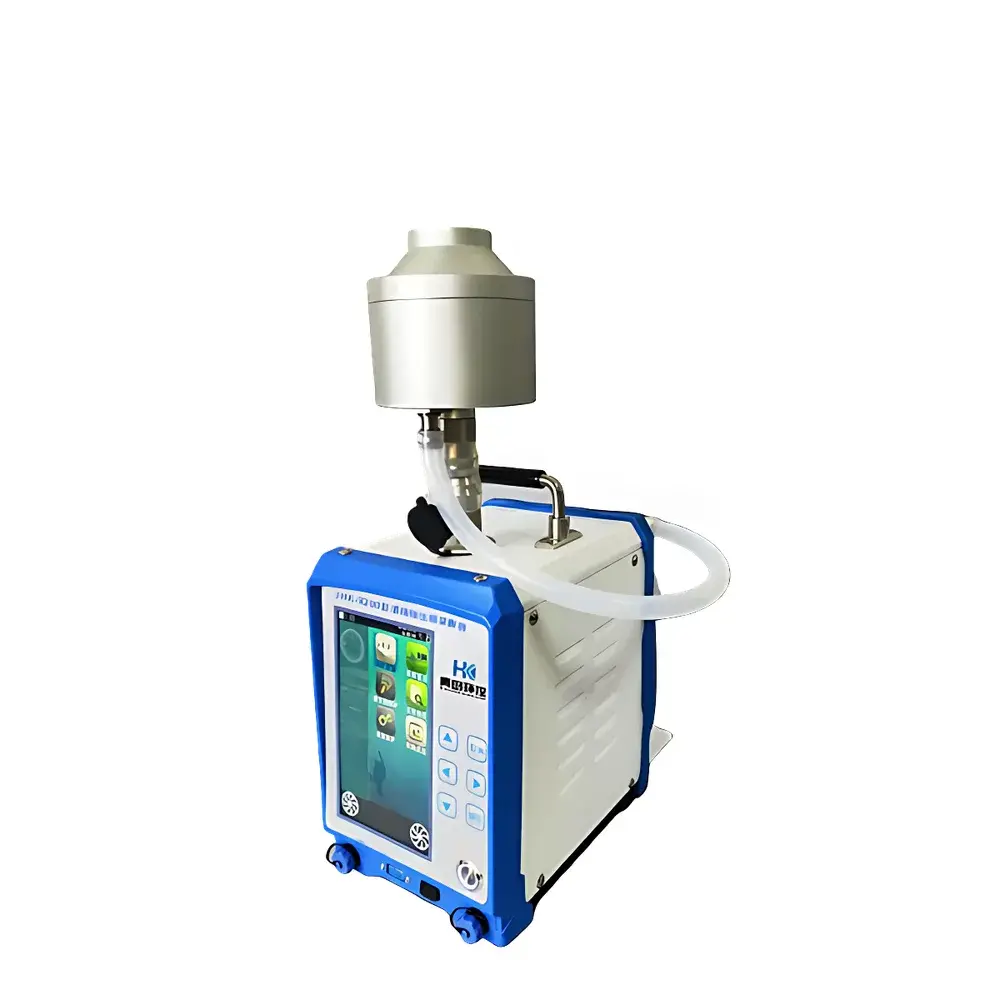
HUANKONG JHK-3200 Concentrating Air Microbial Sampler
| Brand | HUANKONG |
|---|---|
| Model | JHK-3200 |
| Origin | Shandong, China |
| Manufacturer Type | Direct Manufacturer |
| Sampling Principle | Virtual Impactor Coupled with Liquid Impingement |
| Flow Control | Closed-loop Electronic Mass Flow Control |
| Collection Efficiency | >90% for particles ≥0.5 µm |
| Concentration Ratio | ≥8× |
| Display | 7.0-inch Wide-Temperature High-Brightness Touchscreen |
| Data Storage Capacity | >100,000 sample records |
| Battery Life | ≥4 hours (built-in Li-ion) |
| Environmental Compensation | Automatic temperature & atmospheric pressure measurement |
| Data Export | USB flash drive |
| Programmable Sampling | Interval, timed, and multi-cycle modes |
| Power Failure Recovery | Auto-resume with timestamp retention |
| Optional | Bluetooth thermal printer interface |
| Compliance | JJF 1826–2020, GB/T 18204.3–2013, GB/T 18204.5–2013 |
Overview
The HUANKONG JHK-3200 Concentrating Air Microbial Sampler is an engineered solution for low-abundance airborne microbial surveillance—designed specifically to address the analytical challenge of detecting trace-level bioaerosols in ambient, indoor, or controlled-environment air. Unlike conventional single-stage impactors or filter-based samplers, the JHK-3200 integrates a virtual impactor pre-concentrator with a liquid impingement collection stage, enabling real-time enrichment of viable and culturable microorganisms prior to capture in sterile collection fluid (e.g., neutralizing broth or phosphate-buffered saline). This dual-stage architecture enhances detection sensitivity by at least one order of magnitude compared to standard 28.3 L/min single-pass samplers—critical for monitoring pathogens such as Legionella pneumophila, SARS-CoV-2 aerosols, Aspergillus spores, and other respirable biohazards where environmental concentrations fall below conventional detection thresholds. The device operates on the principle of inertial separation followed by hydrodynamic impaction: aerosol-laden air enters the virtual concentrator, where larger particles (>0.5 µm aerodynamic diameter) are selectively accelerated into a high-velocity jet and redirected into the impinger’s liquid surface, while smaller particles and background airflow bypass the collection zone. This design ensures high viability retention—essential for downstream culture-based analysis, qPCR, or metagenomic sequencing.
Key Features
- Integrated dual-mode sampling: combines virtual impactor-based concentration (≥8× enrichment factor) with liquid impingement collection in a single portable platform
- Closed-loop electronic mass flow control maintains precise volumetric flow (±2% accuracy) across variable system backpressure—ensuring reproducible collection efficiency regardless of filter loading or impinger fluid viscosity changes
- High-efficiency impingement stage achieves >90% collection efficiency for particles ≥0.5 µm, validated per ISO 14698-1 and ASTM E2994-15 guidelines for bioaerosol sampler performance
- 7.0-inch wide-temperature TFT touchscreen with optical bonding technology—operable from –10°C to 50°C, readable under direct sunlight (nits ≥800)
- Onboard environmental sensors measure real-time ambient temperature and barometric pressure, automatically correcting sampled volume to standard conditions (25°C, 101.325 kPa) per ISO 8573-1 and USP <797> requirements
- Internal rechargeable lithium-ion battery supports ≥4 hours of continuous operation at full flow (up to 150 L/min total intake), with intelligent power management and low-voltage warning
- Non-volatile memory stores >100,000 complete sampling records—including date/time stamp, flow rate, duration, environmental parameters, and user-defined batch IDs
- Robust data integrity: USB export supports CSV-formatted logs compatible with LIMS integration; optional Bluetooth thermal printer enables on-site hardcopy generation of QA/QC reports
Sample Compatibility & Compliance
The JHK-3200 is validated for use with common microbiological collection media, including tryptic soy broth (TSB), buffered peptone water (BPW), and glycine–Tween 80–lecithin–polysorbate (LTP) neutralizing solution. Its impinger geometry and flow dynamics preserve microbial viability during collection—demonstrated through recovery testing with Bacillus atrophaeus spores and Pseudomonas fluorescens aerosols per ISO 14698-2 Annex B. The instrument complies with national metrological verification specifications JJF 1826–2020 (Calibration of Air Microbial Samplers), and aligns with sampling methodology standards GB/T 18204.3–2013 (Public Health Inspection—Part 3: Air Microbiology) and GB/T 18204.5–2013 (HVAC System Air Quality Testing). While not CE-marked or FDA 510(k)-cleared, its operational parameters and documentation support GLP-compliant environmental monitoring programs in pharmaceutical cleanrooms (ISO 14644-1 Class 5–8), hospital HVAC validation, and outbreak investigation workflows.
Software & Data Management
Data acquisition and configuration are managed via embedded firmware with audit-trail-capable session logging. Each sampling event generates a timestamped record containing raw flow data, compensated volume, environmental metadata, and operator ID (if configured). Exported CSV files include column headers compliant with ISO/IEC 17025 data formatting conventions. Firmware supports firmware-over-the-air (FOTA) updates via USB; no cloud connectivity or remote telemetry is implemented—ensuring data sovereignty and alignment with ITAR- and HIPAA-aligned institutional policies. Optional Bluetooth printing outputs calibrated test reports with embedded instrument ID, calibration due date, and flow verification summary—suitable for internal QA documentation.
Applications
- Legionella risk assessment in cooling towers, hot water systems, and hospital HVAC networks
- Environmental monitoring of cleanroom air in aseptic manufacturing (pharmaceutical, biotech, medical device facilities)
- Field-based surveillance of airborne viral RNA (e.g., SARS-CoV-2) in congregate settings—integrated with RT-qPCR or digital PCR workflows
- Food processing facility pathogen mapping (e.g., Listeria monocytogenes, Salmonella) in high-humidity environments
- Educational and research applications in aerobiology, environmental health, and infectious disease modeling
- Post-remediation verification following mold or biofilm abatement in building infrastructure
FAQ
What is the recommended collection fluid volume for optimal recovery?
Standard operation uses 15–20 mL of sterile neutralizing broth in the impinger vial; volume may be adjusted between 10–30 mL depending on expected microbial load and downstream assay sensitivity.
Can the JHK-3200 be used for non-viable particle counting?
No—the instrument is purpose-built for viable and culturable microorganism collection; it does not integrate optical particle counters or laser scattering modules.
Is calibration traceable to national standards?
Yes—flow calibration is performed using NIST-traceable primary standards per JJF 1826–2020; certificate of calibration includes uncertainty budget and reference instrument ID.
Does the device meet FDA 21 CFR Part 11 requirements?
The JHK-3200 does not implement electronic signatures or role-based access control; however, its immutable local log structure and USB-exported CSV format support manual Part 11 compliance when integrated into validated laboratory information management systems (LIMS).
What maintenance intervals are recommended?
Impinger tubing and O-rings should be inspected before each use; full cleaning and sterilization (autoclave or 70% ethanol soak) required after every sampling session involving pathogenic agents. Annual recalibration is advised for regulated environments.
Related Products







