
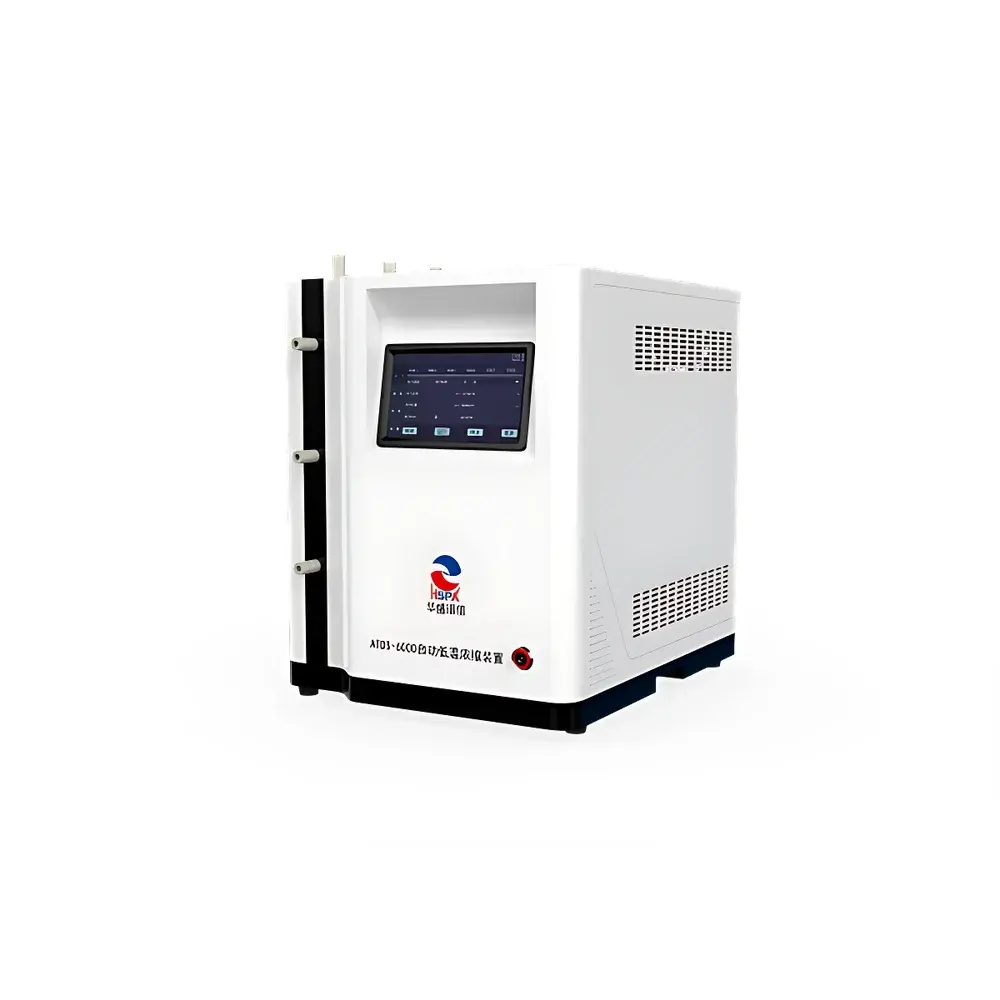
HuaShengPuXin ATDS-6000 Automated Cryo-Concentrator for GC Sample Preparation
| Brand | HuaShengPuXin |
|---|---|
| Origin | Beijing, China |
| Manufacturer Type | Direct Manufacturer |
| Model | ATDS-6000 |
| Instrument Category | GC Autosampler with Cryogenic Trapping |
| Max Sample Capacity | 6 positions |
| Valve Injection System Temp Range | RT–220°C (1°C increments) |
| Transfer Line Temp Range | RT–240°C (1°C increments, low-voltage heating) |
| Desorption Temp Range | RT–350°C (1°C increments, >1000°C/min ramp rate) |
| Cryo-Trap Temp Range | −50°C to +50°C (1°C increments, solid-state electronic cooling) |
| Dimensions | 465 × 220 × 380 mm |
| Power Consumption | 500 W |
| Weight | ~20 kg |
Overview
The HuaShengPuXin ATDS-6000 is an automated cryogenic thermal desorption concentrator engineered for precise, reproducible sample introduction in gas chromatography (GC) and GC–mass spectrometry (GC–MS) workflows. It integrates thermally controlled valve-based injection, programmable heated transfer lines, high-rate thermal desorption, and a solid-state electronic cryo-trap — all within a compact benchtop architecture. Unlike conventional thermal desorbers relying on liquid nitrogen or mechanical compressors, the ATDS-6000 employs proprietary Peltier-based cooling technology to achieve stable, controllable trapping temperatures from −50°C to +50°C without consumables or external chillers. Its core function is the quantitative enrichment and focused re-injection of volatile and semi-volatile organic compounds (VOCs/SVOCs) from gaseous or sorbent-tube-collected samples, enabling sub-part-per-trillion (pptv) detection limits and minimizing matrix interference through cold trapping and sharp thermal focusing.
Key Features
- Automated 6-position sample handling with programmable sequence execution and unattended operation
- Independent temperature control of four critical zones: valve manifold (RT–220°C), transfer line (RT–240°C), desorption oven (RT–350°C), and cryo-trap (−50°C to +50°C), each adjustable in 1°C increments
- Ultra-rapid desorption heating capability (>1000°C/min ramp rate) ensures narrow analyte band widths and minimal thermal degradation
- Low-voltage heating design for transfer line — compliant with IEC 61010-1 safety standards for laboratory equipment
- Electronic cryo-cooling system eliminates reliance on LN₂ or refrigerant gases, reducing operational cost, footprint, and maintenance overhead
- Built-in leak-tight pneumatic circuitry with stainless-steel and fused-silica flow paths, compatible with inert carrier gases (He, H₂, N₂)
- Front-panel touchscreen interface with real-time temperature logging and error diagnostics
Sample Compatibility & Compliance
The ATDS-6000 supports standard 1/4″ OD stainless-steel or glass thermal desorption tubes (e.g., Tenax TA, Carbopack B/C, Carboxen series) and accommodates both single- and multi-bed configurations. It is validated for use with EPA Methods TO-17, TO-14A, and ISO 16017-1 for ambient air, workplace air, and indoor air analysis. The instrument’s temperature control accuracy (±0.5°C) and thermal stability (<0.1°C drift over 30 min) meet ASTM D6196 and USP requirements for residual solvent quantification. All firmware and hardware designs adhere to CE marking directives (2014/30/EU EMC, 2014/35/EU LVD) and support GLP-compliant audit trails when interfaced with validated LIMS or chromatography data systems.
Software & Data Management
The ATDS-6000 operates via embedded firmware with USB and RS-232 interfaces for bidirectional communication with third-party GC control software (e.g., Agilent OpenLab CDS, Thermo Chromeleon, Shimadzu GC Solutions). Method parameters—including trap/desorb/transfer timing, temperature ramps, and purge cycles—are stored as encrypted .cfg files with timestamped version history. Full event logging (temperature setpoints, actual readings, valve actuation, fault codes) is retained for ≥30 days onboard and exportable in CSV format. When deployed in regulated environments, optional 21 CFR Part 11–compliant software modules provide user authentication, electronic signatures, and immutable audit trails for method changes and run logs.
Applications
- Trace-level VOC monitoring in environmental air, stack emissions, and cleanroom atmospheres
- Residual solvent analysis in pharmaceutical excipients, packaging materials, and medical devices per ICH Q3C guidelines
- Odor profiling and off-gas characterization in polymer, automotive interior, and consumer product development
- Forensic toxicology screening of volatiles in blood headspace and post-mortem samples
- Method development for coupling with comprehensive two-dimensional GC (GC×GC) systems requiring ultra-sharp injection bands
FAQ
Does the ATDS-6000 require liquid nitrogen or external refrigeration units?
No — it uses solid-state thermoelectric cooling, eliminating consumables and external infrastructure.
Can it be integrated with legacy GC systems lacking digital I/O?
Yes — analog trigger inputs (TTL/5 V) and relay-controlled start/stop signals enable compatibility with older GC models.
What is the maximum allowable moisture content in sampled air before condensation risks occur?
For optimal cryo-trap performance, inlet humidity should remain below 60% RH at 25°C; optional Nafion dryers are recommended for high-humidity sampling.
Is method validation support documentation available?
Yes — instrument qualification protocols (IQ/OQ/PQ), temperature calibration certificates, and application notes for EPA/ISO methods are provided upon request.
How often does the electronic cooling module require servicing?
Under normal lab conditions (20–25°C ambient, 60% RH), no scheduled maintenance is required; mean time between failures exceeds 25,000 operating hours.
Related Products






