
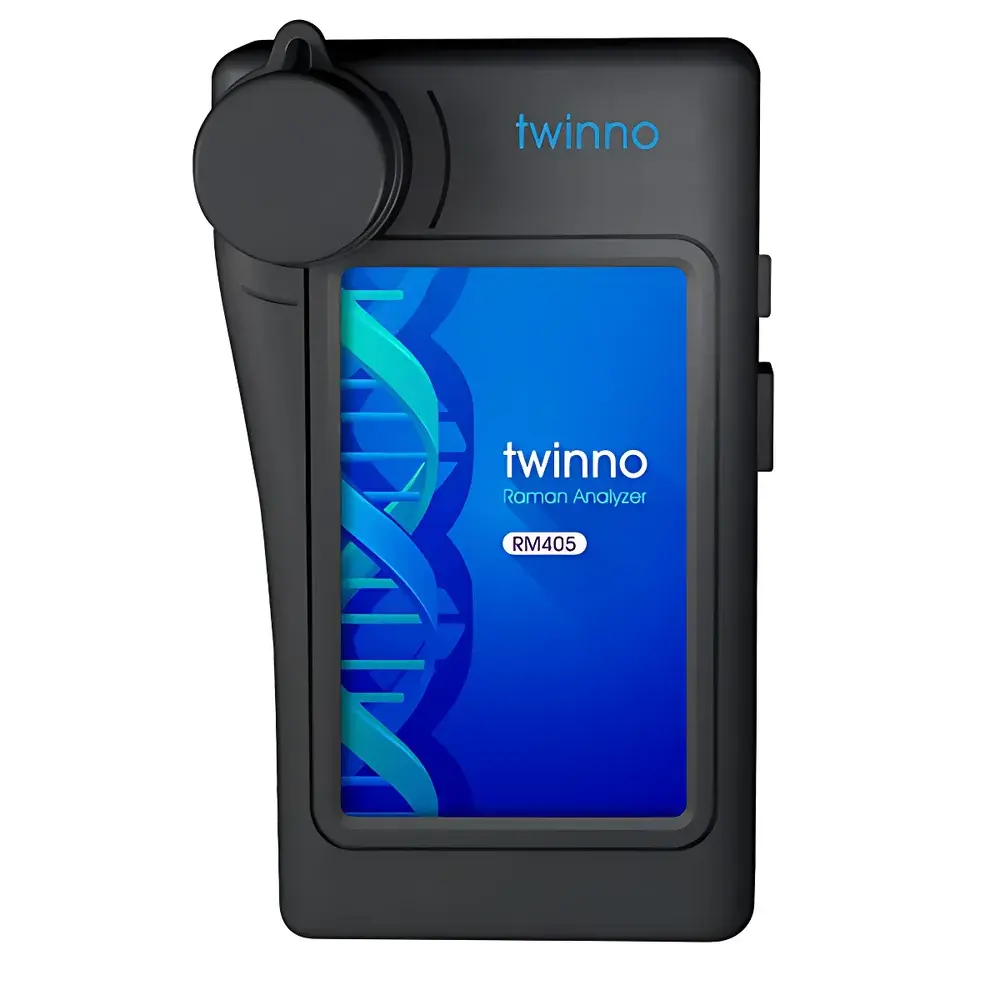
RM405 Handheld Raman Spectrometer
| Origin | Taiwan |
|---|---|
| Manufacturer Type | Authorized Distributor |
| Model | RM405 |
| Price Range | USD 14,000 – 28,000 |
| Instrument Type | Portable/Handheld Raman Spectrometer |
| Spectral Range | 400 cm⁻¹ to 4500 cm⁻¹ |
| Spectral Resolution | ≤1 cm⁻¹ |
| Spatial Resolution | 1 µm (lateral), 1 µm (axial) |
| Minimum Wavenumber | 400 cm⁻¹ |
| Spectral Reproducibility | ±≤0.15 cm⁻¹ |
Overview
The RM405 Handheld Raman Spectrometer is an engineered field-deployable analytical instrument designed for rapid, non-destructive molecular identification and semi-quantitative assessment of transparent solids and liquids in situ. Based on spontaneous Raman scattering induced by a 405 nm diode laser (max. 60 mW), the system captures vibrational mode signatures across a broad spectral window—400 cm⁻¹ to 4500 cm⁻¹—with high wavenumber accuracy and reproducibility (±≤0.15 cm⁻¹). Its compact architecture integrates optical excitation, spectral dispersion via high-efficiency transmission grating, and low-noise CMOS detection into a single ergonomic unit weighing under 650 g. Unlike benchtop systems requiring controlled environments and external computing, the RM405 operates autonomously with onboard processing, enabling real-time spectral acquisition, library matching, and multi-sample comparison without tethering to a PC.
Key Features
- Integrated 405 nm laser source (Class 3B, max. 60 mW) optimized for strong Raman signal generation with minimal fluorescence interference in organic and crystalline materials
- High-fidelity spectral acquisition over 400–4500 cm⁻¹ range at ≤1 cm⁻¹ resolution (FWHM), validated against NIST-traceable polystyrene and silicon standards
- On-device spectral processing engine supporting three operational modes: (1) Single-sample identification, (2) Multi-spectrum overlay comparison (up to six spectra), and (3) Interactive spectral database browsing
- Self-contained 4.3″ TFT-LCD touchscreen interface (480 × 800 pixels) with intuitive English-language UI; no external display or keyboard required
- Dual data storage architecture: internal flash memory + microSD card slot (supporting up to 128 GB) for raw spectra, metadata, and user-defined libraries
- Battery-powered operation using rechargeable Li-ion cell (≥4 hours continuous use); optional 5 V/1 A DC input for extended field deployment
- Compact form factor (155 × 95 × 40 mm, L × W × H) compliant with IEC 60529 IP54 for dust and splash resistance during mobile inspection
Sample Compatibility & Compliance
The RM405 accommodates standard 4 mL transparent glass vials (12 mm OD) for liquid and powder analysis, as well as bulk solid specimens—including gemstones up to 15 mm diameter (e.g., diamonds ≤10 ct). Its 1 µm lateral and axial spatial resolution enables localized interrogation of heterogeneous samples without physical sectioning. For diamond authentication, the instrument reliably resolves the characteristic 1332 cm⁻¹ first-order phonon peak of sp³-bonded carbon in diamond lattice—distinguishing natural diamond from synthetic CVD-grown, HPHT-treated, fracture-filled, or surface-coated variants based on peak position, full-width-at-half-maximum (FWHM), and overtone/combination band ratios. The system complies with ISO/IEC 17025 requirements for field instrumentation validation and supports GLP-aligned documentation workflows when used with twinno RM405 desktop software (v3.2+), which provides audit trail logging per FDA 21 CFR Part 11 for regulated environments.
Software & Data Management
The RM405 ships with embedded firmware supporting spectrum acquisition, baseline correction, peak detection, and Euclidean distance-based library matching. Twinno RM405 Desktop Software (Windows 10/11 compatible) extends functionality with advanced chemometric tools: PCA clustering, PLS regression for semi-quantitative estimation, and customizable spectral library import/export (CSV, .spc, .jdx formats). All acquired spectra include embedded metadata (timestamp, GPS coordinates if enabled via USB-connected GNSS module, laser power, integration time). Software-generated reports are exportable as PDF or Excel, with configurable templates meeting internal QA/QC or external regulatory submission requirements (e.g., USP , ASTM E1840).
Applications
- Pharmaceutical: Raw material identification (APIs, excipients), counterfeit drug screening, polymorph verification, and packaging integrity checks
- Food safety: Detection of adulterants (e.g., melamine in milk powder, Sudan dyes in spices), authenticity verification (olive oil, honey, vanilla)
- Chemical manufacturing: In-line batch verification, reaction monitoring, and impurity profiling of intermediates
- Geoscience & gemology: Diamond origin determination, synthetic vs. natural gemstone discrimination, mineral phase mapping
- Forensics & customs: Rapid identification of unknown powders, tablets, or residues at checkpoints or crime scenes
- Academic research: Teaching spectroscopy fundamentals, field-based environmental sampling (e.g., microplastics, soil organics)
FAQ
Is the RM405 suitable for quantitative analysis?
It supports semi-quantitative assessment via peak intensity ratios and PLS calibration models built in twinno Desktop Software—but is not certified for absolute quantification under ISO 80000 or CLSI EP21-A guidelines.
Can it analyze opaque or highly fluorescent samples?
Performance is optimized for transparent or translucent materials; opaque samples require surface preparation or alternative excitation (e.g., 785 nm), which the RM405 does not support.
What spectral libraries are pre-installed?
A core reference library of >200 compounds (pharmaceuticals, explosives, polymers, minerals) is included; users may expand it via CSV upload or spectral acquisition.
Does the device meet regulatory requirements for GMP labs?
While the hardware itself is not GMP-certified, its data management ecosystem—including audit trails, electronic signatures, and version-controlled libraries—enables compliance when deployed within validated SOPs.
How is calibration maintained in the field?
Automatic wavelength calibration occurs at startup using an integrated silicon reference; users may perform manual recalibration using NIST-traceable standards via the desktop software.




