
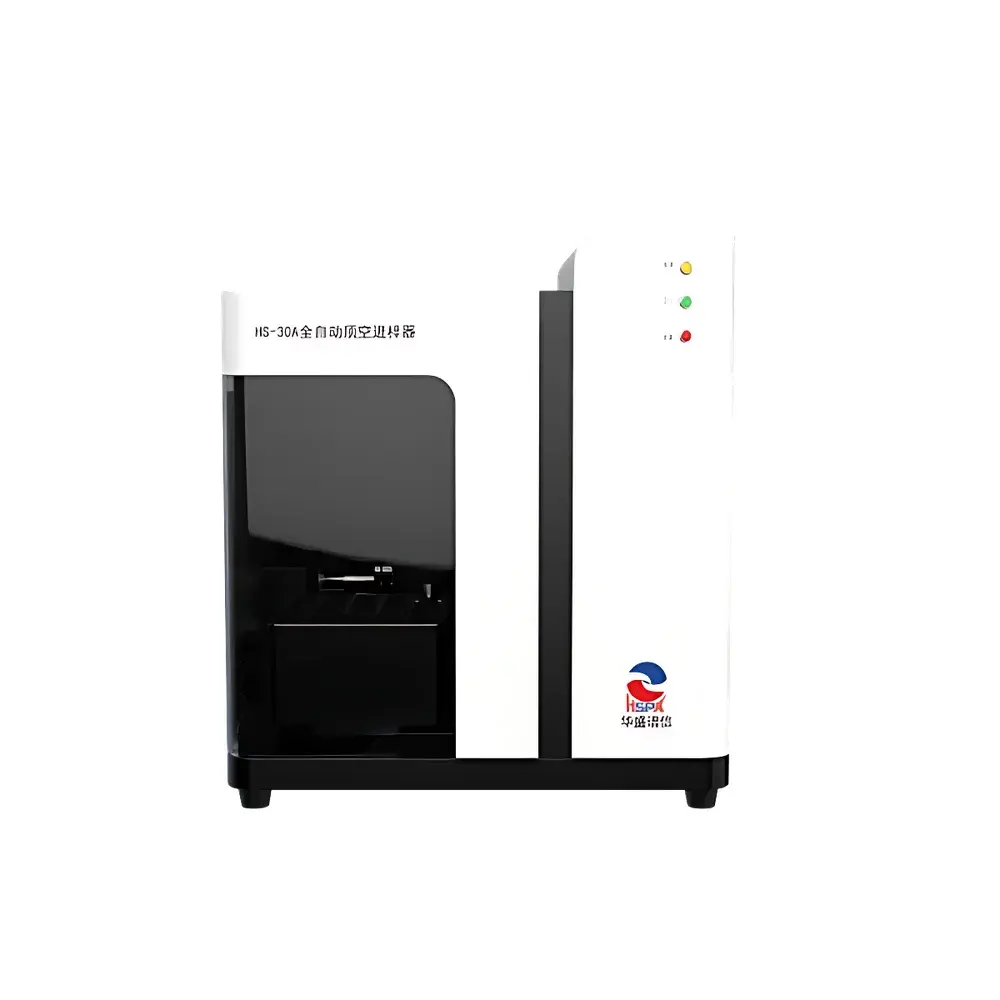
HuaShengPuXin HS-30A Fully Automated Headspace Sampler
| Brand | HuaShengPuXin (HSPX) |
|---|---|
| Origin | Beijing, China |
| Manufacturer Type | Direct Manufacturer |
| Model | HS-30A |
| Automation Level | Fully Automated |
| Sample Tray Capacity | 30 positions |
| Vial Size Options | 10 mL or 20 mL standard headspace vials |
| Oven Temperature Range | Ambient to 240 °C (1 °C increment, ±0.1 °C accuracy, ~400 W heating power) |
| Valve & Transfer Line Temperature Range | Ambient to 240 °C (1 °C increment, ±0.1 °C accuracy |
| valve | ~100 W, transfer line: ~200 W) |
| Dimensions (W×D×H) | 460 × 450 × 520 mm |
| Weight | ~38 kg |
Overview
The HuaShengPuXin HS-30A Fully Automated Headspace Sampler is a precision-engineered thermal desorption system designed for quantitative analysis of volatile and semi-volatile organic compounds (VOCs and SVOCs) in solid, liquid, and slurry matrices via gas chromatography (GC) or gas chromatography–mass spectrometry (GC–MS). It operates on the principle of equilibrium headspace sampling: samples are sealed in standardized vials and heated to a precisely controlled temperature, allowing analytes to partition into the vapor phase above the sample matrix. Once equilibrium is achieved, a pressurized carrier gas transfers the headspace vapor through a thermostatted valve and heated transfer line directly into the GC injector. This method eliminates solvent interference, reduces matrix effects, and enhances reproducibility—particularly critical for environmental, pharmaceutical, and forensic applications where trace-level quantitation and regulatory compliance are mandatory.
Key Features
- Fully automated 30-position sample carousel with programmable sequence control and unattended operation up to 72 hours
- Triple-zone independent temperature control: sample oven (ambient–240 °C), injection valve (ambient–240 °C), and transfer line (ambient–240 °C), each with ±0.1 °C stability and 1 °C resolution
- High-efficiency thermal architecture: 400 W oven heater, 100 W valve heater, and 200 W transfer line heater ensure rapid equilibration and minimal thermal lag
- Compatible with standard 10 mL and 20 mL crimp-top or screw-cap headspace vials per ASTM D6866, ISO 17993, and USP
- Robust pneumatic system with pressure-controlled vial pressurization and precise syringe-driven sample loop filling for high injection repeatability
- Integrated leak detection and diagnostic self-check at startup and between runs to maintain method integrity
Sample Compatibility & Compliance
The HS-30A supports diverse sample types including aqueous solutions, soils, sediments, sludges, polymers, pharmaceutical excipients, and packaged consumer products. Its thermal performance and protocol flexibility align with over ten Chinese Environmental Monitoring Standards (HJ series), including HJ 620–2011, HJ 642–2013, HJ 714–2014, HJ 736–2015, HJ 810–2016, and others governing VOC analysis in water, soil, sediment, and solid waste. While developed to meet national environmental testing requirements, its operational parameters—including temperature accuracy, vial sealing integrity, and carrier gas flow consistency—are fully compatible with internationally recognized methodologies such as EPA Method 502.2, EPA Method 8260D, ISO 15681-2, and ASTM D7622. The instrument’s design facilitates full auditability under GLP and GMP frameworks, supporting 21 CFR Part 11-compliant data handling when integrated with validated chromatography data systems.
Software & Data Management
The HS-30A communicates bidirectionally with major GC/GC–MS platforms (Agilent, Thermo Fisher, Shimadzu, PerkinElmer) via industry-standard RS-232 or Ethernet interfaces. Its embedded firmware enables method storage, run-time parameter logging, and real-time status monitoring. When paired with compliant chromatography data systems (CDS), it supports electronic signatures, user access levels, and full audit trails—including timestamps for vial loading, oven ramp initiation, valve actuation, and injection completion. All temperature setpoints, dwell times, pressurization pressures, and loop fill volumes are stored as metadata within raw data files, ensuring traceability from sample preparation through final report generation.
Applications
- Environmental monitoring: Quantification of chlorinated solvents (e.g., chloroform, carbon tetrachloride), BTEX (benzene, toluene, ethylbenzene, xylenes), and aldehydes (e.g., acrolein) in groundwater, soil, and landfill leachate
- Pharmaceutical quality control: Residual solvent analysis per ICH Q3C guidelines in active pharmaceutical ingredients (APIs) and finished dosage forms
- Food and packaging safety: Migration testing of volatile migrants (e.g., styrene, limonene) from plastics and multilayer films into food simulants
- Forensic toxicology: Detection of ethanol, acetone, and other volatiles in blood and tissue homogenates
- Materials science: Off-gassing profiling of adhesives, coatings, and composite resins under controlled thermal stress
FAQ
Does the HS-30A support method validation per ISO/IEC 17025?
Yes—the instrument’s temperature calibration traceability, repeatability data (RSD <1.5% for peak area across 10 injections), and documented maintenance logs enable full compliance with ISO/IEC 17025 clause 5.5.2 for equipment qualification.
Can it be integrated with third-party CDS without proprietary drivers?
Yes—it uses open-command ASCII protocols over RS-232 or TCP/IP, enabling integration with OpenLab CDS, Chromeleon, Empower, and MassHunter without custom DLLs or middleware.
Is the 30-position tray configurable for mixed vial sizes during a single run?
No—vial size must be uniform per batch to ensure consistent crimp seal compression and thermal contact; however, trays can be manually swapped between 10 mL and 20 mL configurations.
What maintenance intervals are recommended for long-term reliability?
Valve seals and septa should be replaced every 1,000 injections; oven insulation and transfer line ferrules inspected quarterly; full system performance verification (temperature accuracy, carryover, precision) performed monthly per SOP.
Does the system include built-in diagnostics for GC inlet synchronization?
Yes—hardware-level trigger signals (TTL-compatible) confirm successful injection timing and coordinate GC oven ramp initiation, minimizing retention time drift in multi-method sequences.





