
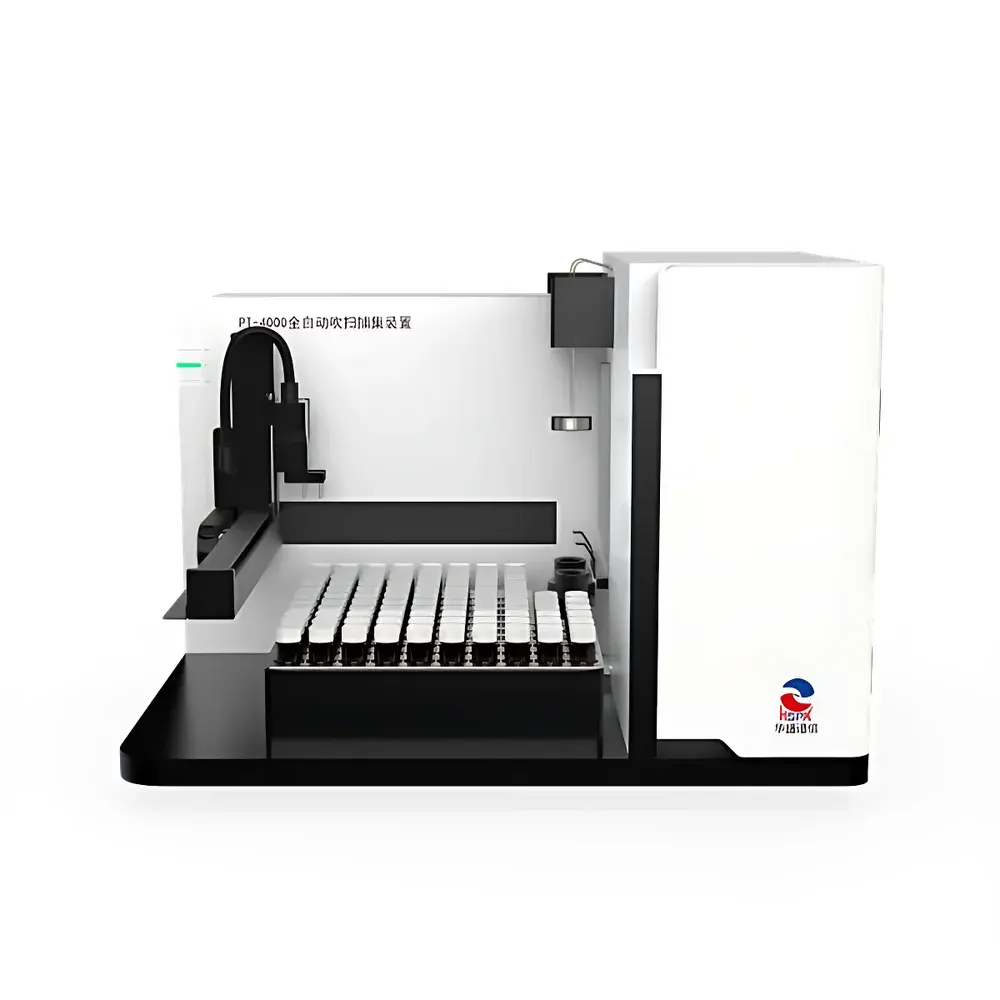
HuaShengPuXin PT-4000 Automated Purge and Trap System
| Brand | HuaShengPuXin (HSPX) |
|---|---|
| Origin | Beijing, China |
| Manufacturer Type | Direct Manufacturer |
| Instrument Category | Domestic |
| Model | PT-4000 |
| Sample Tray Capacity | 100 positions |
| Injection Precision | RSD < 1% |
| Trap Temperature Range | Ambient to 350 °C |
| Sample Heating Temperature Range (Purge Zone) | Ambient to 90 °C |
| Application Class | Water and Soil VOC Analysis |
Overview
The HuaShengPuXin PT-4000 Automated Purge and Trap System is a fully integrated, laboratory-grade sample preparation platform engineered for the quantitative extraction and preconcentration of volatile organic compounds (VOCs) from aqueous and solid-phase environmental matrices. Based on the principle of dynamic headspace purging—where inert gas continuously sweeps VOCs from a heated, agitated sample into a sorbent-packed trap—the system delivers high recovery efficiency and analytical reproducibility required for trace-level environmental monitoring. Unlike manual or semi-automated alternatives, the PT-4000 executes the entire workflow—including purge, desorption, transfer, and trap bake-out—under programmable, unattended operation. Its architecture supports dual-mode sample introduction: direct liquid injection for water samples (e.g., drinking water, wastewater, seawater) and thermal equilibration with moisture management for heterogeneous solids (e.g., soils, sediments, sludges). This design ensures compliance with the thermodynamic and kinetic constraints inherent in EPA Method 502.2, 524.4, and ISO 15681-2, while maintaining compatibility with downstream GC or GC–MS instrumentation.
Key Features
- 100-position automated sample carousel with barcode-ready vial support and configurable rack mapping for batch processing
- High-precision liquid handling module delivering RSD < 1% across full dynamic range, validated per ISO 5725-2 for repeatability
- Independent thermal control zones: purge heater (ambient to 90 °C, ±0.5 °C accuracy), trap oven (ambient to 350 °C, ±1 °C stability), and transfer line (up to 300 °C)
- Multi-bed sorbent trap configuration supporting Tenax TA, Carbopack B/C, and fused-silica-coated variants for broad VOC coverage (C2–C12)
- Integrated moisture management via cryofocusing or selective membrane drying, minimizing water vapor overload during desorption
- Self-diagnostic routines for gas flow calibration, valve sequencing verification, and trap integrity testing prior to each run
Sample Compatibility & Compliance
The PT-4000 accommodates diverse sample types without matrix-specific hardware modification: liquid matrices (groundwater, surface water, biological fluids such as blood plasma), semi-solids (sediment slurries, digested sludge), and dry solids (soil cores, textile fibers, packaging materials, cosmetic emulsions). All operational parameters align with Chinese national and industry standards including HJ 605–2011 (VOC analysis in water), HJ 639–2012 (VOCs in soil), HJ 735–2015 (petroleum hydrocarbons), and GB/T 5750.8–2023 (drinking water quality testing). The system’s firmware and method templates are structured to facilitate audit-ready documentation per GLP and ISO/IEC 17025 requirements. While not certified under FDA 21 CFR Part 11 out-of-the-box, its data logging architecture supports electronic signature implementation and full audit trail generation when deployed within validated laboratory information management systems (LIMS).
Software & Data Management
Controlled via HSPX-PurgeSoft v3.x, the embedded software provides method editor, real-time status dashboard, and event-driven alerting (e.g., pressure deviation >5%, trap saturation warning). All acquisition metadata—including timestamped temperature profiles, gas flow logs, valve actuation sequences, and calibration history—are stored in encrypted SQLite databases compliant with FAIR data principles. Raw method files (.pmt) and processed reports (.pdf/.csv) export with embedded instrument ID, operator credentials, and version-controlled firmware revision. Optional API integration enables bidirectional communication with third-party chromatography data systems (CDS) such as Thermo Chromeleon, Agilent OpenLab, or Waters Empower.
Applications
- Regulatory monitoring of chlorinated solvents (e.g., PCE, TCE), benzene-toluene-ethylbenzene-xylene (BTEX), and fuel oxygenates (MTBE, ETBE) in municipal water supplies
- Site assessment of contaminated land per HJ 1020–2019, including low-permeability soils and dredged sediments
- Leachate screening in landfill monitoring programs using SL 741–2016 protocols
- Migration testing of VOCs from food contact materials (packaging, textiles) per GB/T 5009.198–2022-aligned workflows
- Method development for emerging contaminants including halogenated anisoles, naphthalene derivatives, and short-chain chlorinated paraffins
FAQ
Does the PT-4000 support EPA Method 524.4 for drinking water analysis?
Yes—the system meets all instrumental performance criteria for purge efficiency, blank integrity, and surrogate recovery specified in EPA Method 524.4 when operated with certified Tenax TA/Carbopack B traps and calibrated helium or nitrogen carrier gas.
Can it handle high-salinity seawater samples without clogging?
Yes—integrated salt precipitation management and optional inline filtration prevent particulate carryover; method templates include extended purge cycles and optimized desorption ramp rates for saline matrices.
Is remote monitoring and troubleshooting supported?
Yes—via secure SSH-enabled Ethernet connection, technicians can access live diagnostics, download error logs, and push firmware updates without physical site presence.
What trap regeneration protocols are available?
Three bake-out modes: standard (280 °C × 15 min), deep-clean (350 °C × 30 min with inert purge), and conditioned storage (120 °C under vacuum), all user-programmable and logged.
How is method validation documented for regulatory submissions?
Each run generates a PDF report containing system suitability test results, calibration curves, QC spike recoveries, and raw chromatographic integrations—formatted to meet HJ 168–2020 and ISO/IEC 17025 clause 7.8 reporting requirements.
Related Products





