
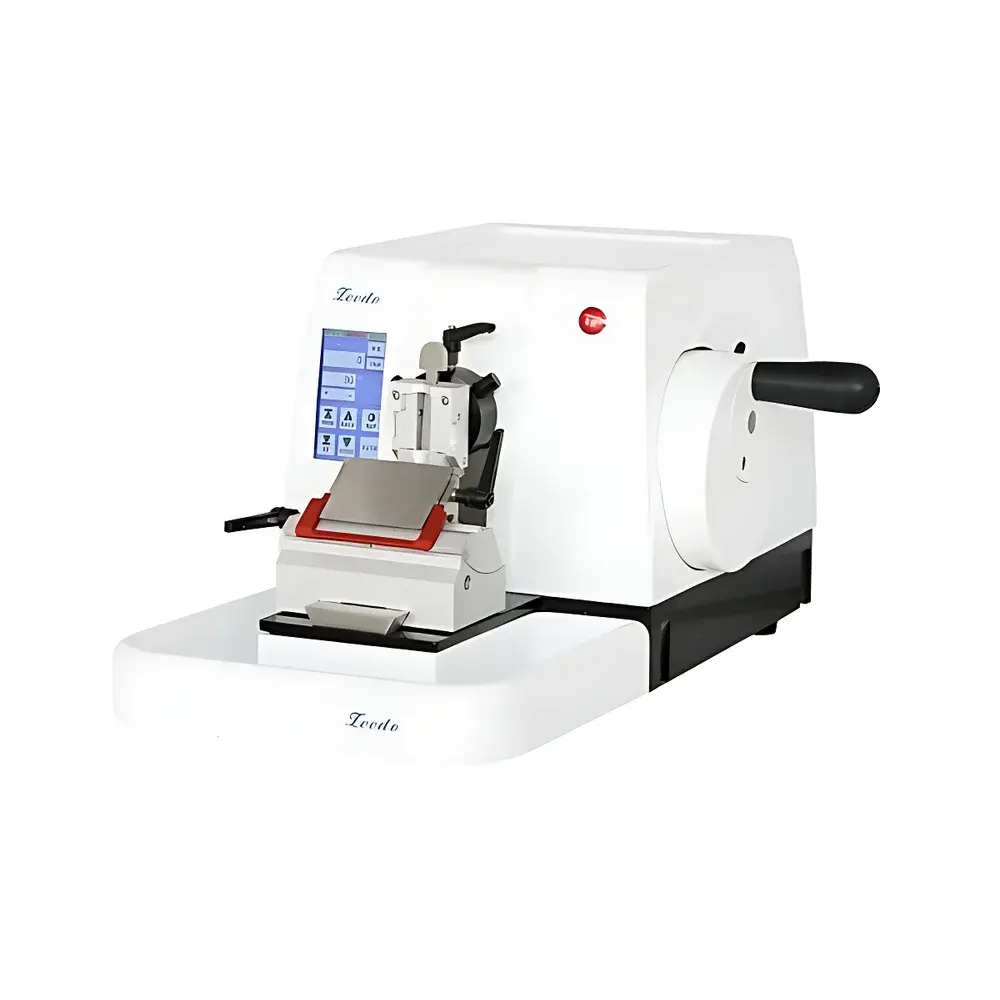
Huasu HS-3345 Fully Automatic Rotary Microtome for Paraffin-Embedded Tissue Sections
| Origin | Zhejiang, China |
|---|---|
| Manufacturer Type | Authorized Distributor |
| Product Origin | Domestic (China) |
| Model | HS-3345 |
| Price Range | USD 7,000–14,000 (FOB) |
| Max Specimen Size (with C-clamp) | 55 mm × 40 mm |
| Section Thickness Range | 0.5 µm to 100 µm (adjustable in 0.5 µm increments ≤5 µm |
| Trim Thickness Range | 1 µm to 600 µm |
| Specimen Retraction | 0–95 µm (5 µm increments) |
| Specimen Horizontal Stroke | 25 mm |
| Specimen Vertical Stroke | 60 mm |
| Blade Travel Adjustment | Horizontal 3-zone positioning |
| Specimen Orientation | ±8° X/Y tilt adjustment |
| Display Language | English & Chinese |
| Safety | Dual handwheel locks, emergency stop button, forward/reverse limit alarm, self-diagnostic system |
Overview
The Huasu HS-3345 is a fully automatic rotary microtome engineered for high-precision sectioning of paraffin-embedded biological tissues in histopathology laboratories. Based on the classical Couette-type rotary motion principle, it delivers consistent, artifact-free sections by integrating a stepper motor–driven specimen advancement system with optical position feedback and closed-loop micro-motion control. Designed for routine diagnostic workflows as well as research-grade morphological analysis, the HS-3345 supports reproducible sectioning across the full clinically relevant thickness range—from ultra-thin 0.5 µm sections for electron microscopy prep to robust 100 µm sections for immunohistochemistry or 3D reconstruction. Its mechanical architecture complies with ISO 13485–aligned manufacturing standards for medical device accessories and meets functional safety requirements per IEC 61010-1 for laboratory equipment.
Key Features
- Fully automated sectioning with three operational modes: continuous, step, and single-section—each configurable via intuitive LED interface with real-time parameter confirmation.
- Precision micro-feeding system utilizing optical encoder feedback and a high-torque stepper motor ensures sub-micron positional repeatability (<±0.3 µm) over extended operation cycles.
- Cross-roller linear guide rails eliminate lubrication requirements and reduce long-term drift—ensuring stable horizontal specimen travel across the full 25 mm stroke without periodic recalibration.
- Dual-stage handwheel balancing mechanism dynamically compensates for rotational inertia shifts during thick-sectioning, maintaining uniform torque response from 0.5 µm to 100 µm settings.
- Horizontal blade carriage allows lateral repositioning of disposable blades into three distinct cutting zones—extending effective blade life by up to 3× compared to fixed-position systems.
- Specimen retraction function (0–95 µm, 5 µm steps) prevents knife-edge contact during specimen return, minimizing chatter artifacts and preserving tissue integrity at critical interfaces.
- Integrated emergency stop switch, dual mechanical handwheel locks (top-lock + positional lock), and forward/reverse travel limit alarms satisfy institutional biosafety and GLP-compliant lab protocols.
Sample Compatibility & Compliance
The HS-3345 accommodates standard histology cassettes (max 40 mm × 28 mm) and larger C-clamp specimens up to 55 mm × 40 mm, supporting both routine formalin-fixed paraffin-embedded (FFPE) blocks and harder resin-embedded samples. Its ±8° X/Y specimen orientation adjustment enables precise alignment of anatomical planes—critical for serial sectioning of neural or musculoskeletal tissues. The unit conforms to ASTM E2137-22 (Standard Practice for Microtome Performance Verification) and supports traceable calibration documentation required under CAP-accredited histopathology labs. While not FDA-cleared as an IVD device, its design and documentation align with ISO 15189 Annex A.3.2.3 for pre-analytical instrumentation used in diagnostic tissue processing.
Software & Data Management
The HS-3345 operates via embedded firmware with no external PC dependency. All sectioning parameters—including total section count, cumulative thickness, current mode, and error logs—are stored in non-volatile memory and displayed in real time on the dual-language (English/Chinese) LED interface. Section counters maintain persistent records across power cycles and support manual reset for batch tracking. Though lacking network connectivity or LIMS integration, the unit’s self-diagnostic prompt system flags mechanical anomalies (e.g., feed inconsistency, limit switch failure, motor stall) with alphanumeric codes compliant with IEC 62304 Class B software safety principles. Audit trails are printable via optional foot-switch–triggered logging (requires external thermal printer interface).
Applications
- Routine histopathology: Standard 3–5 µm H&E sections for surgical pathology reporting in clinical laboratories.
- Research morphology: Serial 1–2 µm sections for neuronal tracing, tumor margin mapping, or spatial transcriptomics library prep.
- Quality assurance: Reproducible 10–20 µm sections for embedding validation and block-face imaging prior to laser capture microdissection.
- Teaching laboratories: Robust 50–100 µm sections for gross anatomy instruction and 3D tissue model reconstruction.
- Biobanking: High-throughput sectioning of archival FFPE blocks with minimal operator fatigue due to automated mode selection and ergonomic handwheel dynamics.
FAQ
What is the minimum achievable section thickness, and how is accuracy verified?
The HS-3345 achieves 0.5 µm nominal thickness with ±0.2 µm repeatability over 100 consecutive sections when operated under controlled temperature (20–22°C) and using certified tungsten-carbide knives. Accuracy is verified per ASTM E2137-22 using calibrated stage micrometers and digital image metrology.
Does the unit support regulatory-compliant data integrity for GxP environments?
Yes—the embedded counter and error log retain timestamps and parameter states without volatile memory dependence. While not Part 11–compliant out-of-the-box, audit-ready reports can be exported manually for inclusion in GLP/GMP study files.
Can the HS-3345 accommodate frozen sections?
No—it is optimized exclusively for room-temperature paraffin and low-melting-point resin blocks. Cryosectioning requires dedicated freezing microtomes with thermal management systems.
What maintenance intervals are recommended for sustained precision?
Zero-lubrication cross-roller guides require only quarterly visual inspection and compressed-air cleaning. Stepper motor calibration is factory-set and does not require field adjustment within 5 years of normal use (≤8 hrs/day).
Is remote diagnostics or firmware update capability available?
Firmware updates must be performed locally via USB port using authorized service tools. Remote access is intentionally excluded to preserve system determinism and cybersecurity compliance in regulated lab networks.



