
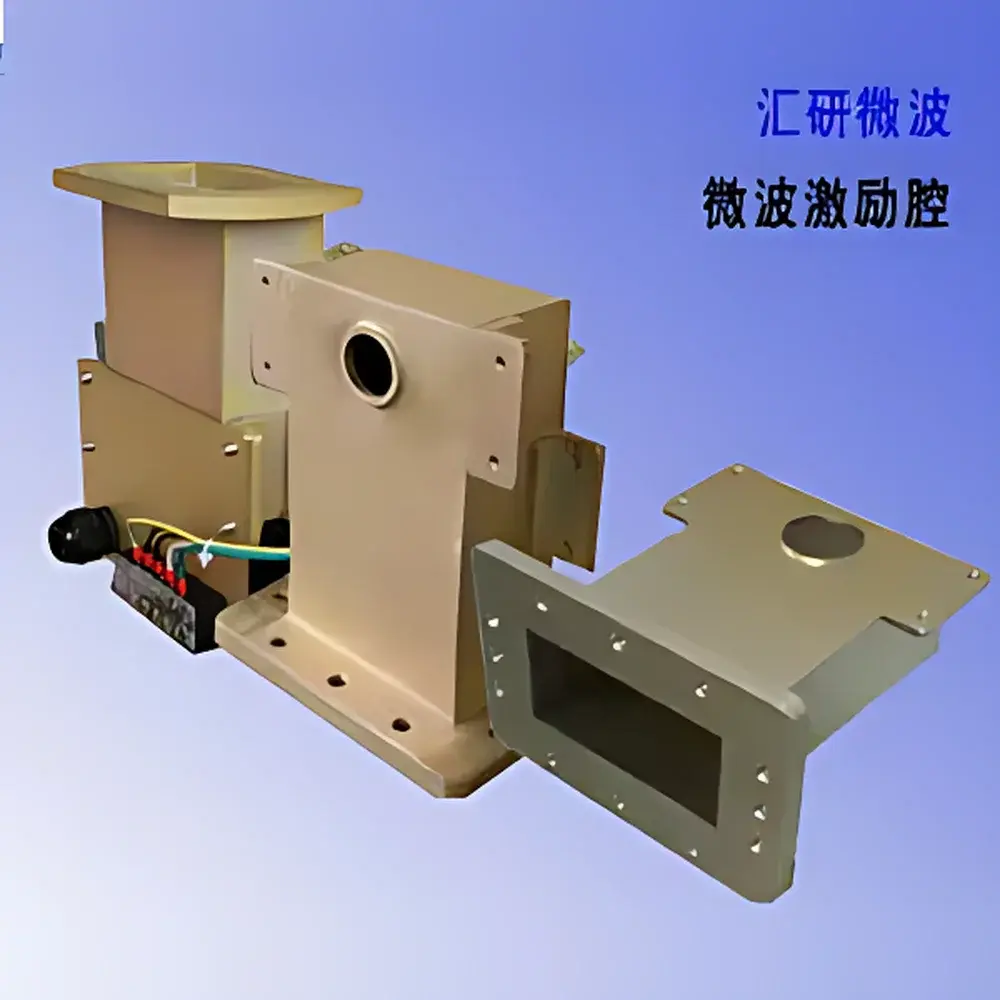
Huayan Custom Microwave Excitation Cavity (Magnetron Mount)
| Brand | Huayan |
|---|---|
| Origin | Jiangsu, China |
| Manufacturer Type | Authorized Distributor |
| Regional Classification | Domestic (China) |
| Model | Custom-Engineered |
| Pricing | Available Upon Request |
| Waveguide Standards | BJ26/WR340, BJ22/WR430, BJ32/WR284, BJ9/WR975 |
| Flange Standards | FDP26, FDP22 (×2), FDP9 |
| Construction Materials | Anodized Aluminum or Oxygen-Free Copper |
| Operating Frequencies | 915 MHz and 2450 MHz |
| Power Handling Capacity | 900 W – 20 kW (continuous wave, CW) |
| Magnetron Compatibility | Universal fit for industrial and scientific magnetrons per IEC 60705 and MIL-STD-461E RF interface specifications |
Overview
The Huayan Custom Microwave Excitation Cavity (Magnetron Mount) is a precision-engineered RF component designed for reliable coupling of microwave energy from magnetron sources into applicator systems. Built upon fundamental cavity resonance principles—specifically TE10 mode propagation in rectangular waveguides—the excitation cavity serves as the critical interface between the magnetron anode output and downstream waveguide transmission lines. Its geometry is optimized to minimize VSWR (<1.25 typical across rated band), suppress higher-order modes, and ensure thermal stability under sustained high-power operation. This product line supports two internationally standardized ISM bands: 915 MHz (primary for industrial heating and plasma generation) and 2450 MHz (widely used in analytical instrumentation, material processing, and laboratory-scale microwave chemistry). Each unit is dimensionally compliant with EIA/IEC waveguide standards—including WR340 (BJ26), WR430 (BJ22), WR284 (BJ32), and WR975 (BJ9)—and features flanges conforming to FDP26, FDP22 (dual variant), and FDP9 mechanical specifications.
Key Features
- Custom cavity geometry tailored to specified magnetron flange type, output window dimensions, and required Q-factor
- Thermally robust construction using either high-conductivity oxygen-free copper (OFHC) or hard-anodized 6061-T6 aluminum, selected per thermal load and corrosion resistance requirements
- Integrated choke grooves and tuned iris structures to suppress back-reflected power and enhance impedance matching
- RF-tight assembly with precision-machined mating surfaces and silver-plated contact zones for low-loss conduction
- Compliance with IEC 60705 (microwave ovens) and MIL-STD-461E CS114 conducted emissions limits at cavity input interface
- Optional integrated thermocouple ports and vacuum feedthroughs for in-situ temperature monitoring and sealed-system integration
Sample Compatibility & Compliance
The excitation cavity accommodates standard industrial magnetrons including but not limited to Panasonic E2313, Toshiba R1000B, and Litton 2M200 series. Mechanical compatibility is verified against IEC 60127-6 mounting interfaces and ANSI C95.1–2019 RF exposure zone definitions. All units undergo factory-tested cold-VSWR verification using vector network analyzers (VNA) calibrated to NIST-traceable standards. Documentation includes full RF performance reports (S11, S21, group delay) and material certification (ASTM B152 for copper; ASTM B221 for aluminum). Units intended for GMP-regulated environments may be supplied with IQ/OQ documentation packages aligned with FDA 21 CFR Part 11 electronic record requirements.
Software & Data Management
While the cavity itself is a passive RF component, Huayan provides optional digital twin support via STEP AP242 CAD models and CST Studio Suite-compatible boundary condition templates. These enable electromagnetic co-simulation with adjacent waveguide runs, circulators, and applicators. For system integrators, API-accessible performance databases (JSON format) are available—containing frequency-dependent loss coefficients, thermal expansion profiles, and derating curves versus ambient temperature and duty cycle. Audit trails for calibration and material lot traceability are maintained for 10 years per ISO 9001:2015 Clause 8.5.2.
Applications
- Industrial microwave drying and vulcanization systems operating at 915 MHz with 20 kW CW loads
- Plasma-enhanced chemical vapor deposition (PECVD) reactors requiring stable 2450 MHz coupling into quartz-lined cavities
- Academic and national lab setups for microwave-assisted synthesis, where reproducible field distribution is essential for reaction kinetics studies
- Non-destructive testing (NDT) platforms utilizing swept-frequency microwave interferometry
- Medical device sterilization equipment validated per ISO 14937 and AAMI TIR17
- Space-qualified subsystems where outgassing performance (per ECSS-Q-ST-70-02C) and shock survivability (MIL-STD-810H Method 516.7) are specified
FAQ
What waveguide standards are supported?
Standard configurations comply with EIA/IEC WR340 (BJ26), WR430 (BJ22), WR284 (BJ32), and WR975 (BJ9), with corresponding FDP-series flanges.
Can the cavity be qualified for vacuum environments?
Yes—copper variants with vacuum-brazed joints and helium-leak tested assemblies meet UHV requirements (≤1×10⁻⁹ mbar·L/s) per ISO 20483.
Is thermal derating data provided for continuous 20 kW operation?
Yes—derating curves for forced-air and water-cooled configurations are included in the technical datasheet, referenced to ambient temperatures from 10 °C to 40 °C.
Do you supply test reports traceable to national metrology institutes?
All production units include VNA-measured S-parameter reports with NIST-traceable calibration certificates issued by CNAS-accredited labs.
Can I integrate this cavity into an existing waveguide run using non-Huayan components?
Yes—mechanical and electrical interface specifications fully adhere to IEC 60154-2 and IEEE Std 287-2022, ensuring interoperability with third-party circulators, directional couplers, and dummy loads.



