
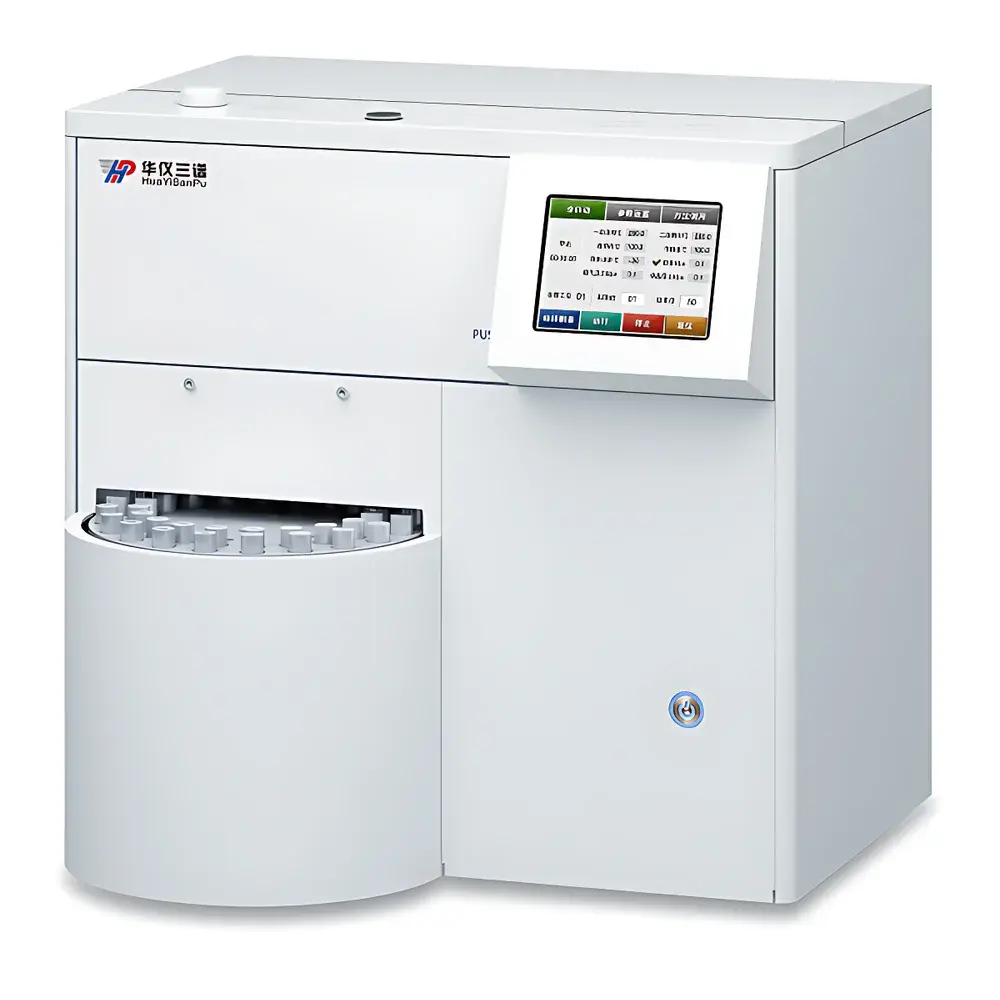
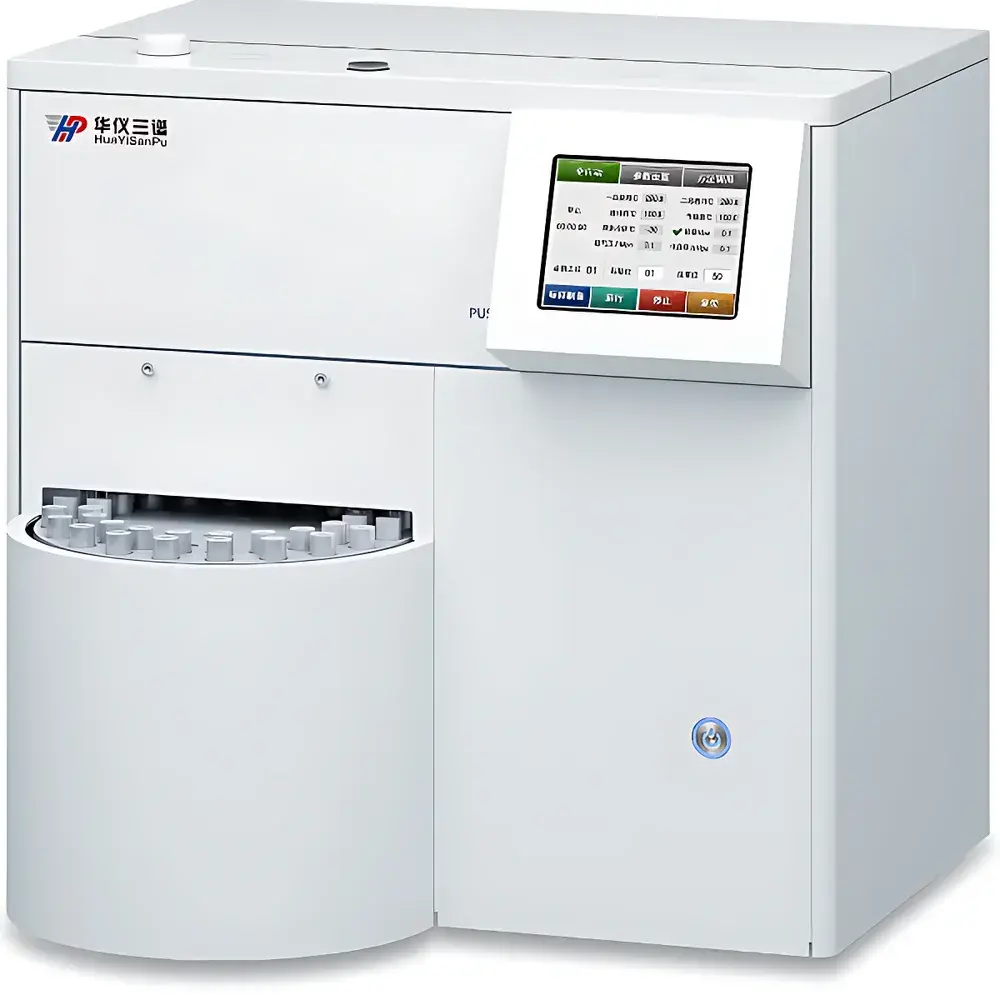
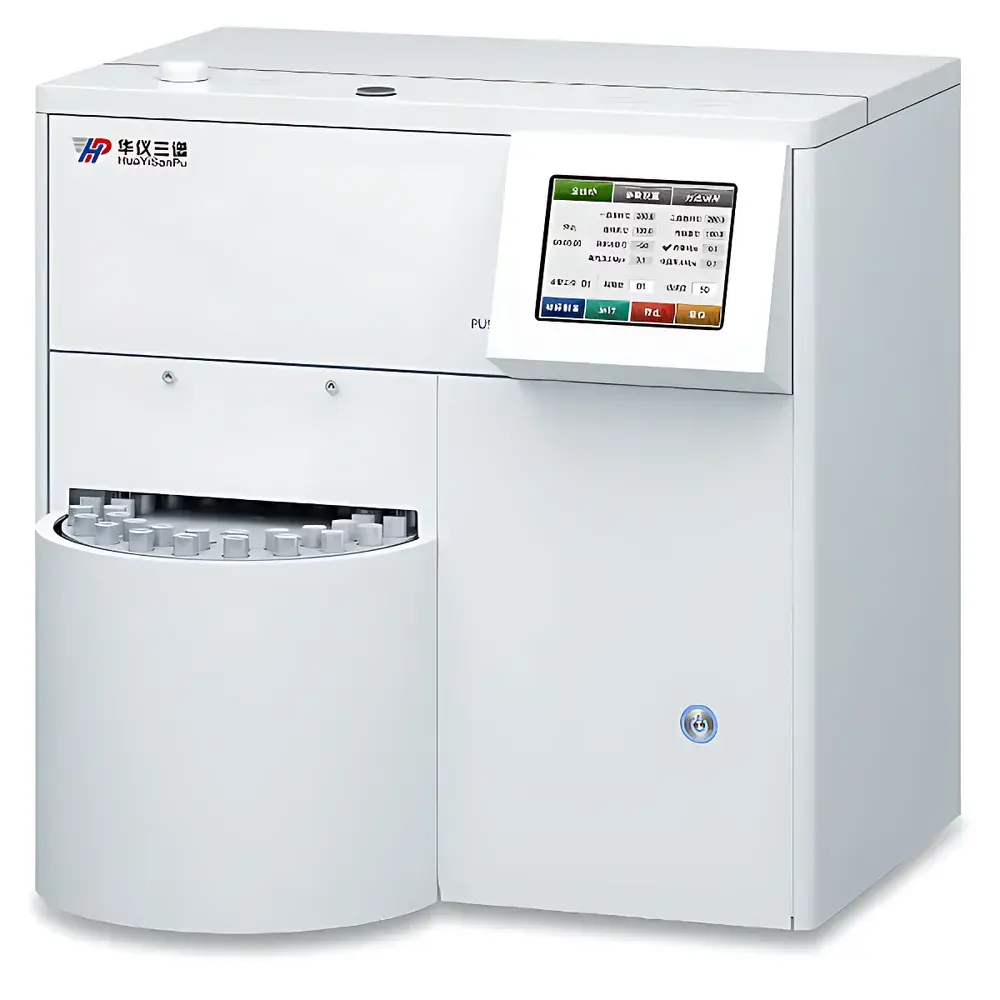
Huayisanpu ATDS-3440S-II Dual-Channel Automated Two-Stage Thermal Desorber
| Brand | Huayisanpu |
|---|---|
| Origin | Beijing, China |
| Model | ATDS-3440S-II |
| Automation Level | Fully Automated |
| Primary Desorption Temp Range | Ambient to 380°C (±0.5°C accuracy, 1°C increment) |
| Secondary Desorption Temp Range | Ambient to 380°C (±0.5°C accuracy, 1°C increment, >3000°C/min ramp rate) |
| Cold Trap Temp Range | Ambient to –40°C (±1°C accuracy, 1°C increment) |
| Valve & Transfer Line Temp Range | Ambient to 260°C (±1°C accuracy, 1°C increment) |
| Sample Capacity | 40 tubes |
| Desorption Recovery | >98% (toluene, 0.1 µL, 10:1 split) |
| Peak Width (FWHM) | <3 s |
| RSD | <2.5% (system-dependent, GC and operator performance included) |
| Power Consumption | <1000 VA |
| Dimensions (H×W×D) | 470 × 490 × 450 mm |
| Weight | ~40 kg |
Overview
The Huayisanpu ATDS-3440S-II is a fully automated, dual-channel two-stage thermal desorber engineered for high-throughput, quantitative analysis of volatile and semi-volatile organic compounds (VOCs and SVOCs) in environmental, occupational health, and industrial hygiene applications. It operates on the principle of sequential thermal desorption: first, analytes are thermally released from sorbent tubes under controlled inert gas flow (primary desorption); second, the evolved vapors are cryogenically focused onto a narrow cold trap (–40°C), then rapidly flash-heated (>3000°C/min) and transferred as a sharp, narrow band into the gas chromatograph (GC) inlet (secondary desorption). This two-stage architecture significantly enhances sensitivity, peak shape integrity, and method reproducibility—particularly critical for trace-level analysis per EPA Method TO-17, ISO 16017-1, and ASTM D6196. The instrument integrates precision temperature control across all thermally active zones—including primary furnace, secondary focus trap, multi-port valve, and transfer lines—to ensure consistent desorption kinetics and minimize carryover or degradation.
Key Features
- Dual-channel parallel operation enables uninterrupted sample processing: while one channel performs secondary desorption and GC injection, the other executes primary desorption and tube conditioning—maximizing instrument uptime and laboratory throughput.
- Independent, high-stability temperature control for primary desorption (ambient to 380°C, ±0.5°C), secondary cold trap (ambient to –40°C, ±1°C), valve manifold (ambient to 260°C), and transfer lines (ambient to 260°C), each with 1°C programmable resolution and real-time PID feedback.
- Programmable sample handling logic supports customizable tube activation (baking), backflush, purge, and carrier gas flow (0–100 mL/min, continuously adjustable with visual indication).
- 15 configurable external event outputs (TTL-compatible) allow precise synchronization with GC start signals, data system triggers, or auxiliary equipment (e.g., autosamplers, pressure controllers).
- Robust pneumatic architecture: stainless-steel and quartz-lined flow paths; pressure-rated components (>0.4 MPa); regulated drive air (<0.4 MPa, adjustable); leak-tight valving with <2 s signal response time.
- 40-position carousel accommodates standard 6 mm OD stainless steel, quartz, or fused silica sorbent tubes; optional trap configurations include stainless steel, quartz, and elastomeric capillary traps.
Sample Compatibility & Compliance
The ATDS-3440S-II is compatible with industry-standard sorbent tubes (e.g., Tenax TA, Carbopack B/C, Carboxen, graphitized carbon black) and supports method development per regulatory frameworks including U.S. EPA TO-11A (indoor air), TO-15 (ambient air), and TO-17 (workplace air), as well as ISO 16017-1 (indoor air VOCs) and EN 16705 (tobacco smoke analysis). All temperature zones meet GLP-relevant stability and calibration traceability requirements. The system’s hardware design supports 21 CFR Part 11–compliant software integration when paired with validated chromatography data systems (CDS), enabling audit trails, electronic signatures, and secure user access controls.
Software & Data Management
Instrument control and method sequencing are executed via a dedicated Windows-based application supporting full parameter logging, method saving/loading, and real-time status monitoring. Each run records complete thermal profiles, valve actuation timestamps, gas flow values, and external event triggers. Raw method files include metadata required for ISO/IEC 17025 documentation—such as operator ID, calibration dates, and version-controlled parameters. Export formats include CSV and XML for LIMS integration. Optional CDS drivers enable direct GC trigger handshaking and synchronized data acquisition without manual intervention.
Applications
- Environmental monitoring: quantification of benzene, toluene, ethylbenzene, xylenes (BTEX), polycyclic aromatic hydrocarbons (PAHs), and chlorinated solvents in ambient and indoor air samples.
- Occupational hygiene: compliance testing for OSHA Permissible Exposure Limits (PELs) and ACGIH Threshold Limit Values (TLVs®) using NIOSH and OSHA-certified sampling protocols.
- Material emission testing: VOC screening from building materials, automotive interiors, packaging, and consumer products per ASTM D5116 and ISO 16000 series standards.
- Forensic and failure analysis: detection of residual solvents in pharmaceutical excipients, polymer degradation products, or counterfeit product characterization.
FAQ
What is the maximum allowable desorption temperature for both stages?
The primary and secondary desorption furnaces are independently controllable from ambient to 380°C, with ±0.5°C accuracy and 1°C resolution.
Does the system support cold trap focusing with liquid nitrogen or mechanical cooling?
The ATDS-3440S-II employs a closed-cycle thermoelectric (Peltier) cooling system capable of reaching –40°C without cryogens, ensuring operational safety and long-term maintenance simplicity.
Can the instrument be integrated with third-party gas chromatographs?
Yes—standard TTL-level start/stop and ready/busy signals enable seamless interfacing with all major GC platforms (Agilent, Thermo Fisher, Shimadzu, PerkinElmer) via dry-contact or opto-isolated I/O.
Is method validation support available for ISO 17025 or GMP environments?
The system provides full temperature calibration logs, event-driven audit trails, and parameter versioning; final validation must be performed in situ per laboratory-specific SOPs and regulatory requirements.
What maintenance intervals are recommended for the pneumatic and thermal subsystems?
Valve manifold inspection and sorbent trap replacement are recommended every 500 runs or 6 months; temperature sensor verification should occur quarterly using NIST-traceable references.




