
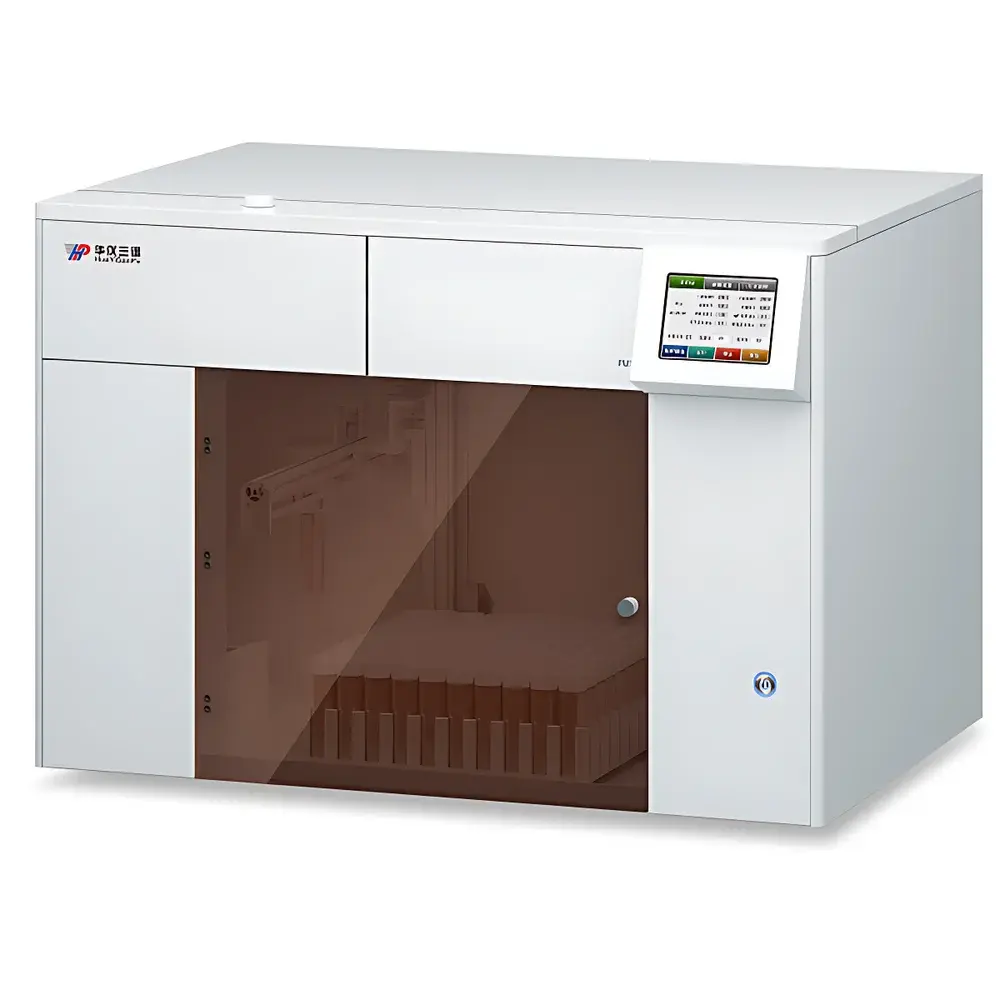
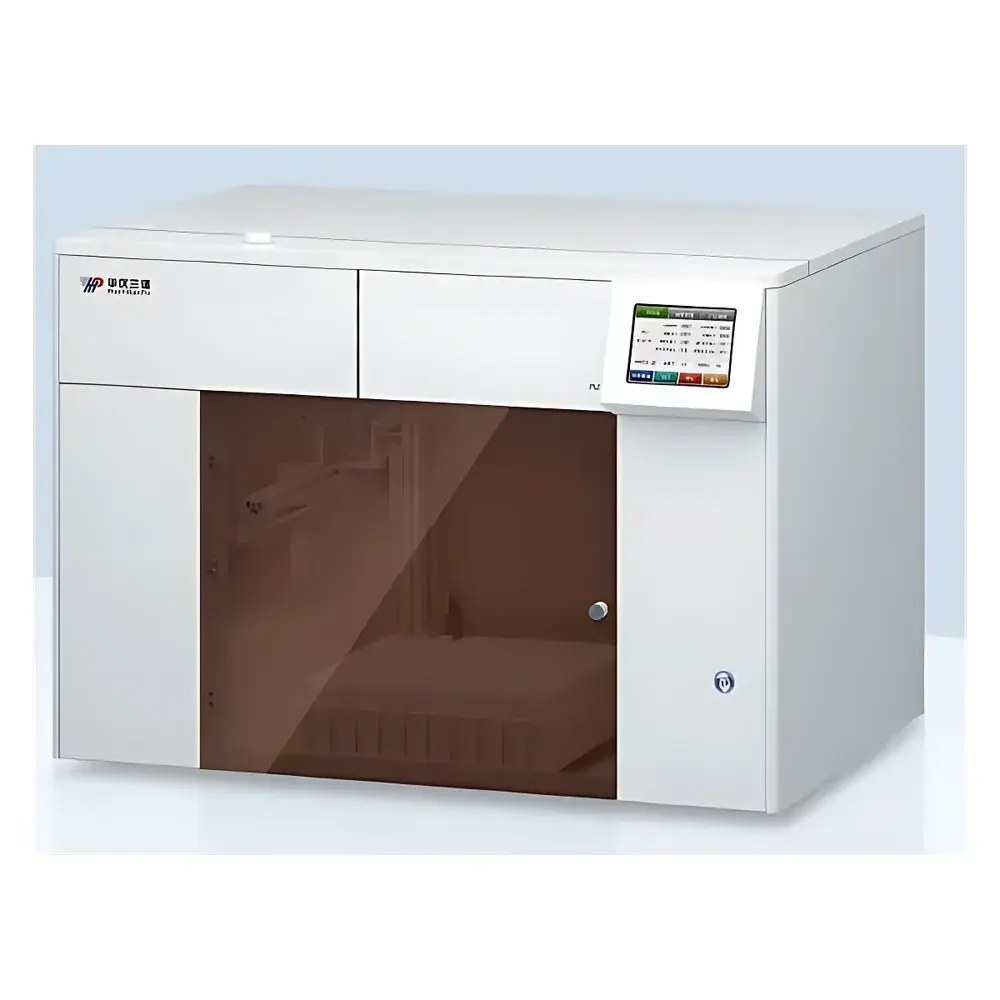
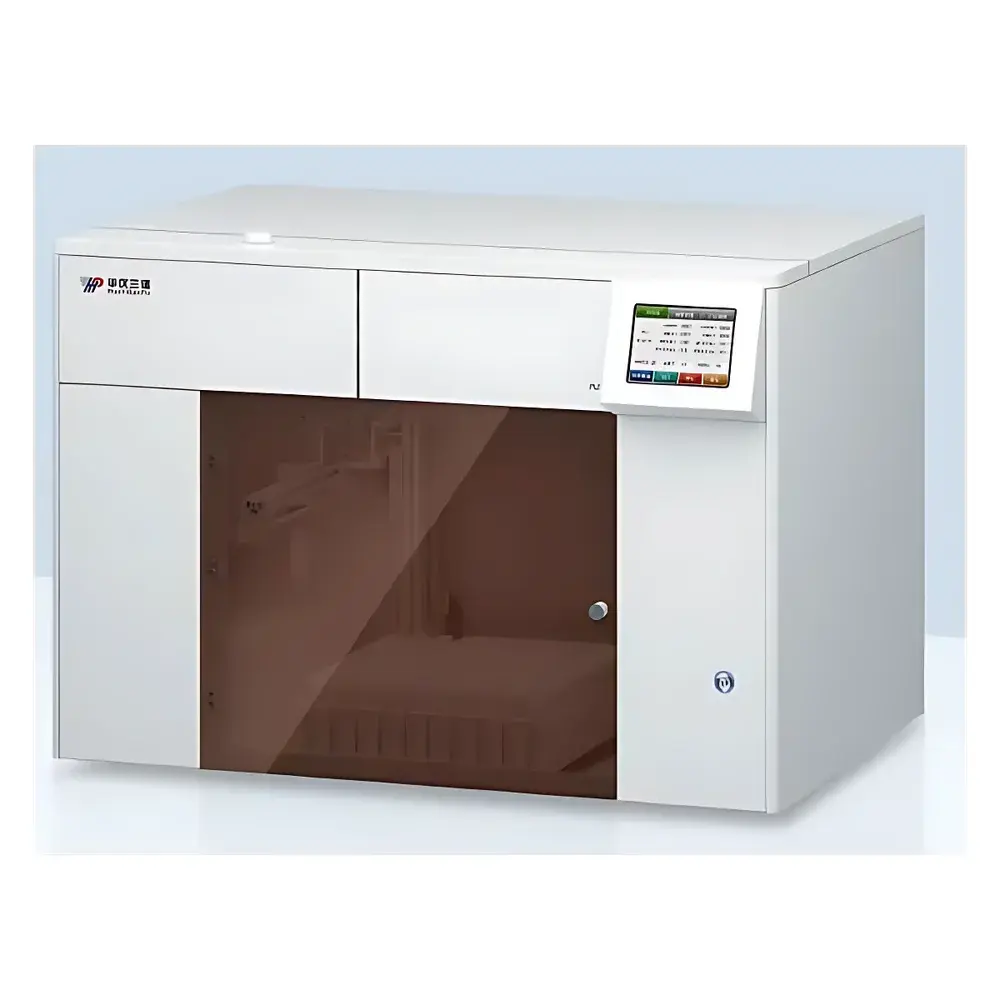
Huayisanpu PTC-100 Automated Purge and Trap Concentrator
| Brand | Huayisanpu |
|---|---|
| Origin | Beijing, China |
| Model | PTC-100 |
| Sample Capacity | 100-position carousel |
| Injection Precision | RSD < 2.5% (GC-dependent) |
| Trap Temperature Range | Ambient to 380 °C |
| Purge Heating Temperature | Ambient to 250 °C |
| Sample Chilling Temperature | 4–10 °C |
| Cold Trap Temperature | Ambient to −40 °C |
| Water Removal Trap Temperature | Ambient to −30 °C |
| Desorption Ramp Rate | >2000 °C/min (low-voltage controlled) |
| Purge Flow Control | 0–100 mL/min, adjustable with digital readout |
| Carrier Gas Pressure Regulation | 0–0.4 MPa |
| Programmable External Events | 15 independent time-controlled functions (0.1–99 min, timing accuracy <0.1%) |
| Sample Vial Format | Standard 40 mL vials |
| System Dimensions | 580 × 640 × 850 mm (H×W×D) |
| Weight | ~50 kg |
| Power Consumption | <1000 VA |
| Interlock Signal Latency | <2 s |
Overview
The Huayisanpu PTC-100 Automated Purge and Trap Concentrator is a modular, high-reliability sample introduction system engineered for trace-level volatile organic compound (VOC) analysis in environmental, regulatory, and research laboratories. It implements dynamic headspace enrichment via purge-and-trap methodology—where inert gas continuously sweeps VOCs from aqueous or solid-phase samples into a sorbent-packed trap, followed by rapid thermal desorption directly into the GC or GC/MS inlet. This technique delivers superior sensitivity (sub-ppt detection limits), minimal matrix interference, and compatibility with standardized methods including U.S. EPA Methods 501.1, 524.2, 601, 602, 603, and 624—making it suitable for compliance-driven water, soil, and wastewater testing under ISO 10301, ASTM D5059, and China’s HJ 639–2012 and HJ 686–2014 protocols.
Key Features
- 100-position automated carousel with programmable vial handling, enabling unattended batch processing of up to 100 samples per run
- Independent, high-stability temperature control across six critical zones: sample heating (ambient–250 °C, ±0.5 °C), cold trap (ambient–−40 °C, ±1 °C), water removal trap (ambient–−30 °C, ±1 °C), trap desorption (ambient–380 °C, ±0.5 °C), water removal trap activation (ambient–150 °C, ±1 °C), and transfer line (ambient–250 °C, ±1 °C)
- Fast, low-voltage thermal ramping: >2000 °C/min for trap desorption and >250 °C/min for water trap conditioning—ensuring sharp, reproducible peaks and reduced carryover
- Digitally regulated purge flow (0–100 mL/min) and carrier gas pressure (0–0.4 MPa), both with real-time feedback and user-defined step profiles
- Modular architecture supporting field-upgradable functionality—including optional static headspace mode, trap regeneration cycles, and customizable back-flush routines for sample loop and transfer lines
- 15 independently programmable external event outputs (0.1–99 min resolution, <0.1% timing error) for synchronization with GC oven ramps, detector triggers, or auxiliary lab equipment
- Robust pneumatic design: all gas paths rated >0.4 MPa; cylinder actuation pressure <0.4 MPa, fully adjustable for long-term valve longevity
Sample Compatibility & Compliance
The PTC-100 accepts standard 40 mL EPA-style vials and accommodates both liquid (aqueous, leachates, extracts) and solid-phase (soil, sediment, sludge) matrices following appropriate homogenization and spiking protocols. Its dual cold trap configuration enables selective water management—critical for high-moisture samples—while maintaining VOC integrity. The system supports multiple trap formats (stainless steel, quartz, fused silica capillary) and customizable sorbent packing (e.g., Tenax TA, Carbopack B/C, Carboxen 1000), allowing method optimization per analyte volatility and polarity. All thermal and flow parameters are logged with timestamps and retained for audit trails, aligning with GLP/GMP documentation requirements. While not pre-certified for 21 CFR Part 11, its deterministic event logging and parameter locking capability support validation under internal SOPs compliant with FDA, ISO/IEC 17025, and CNAS frameworks.
Software & Data Management
Controlled via a dedicated Windows-based interface with intuitive workflow wizards, the PTC-100 software enables full method development—including multi-step temperature ramps, flow modulation, trap bake-out sequences, and conditional logic for failure recovery (e.g., pressure fault retry). All method files are stored in encrypted XML format with version history. Instrument status, run logs, and calibration records export to CSV or PDF for LIMS integration. Audit trail functionality captures operator ID, timestamp, parameter changes, and execution outcomes—meeting minimum ALCOA+ data integrity criteria. Remote monitoring via Ethernet is supported; RS-232 and TTL trigger I/O ensure seamless GC synchronization.
Applications
- Regulatory environmental testing: VOCs in drinking water, groundwater, surface water, and wastewater per EPA and Chinese HJ standards
- Soil and sediment analysis for chlorinated solvents (e.g., TCE, PCE), BTEX, and fuel oxygenates
- Method development and validation studies requiring high reproducibility (RSD <2.5% across replicate runs)
- Academic research in environmental chemistry, geochemistry, and forensic toxicology where flexible trap chemistry and thermal programming are essential
- Multi-residue screening in food safety and pharmaceutical stability studies involving volatile impurities
FAQ
Can the PTC-100 operate in static headspace mode?
Yes—the system can be configured to perform static headspace analysis without purge gas flow, leveraging its precise vial heating and transfer line temperature control.
Is trap regeneration automated?
Yes—programmable trap bake-out cycles (including inert gas purging and high-temperature conditioning) are fully integrated and schedulable per run or at user-defined intervals.
What sorbent materials are compatible?
Standard configurations support Tenax TA, Carbopack series, Carboxen 1000, and custom-packed traps; quartz and stainless-steel trap bodies are interchangeable.
Does it support EPA Method 524.2 out-of-the-box?
The hardware and thermal specifications meet all technical requirements of EPA 524.2; final method validation requires user-specific optimization of purge time, desorption profile, and GC parameters.
How is data integrity ensured during long unattended runs?
All operational parameters, timestamps, and system events are written to non-volatile memory in real time; power-loss recovery resumes from last valid step upon reboot.
Related Products





