
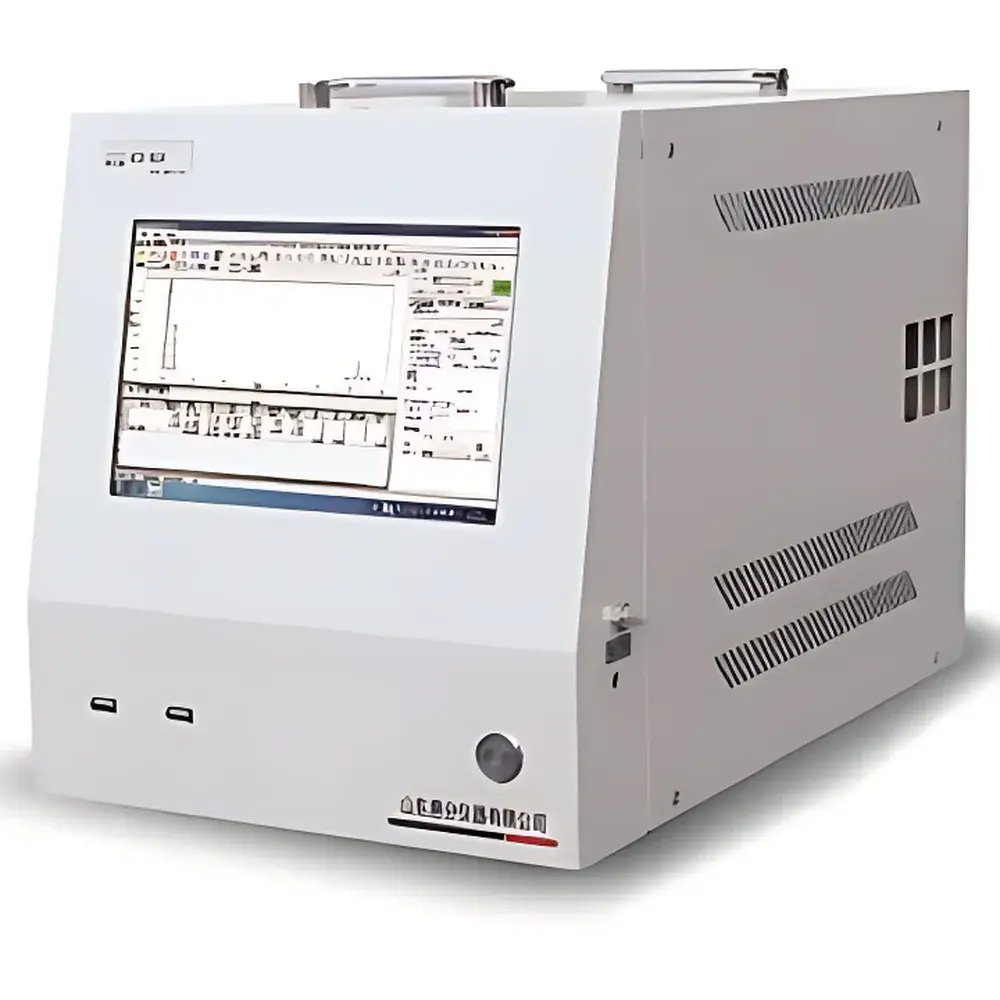
HUIFEN GCS-8A Portable Trace Sulfur Analyzer
| Brand | HUIFEN |
|---|---|
| Origin | Shandong, China |
| Model | GCS-8A |
| Detector Type | Flame Photometric Detector (FPD) |
| Detection Range | 100 ppb – 0.1% (S) |
| Accuracy | ±5% for major components, ±10% for trace sulfur |
| Power Supply | DC 24 V lithium battery |
| Operating Temperature | 5–45 °C |
| Operating Humidity | 5–95% RH |
| Power Consumption | 500 W |
| Dimensions | 390 × 230 × 310 mm |
| Net Weight | ≤12 kg |
| Carrier Gas | Hydrogen (solid-state storage), Nitrogen (with rapid-fill cylinder interface) |
| Flow Control | Electronic Pressure Control (EPC) |
| Data Output | Integrated thermal printer |
Overview
The HUIFEN GCS-8A Portable Trace Sulfur Analyzer is a field-deployable gas chromatographic system engineered for quantitative determination of sulfur-containing compounds—particularly hydrogen sulfide (H₂S), mercaptans, sulfides, and thiophenes—in natural gas, refinery gas streams, biogas, and liquefied petroleum gas (LPG). It employs gas chromatography coupled with a flame photometric detector (FPD), a highly selective detection method based on the characteristic blue-green luminescence emitted by excited sulfur dioxide (SO₂) radicals formed during combustion in a hydrogen-rich flame. Unlike generic GC systems, the GCS-8A integrates chromatographic separation, precise gas flow regulation, thermal stabilization, and real-time quantification into a single ruggedized platform optimized for on-site operation without laboratory infrastructure. Its design prioritizes operational autonomy, environmental resilience, and regulatory traceability—making it suitable for routine QC at pipeline custody transfer points, flare gas monitoring, sour gas screening, and compliance verification against ISO 8573-5, ASTM D6229, and GB/T 11060.4.
Key Features
- Integrated solid-state hydrogen generator: Eliminates high-pressure gas cylinders; provides stable, ultra-pure H₂ fuel for FPD with >12 hours of continuous operation under typical sampling conditions.
- DC 24 V lithium-ion battery pack with pre-heating capability: Enables cold-start readiness—column oven and detector can reach operating temperature prior to sample introduction, reducing total analysis cycle time by up to 40% compared to conventional portable GCs.
- Electronic Pressure Control (EPC) system: Delivers sub-mbar precision in carrier (N₂) and fuel (H₂) gas flow management, ensuring retention time stability (<0.05 min RSD) and peak area reproducibility (<3% RSD) across varying ambient conditions.
- Ruggedized mechanical architecture: Aluminum alloy chassis with shock-absorbing mounts, IP54-rated enclosure, and reinforced column compartment—certified for transport and operation on mobile platforms including service vehicles and offshore modules.
- Onboard thermal printer: Generates audit-ready hardcopy reports with date/time stamp, sample ID, calibration status, peak integration parameters, and quantitative results—fully compliant with GLP documentation requirements.
- Rapid nitrogen cylinder interface: Patented quick-connect fitting enables safe, tool-free refilling of N₂ supply within 90 seconds; integrated pressure relief and check-valve protection meet PED 2014/68/EU safety directives.
Sample Compatibility & Compliance
The GCS-8A accepts gaseous samples directly via stainless-steel sampling valve (standard 10-port configuration) or through optional heated gas-tight syringe injection. It supports sample matrices containing up to 5% CO₂, 10% moisture (with integrated Nafion dryer option), and total hydrocarbon concentrations ≤30% v/v without column overload or detector saturation. All wetted parts are electropolished 316L stainless steel or fused silica-lined, minimizing sulfur adsorption and memory effects. The system conforms to IEC 61000-6-2 (immunity) and IEC 61000-6-3 (emissions); its FPD response linearity (R² ≥ 0.999 over 100 ppb–100 ppm) satisfies US EPA Method 1664B sulfur reporting criteria. Full electronic records—including method files, raw chromatograms, calibration curves, and operator logs—are timestamped and exportable in .cdf (NetCDF) format for FDA 21 CFR Part 11-compliant data integrity workflows.
Software & Data Management
The embedded firmware (v3.2.1) features a touchscreen GUI with multilingual support (English, Spanish, Arabic, Chinese), intuitive method setup wizard, and real-time chromatogram display with baseline correction and automatic peak detection. Quantitative analysis uses internal standard or external calibration modes with quadratic curve fitting. All data—including audit trail entries for method edits, calibration updates, and user logins—is stored locally on encrypted microSD card (16 GB included) with SHA-256 hashing. USB-C port enables direct transfer to LIMS or ELN systems; optional cloud sync module (HUIFEN CloudLink™) provides TLS 1.3-secured remote diagnostics and firmware OTA updates. Software validation documentation (IQ/OQ protocols) is available upon request for GMP-regulated environments.
Applications
- Custody transfer sulfur monitoring per ISO 14111 and GPA 2261 specifications
- Refinery fuel gas desulfurization unit performance verification
- Biogas upgrading facility H₂S slip detection before membrane separation
- Offshore platform flare stack emissions compliance (IMO MARPOL Annex VI)
- Landfill gas quality control prior to CHP engine feeding
- EPA Title V permit reporting for sulfur compound emissions
FAQ
What carrier gases does the GCS-8A require, and how are they supplied?
Nitrogen (for carrier) and hydrogen (for FPD fuel) are required. Nitrogen is supplied from a standard industrial cylinder with rapid-fill interface; hydrogen is generated on-demand from solid-state metal hydride cartridges—no high-pressure H₂ cylinders needed.
Can the instrument be calibrated using certified gas standards?
Yes. It supports multi-point external calibration using NIST-traceable sulfur gas standards (e.g., H₂S in N₂, SO₂ in air) across its full dynamic range. Calibration verification checks are programmable at user-defined intervals.
Is the system compatible with hazardous area classifications?
The base unit is rated for Zone 2 / Class I Div 2 environments. Optional ATEX-certified version (GCS-8A-ATEX) with intrinsic safety barriers is available for installation in classified locations.
How is data integrity ensured for regulated applications?
All analytical events are logged with immutable timestamps, user IDs, and digital signatures. Audit trail review mode allows full reconstruction of any result—including intermediate calculations and integration parameter changes—meeting ALCOA+ principles for pharmaceutical and energy sector audits.




