
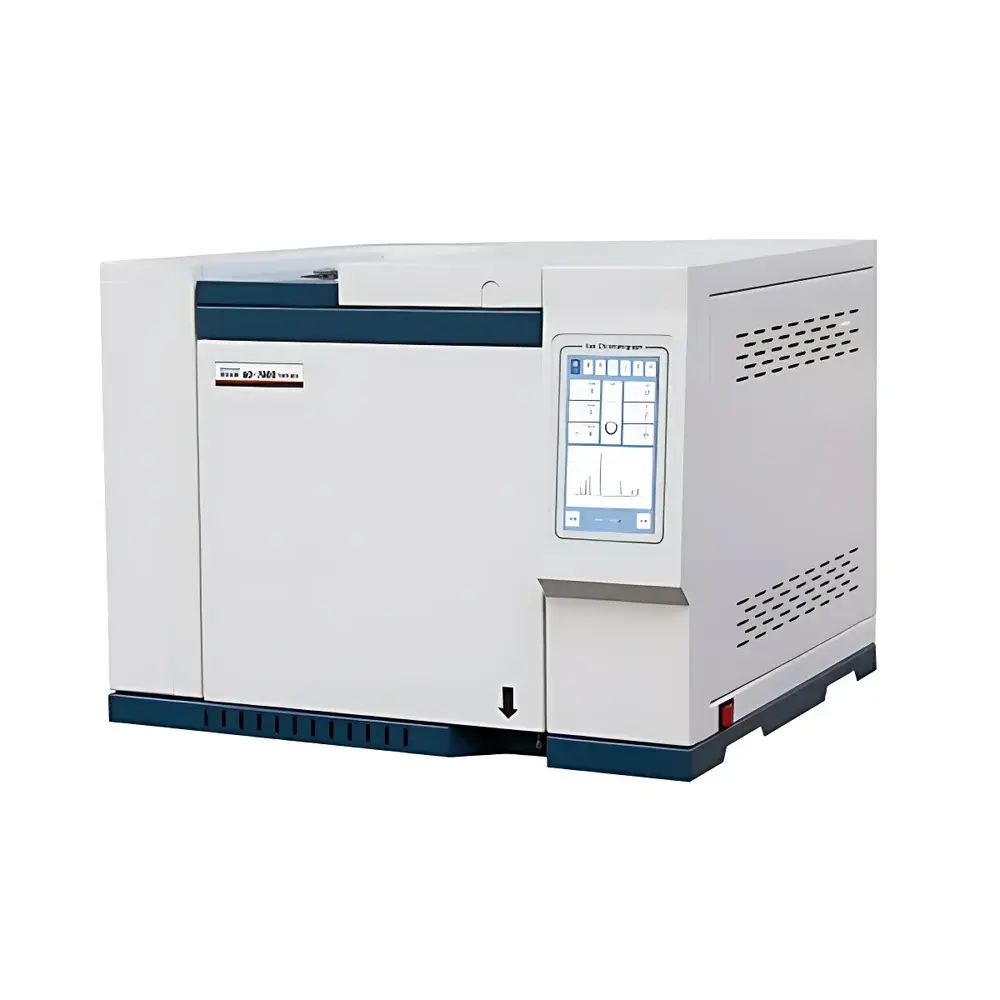
Huifen Instruments GC-7820A Laboratory Gas Chromatograph
| Brand | Huifen Instruments |
|---|---|
| Origin | Shandong, China |
| Model | GC-7820A |
| Oven Temperature Range | Ambient +5 °C to 450 °C |
| Max. Ramp Rate | 0.1–80 °C/min |
| Cooling Rate | 350 °C → 50 °C in <5 min |
| Carrier Gas Flow Range & Control | 0–1200 mL/min |
| Carrier Gas Pressure Range & Control | 0–0.6 MPa |
| Injector Max. Temp. | 450 °C |
| Injector Pressure Setting Range | 0–0.6 MPa |
| Injector Total Flow Setting Range | 0–1200 mL/min |
| Independent Temperature Zones | 8 |
| Programmed Temperature Steps | 16 (expandable) |
| Max. Run Time | 999.99 min |
| Detector Compatibility | FID, TCD, ECD, FPD, NPD, PDHID, PED |
| FID Detection Limit | ≤3.0×10⁻¹² g/s (n-hexadecane) |
| TCD Sensitivity | ≥10,000 mV·mL/mg (benzene/toluene) |
| FPD Detection Limits | S ≤2×10⁻¹¹ g/s, P ≤1×10⁻¹² g/s (methyl parathion) |
| ECD Detection Limit | ≤1.0×10⁻¹⁴ g/mL (γ-HCH) |
| NPD Detection Limits | N ≤1.0×10⁻¹² g/s (azobenzene), P ≤1.0×10⁻¹² g/s (malathion) |
Overview
The Huifen Instruments GC-7820A is a high-performance, modular laboratory gas chromatograph engineered for precision separation and quantitative analysis of volatile and semi-volatile organic compounds. Based on classical capillary and packed-column gas chromatography principles, it employs temperature-programmed elution, carrier gas flow/pressure regulation, and selective detector response to deliver reproducible retention times and peak integrations across diverse sample matrices. Its architecture supports both routine QC testing and method development workflows in academic research laboratories, petrochemical quality control, environmental monitoring (e.g., VOCs, pesticides, hydrocarbons), and food safety screening. The system complies with foundational chromatographic performance criteria defined in ASTM D3606, ISO 10301, and USP , and its operational traceability aligns with GLP and GMP documentation requirements when integrated with compliant data management practices.
Key Features
- Eight independently controlled temperature zones — including column oven, up to three injectors, and up to four detector compartments — each with ±0.1 °C setpoint resolution and automatic overtemperature protection.
- Intelligent dual-airflow oven design with programmable rear door actuation enables rapid cooling (<5 min from 350 °C to 50 °C) and stable near-ambient operation (down to ambient +5 °C), critical for early-eluting compound resolution and method robustness.
- Modular detector architecture — FID, TCD, ECD, FPD, NPD, PDHID, and PED modules are hot-swappable via standardized electrical and pneumatic interfaces, supporting simultaneous multi-detector configurations without hardware reconfiguration.
- Advanced logarithmic amplification circuitry — dynamically adjusts gain across signal magnitudes to maintain linearity over seven orders of magnitude (FID), eliminating saturation artifacts and enabling accurate quantitation of trace analytes alongside major components.
- Full inert flow path — all internal stainless-steel tubing and detector chambers undergo electropolishing and silanization to minimize active sites, ensuring compatibility with labile compounds (e.g., organophosphates, amines) and reducing carryover and adsorption effects.
- Multi-mode injection system — supports split/splitless capillary injection (with septum purge), packed-column injection, gas-tight syringe liquid injection, and automated valve-based sampling; optional integration with third-party autosamplers (e.g., CTC PAL, Gerstel MPS) via TTL/RS-232 protocols.
Sample Compatibility & Compliance
The GC-7820A accommodates a broad range of sample types — including aqueous extracts, solvent-diluted oils, headspace vials, thermal desorption tubes, and gaseous standards — when paired with appropriate inlet liners, columns, and detector selection. Its injector pressure and flow control (0–0.6 MPa / 0–1200 mL/min) ensures compatibility with narrow-bore (0.1 mm ID), wide-bore (0.53 mm ID), and packed columns. Regulatory readiness is supported through configurable audit trails, user-access controls, and electronic signature capability when used with validated chromatography data systems (CDS). While the instrument itself does not include built-in 21 CFR Part 11 compliance, its communication protocols (Ethernet, RS-232) and event logging structure facilitate integration into validated CDS environments meeting FDA, EMA, and MHRA expectations for analytical instrument qualification (AIQ).
Software & Data Management
The GC-7820A operates via an embedded 7-inch industrial color touchscreen running dual-language firmware (English/Chinese), enabling local method setup, real-time chromatogram visualization, and basic peak integration. All acquisition parameters — temperature ramps, valve sequences, detector settings, and calibration tables — are stored in non-volatile memory with timestamped versioning. Raw data files (.DAT or .CSV) export directly to USB storage or network shares for post-run processing in third-party software (e.g., OpenChrom, Chromeleon, Empower). For enterprise deployment, the system supports remote monitoring and control via TCP/IP, allowing centralized fleet management and alignment with LIMS interfaces using ASTM E1384 or HL7-compliant adapters.
Applications
- Environmental analysis: BTEX, PAHs, chlorinated solvents, and pesticide residues per EPA Methods 8021B, 8270, and 508.1.
- Petrochemical QA/QC: Hydrocarbon type analysis (PIONA), gasoline oxygenates (MTBE, ETBE), and refinery gas composition (ASTM D1945, D1946).
- Pharmaceutical impurity profiling: Residual solvents (ICH Q3C), genotoxic impurities, and extractables/leachables screening.
- Food & flavor chemistry: Fatty acid methyl esters (FAMEs), terpenes, aldehydes, and off-flavor compounds in beverages and dairy products.
- Academic teaching labs: Method development exercises, retention index determination, and detector selectivity comparisons (e.g., FID vs. ECD for halogenated compounds).
FAQ
Is the GC-7820A compatible with third-party chromatography data systems (CDS)?
Yes — it provides standard RS-232 and Ethernet interfaces with ASCII-based command protocols, enabling bidirectional communication with commercial CDS platforms for method download, run initiation, and raw data retrieval.
What is the maximum number of detectors that can operate simultaneously?
The system supports up to four physically installed detectors; however, only two may be actively acquiring data during a single run due to signal bus bandwidth limitations. Detector switching is software-controlled and fully automated.
Does the instrument include validation documentation (IQ/OQ/PQ protocols)?
No — as a general-purpose laboratory instrument, the GC-7820A ships without pre-executed qualification documents. However, comprehensive technical specifications, factory calibration reports, and test certificates are provided to support user-led qualification under ISO/IEC 17025 or internal SOP frameworks.
Can the column oven accommodate 100 m capillary columns?
Yes — the large-volume oven (≥12 L internal capacity) and optimized airflow design allow stable temperature control for extended-length capillary columns without thermal gradient distortion or retention time drift.
Is hydrogen gas safe to use with the FID on this system?
Hydrogen is permitted as a fuel gas for the FID; however, users must implement site-specific safety measures including leak detection, ventilation verification, and flame-out monitoring per NFPA 55 and local fire codes. The instrument includes automatic flame re-ignition and hydrogen sensor interlock options (optional accessory).





