
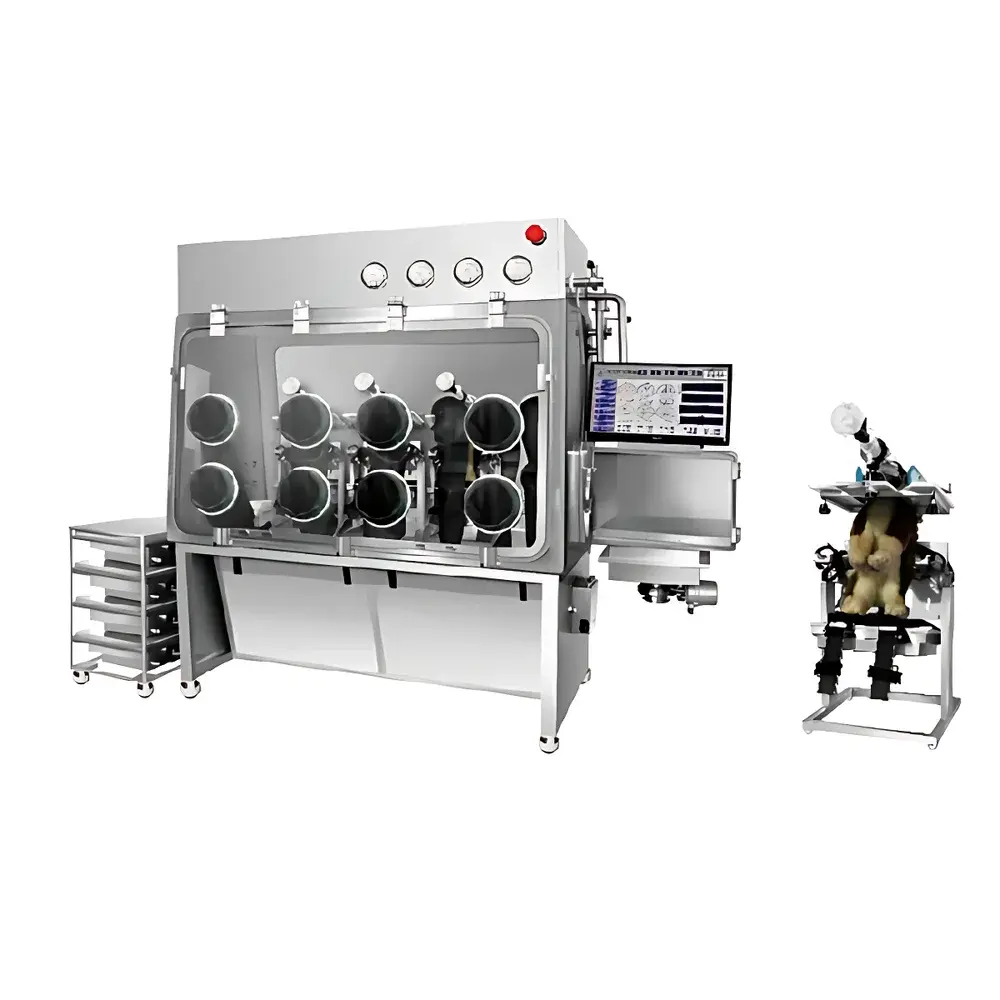
Huiron HRH-BLNE9103 Biosafety-Compliant Nose-Only Inhalation Exposure System for Non-Human Primates
| Brand | Huiron |
|---|---|
| Model | HRH-BLNE9103 |
| Origin | Beijing, China |
| Application Scope | ABSL-3 / ABSL-4 Laboratories |
| Capacity | Simultaneous exposure of up to 3 non-human primates (3–6 kg) |
| Safety Certification | Compliant with OECD TG 412, GB/T 27825–2011, and national chemical/pesticide inhalation toxicity testing guidelines |
| Filtration | H14 HEPA exhaust filter with in-situ leak test & decontamination capability |
| Cabinet Integrity | ≥−120 Pa internal negative pressure |
| Control System | GLP-compliant software with audit trail, real-time parameter logging (O₂, CO₂, T, RH, differential pressure), and safety interlock logic |
Overview
The Huiron HRH-BLNE9103 is a fully integrated, biosafety-engineered nose-only inhalation exposure system designed exclusively for non-human primate (NHP) studies conducted under high-containment conditions—specifically in ABSL-3 and ABSL-4 laboratories. It operates on the principle of controlled aerosol generation and precisely regulated respiratory delivery via individualized oronasal masks, enabling quantitative, reproducible, and ethically compliant inhalation dosing. Unlike whole-body chambers, this system eliminates dermal and gastrointestinal confounding routes by restricting exposure to the respiratory tract only—critical for modeling human inhalation pathogenesis, vaccine immunogenicity, and inhaled therapeutics (e.g., biologics, nanocarriers, or dry powder formulations). The system integrates aerosol generation, real-time environmental monitoring, biological containment, waste capture, and GLP-aligned data governance into a single validated architecture—meeting the stringent physical and procedural requirements of high-biocontainment research infrastructure.
Key Features
- Simultaneous exposure of three NHPs (3–6 kg) with independent, calibrated mask interfaces ensuring dose fidelity and minimizing inter-animal variability.
- Compact, fully welded stainless-steel Class III biological safety cabinet with radiused corners, dual-side access, and validated −120 Pa internal negative pressure—designed for seamless integration with NHP restraint ergonomics and operator workflow.
- Integrated aerosol generation module featuring semi-transparent reservoirs for real-time visual verification of liquid level and nebulization status; supports mid-experiment replenishment without system shutdown.
- H14-grade HEPA exhaust filtration with in-situ integrity testing (DOP/PAO challenge) and vapor-phase hydrogen peroxide (VHP) decontamination compatibility—ensuring biosafety compliance for BSL-3/4 agents including filoviruses, henipaviruses, and highly pathogenic influenza strains.
- Multi-parameter environmental monitoring: continuous logging of O₂, CO₂, temperature, relative humidity, cabinet static pressure, and HEPA delta-P—with configurable alarm thresholds and automatic safety shutdown protocols.
- Primate-specific restraint chair with PTFE-coated seating surfaces, adjustable backrest angle (15°–30°), and removable waste collection tray—optimized for physiological stability, stress reduction, and post-exposure sample recovery.
- Hardware-enforced safety interlocks: cabinet door–mask–aerosol generator–exhaust fan coordination; automated pre-operational self-test sequence verifying pressure differentials, sensor functionality, and filter integrity.
Sample Compatibility & Compliance
The HRH-BLNE9103 accommodates a broad spectrum of test atmospheres—including liquid nebulates (saline, surfactant suspensions), dry powder aerosols (via fluidized bed or rotating drum generators), and bioaerosols (bacterial spores, viral particles, fungal conidia). Aerosol size distribution is tunable within the respirable range (1–5 µm MMAD) using calibrated impactors and cascade samplers integrated into the exhaust train. The system conforms to OECD Test Guideline 412 (Subacute Inhalation Toxicity), Chinese national standards GB/T 27825–2011 and GBZ/T 229.2–2010, as well as EPA OPPTS 870.1300 and ISO 10993-12 for biocompatibility assessment of inhaled medical products. All control firmware and data acquisition modules are developed and validated in accordance with FDA 21 CFR Part 11 requirements for electronic records and signatures—supporting full audit trails, user-level permissions, and immutable data archiving.
Software & Data Management
The embedded control software provides a Windows-based HMI with intuitive configuration wizards for exposure protocol definition (duration, flow rate, target concentration, ramp profiles). All sensor inputs—including gas analyzers, pressure transducers, and humidity sensors—are sampled at ≥2 Hz and time-stamped to microsecond precision. Raw data streams are stored locally in encrypted SQLite databases with optional networked backup to institutional LIMS or ELN platforms. The software implements ALCOA+ principles: Attributable, Legible, Contemporaneous, Original, Accurate, Complete, Consistent, Enduring, and Available. Audit trail logs capture every parameter change, user login/logout, alarm event, and system state transition—fully traceable for regulatory inspection (e.g., FDA, NMPA, EMA preclinical audits).
Applications
- Inhalation infection modeling: SARS-CoV-2, MERS-CoV, Nipah virus, and Mycobacterium tuberculosis aerosol challenge in cynomolgus or rhesus macaques.
- Inhaled vaccine development: Adenoviral vector, mRNA-LNP, or protein subunit vaccine immunogenicity and mucosal immunity assessment.
- Toxicokinetic and biodistribution studies of inhaled nanotherapeutics, monoclonal antibodies, or siRNA conjugates.
- Regulatory safety assessment of industrial nanoparticles, agrochemical sprays, or combustion-derived PM2.5 under GLP conditions.
- Pharmacodynamic evaluation of bronchodilators, anti-fibrotics, or CFTR modulators in NHP models of chronic lung disease.
FAQ
What biosafety levels is the HRH-BLNE9103 certified for?
The system is engineered and validated for routine operation in ABSL-3 and ABSL-4 laboratories, with full containment verified per WHO Laboratory Biosafety Manual (4th ed.) and CDC/NIH Biosafety in Microbiological and Biomedical Laboratories (BMBL, 6th ed.).
Can the system be used for both viral and bacterial aerosol exposures?
Yes—its H14 exhaust filtration, vapor-phase decontamination compatibility, and sealed aerosol pathway support high-consequence pathogens across risk groups 3 and 4, provided facility-level engineering controls (e.g., dedicated air handling, effluent treatment) are in place.
Is third-party validation documentation available for regulatory submissions?
Huiron provides IQ/OQ/PQ protocols, calibration certificates for all critical sensors (traceable to NIST standards), and a comprehensive system validation report aligned with ICH M3(R2) and FDA Guidance for Industry on Inhalation Toxicology Studies.
How is dose uniformity across animals ensured?
Each mask interface features independent mass flow control and real-time pressure feedback; aerosol concentration is continuously monitored upstream of each mask using optical particle sizers and gravimetric samplers—enabling closed-loop adjustment to maintain ±5% CV across subjects.
Does the software support 21 CFR Part 11 compliance for FDA submissions?
Yes—the control application includes role-based authentication, electronic signatures, audit trail export (CSV/XML), and data immutability safeguards—fully documented in the vendor’s Part 11 Readiness Package.




