
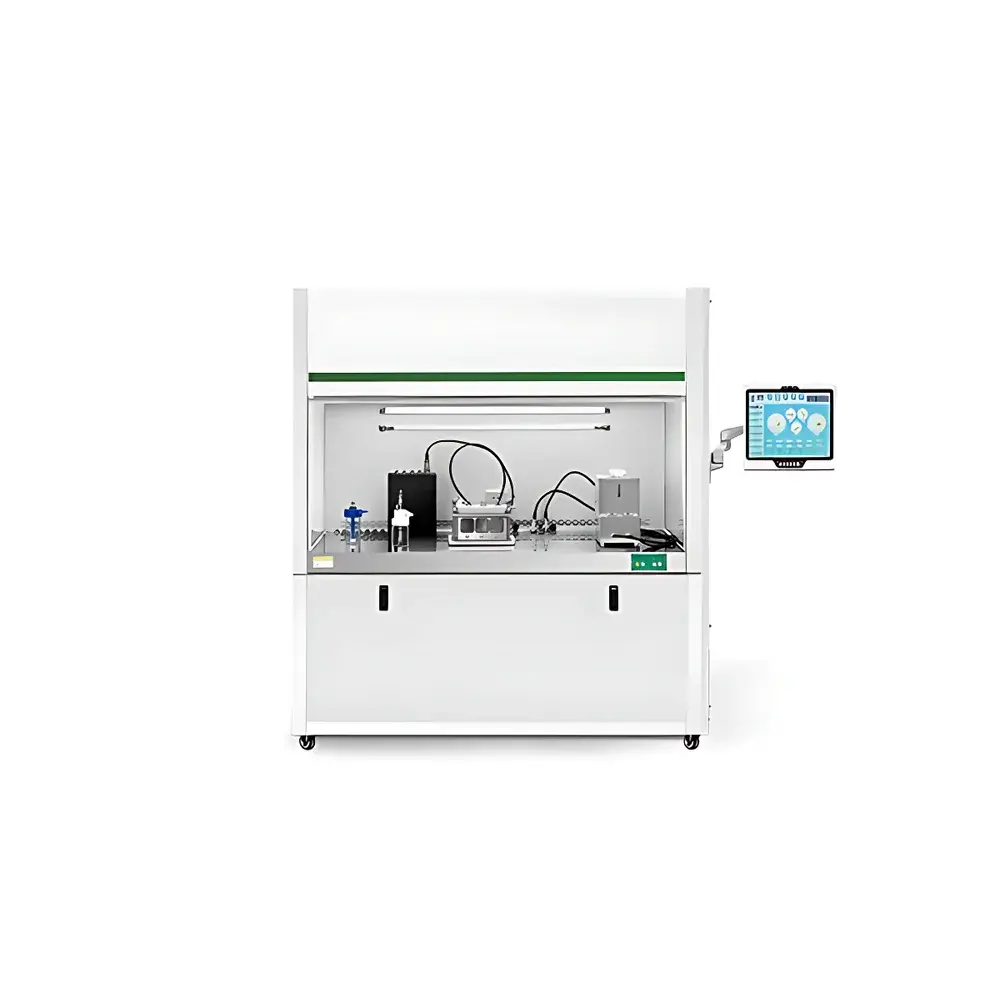
Huiron HRH-CES1314 / HRH-CES1332 Single-Concentration In Vitro Cell Exposure System for Air-Liquid Interface (ALI) Studies
| Brand | Huiron |
|---|---|
| Origin | Beijing, China |
| Model | HRH-CES1314 / HRH-CES1332 |
| Exposure Flow per Well | 5–20 mL/min |
| Flow Control Accuracy | ±1% F.S. |
| Aerosol Concentration Monitoring | Real-time in-line |
| Temperature Control Precision (Water Bath) | ±0.3 °C |
| Compatible Inserts | 6-well and 12-well Transwell® culture inserts |
| QCM Integration | Yes |
| Enclosure Options | Laminar Flow Hood or Class II Biological Safety Cabinet |
| Compliance | OECD TG 403, 412, 413, 436 |
Overview
The Huiron HRH-CES1314 and HRH-CES1332 Single-Concentration In Vitro Cell Exposure Systems are engineered for reproducible, physiologically relevant assessment of airborne substances under air-liquid interface (ALI) conditions. These systems implement a controlled aerosol delivery architecture that enables direct exposure of differentiated human respiratory epithelial cells—cultured on porous membrane inserts—to well-characterized test atmospheres without liquid submersion. Unlike submerged exposure models, ALI-based protocols preserve cellular polarity, ciliary function, mucus secretion, and barrier integrity, thereby enhancing translational relevance for inhalation toxicology, nanomaterial safety evaluation, and pharmaceutical aerosol research. The system maintains strict separation between the apical (air-exposed) and basolateral (nutrient-supplied) compartments while enabling simultaneous multi-well exposure under identical aerosol concentration and flow dynamics—critical for statistical power and inter-sample comparability.
Key Features
- Air-liquid interface (ALI) exposure configuration compliant with OECD inhalation test guidelines for in vitro applications
- Precise, independent flow control per exposure well (5–20 mL/min), with accuracy maintained at ±1% full scale across operational range
- Real-time, in-line aerosol concentration monitoring via integrated optical or gravimetric sensors (configurable)
- Thermally stabilized exposure chamber with water-jacketed temperature regulation (±0.3 °C), ensuring consistent cell viability during extended exposures
- Modular compatibility with standard 6-well and 12-well Transwell® inserts—enabling seamless integration into existing ALI differentiation workflows
- Optional quartz crystal microbalance (QCM) coupling for real-time deposition mass quantification on cell surfaces
- Flexible environmental enclosure support: integrates with ISO Class 5 laminar flow hoods or Class II biological safety cabinets to maintain sterility and operator protection
- Static or dynamic basolateral medium perfusion modes—supporting both conventional static feeding and advanced microfluidic nutrient exchange
Sample Compatibility & Compliance
The HRH-CES platforms accommodate a broad spectrum of test agents including combustion-derived particulates (e.g., diesel exhaust, tobacco smoke condensate), engineered nanomaterials (metal oxides, carbon nanotubes), volatile organic compounds (VOCs), pesticides, microbial bioaerosols, and therapeutic aerosols. All configurations adhere to the experimental design principles outlined in OECD Test Guidelines 403 (acute inhalation toxicity), 436 (acute toxicity stepwise approach), 412 (28-day subacute), and 413 (90-day subchronic), facilitating regulatory submission-ready data generation. System operation supports Good Laboratory Practice (GLP) documentation requirements, including audit trails for flow calibration, temperature logs, and exposure duration records. While not certified as medical devices, the hardware architecture is compatible with ISO 17025-accredited laboratory environments and aligns with FDA-recommended practices for nonclinical inhalation study design.
Software & Data Management
Exposure parameters—including individual well flow rates, chamber temperature, cumulative exposure time, and optional aerosol sensor outputs—are logged at user-defined intervals (1–60 s) via embedded microcontroller firmware. Raw data export is supported in CSV and HDF5 formats for downstream analysis in MATLAB, Python (Pandas/NumPy), or commercial statistical packages. Calibration files for flow controllers and thermal sensors are digitally signed and version-controlled, satisfying traceability requirements under GLP Annex 1 and OECD Principles of Good Laboratory Practice. Optional software modules provide automated exposure protocol sequencing, alarm thresholds for parameter deviation, and integrated reporting templates aligned with OECD summary report structures.
Applications
- Inhalation toxicology studies addressing COPD, idiopathic pulmonary fibrosis, and lung cancer pathogenesis using primary human bronchial/tracheal epithelial cells or immortalized models (e.g., Calu-3, BEAS-2B)
- Nanomaterial biosafety assessment per ISO/IEC 19005 and OECD GD 317, including dose-metric correlation (mass, surface area, particle number)
- Environmental health research on ambient PM2.5/PM10, wildfire smoke, agricultural pesticide drift, and indoor VOC mixtures
- Preclinical evaluation of inhaled therapeutics—including dry powder formulations, nebulized biologics, and mRNA-lipid nanoparticle aerosols
- Regulatory testing for REACH, TSCA, and Biocidal Products Regulation (BPR) dossiers requiring in vitro inhalation endpoints
- Method development for next-generation ALI co-culture systems (e.g., epithelium-immune cell or epithelium-fibroblast interfaces)
FAQ
What cell types are validated for use with the HRH-CES systems?
Primary human airway epithelial cells (NHBE), Calu-3, A549, and BEAS-2B have been experimentally verified; differentiation protocols must achieve transepithelial electrical resistance (TEER) ≥300 Ω·cm² prior to exposure.
Can the system be used for gas-phase exposures without particulates?
Yes—vapor-phase compounds (e.g., formaldehyde, ozone, NO₂) can be introduced via calibrated gas mixing manifolds; optional humidity control modules maintain RH 40–95% to prevent desiccation.
Is remote monitoring supported?
Local Ethernet connectivity enables real-time parameter viewing and limited control via web browser; full remote operation requires on-site network configuration and firewall authorization.
How is aerosol uniformity across wells verified?
Uniformity is confirmed through gravimetric deposition mapping using pre-weighed polycarbonate filters placed at each outlet port, with coefficient of variation (CV) consistently <8% across 12-well configurations.
Does the system meet ISO 14644-1 Class 5 requirements?
The system itself is not classified; however, when operated inside a certified Class II biological safety cabinet or ISO Class 5 laminar flow hood, the entire exposure environment meets ISO 14644-1 specifications for particle count limits.



