
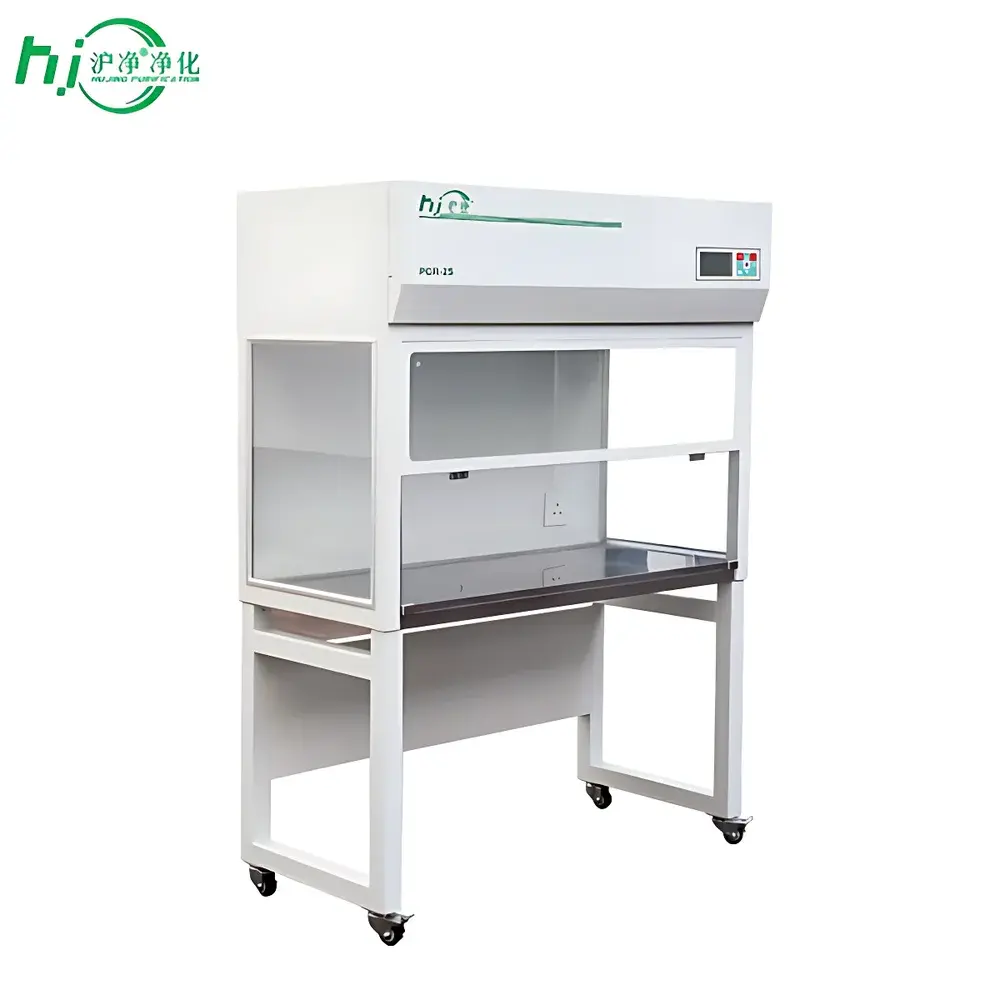
Hujing PCR-Specific Vertical Laminar Flow Clean Bench PCR-2S
| Brand | Hujing Purification (HJ) |
|---|---|
| Origin | Shanghai, China |
| Manufacturer Type | Direct Manufacturer |
| Product Category | Domestic |
| Model | PCR-2S |
| Instrument Type | Vertical Laminar Flow Clean Bench |
| Cleanliness Class | ISO Class 5 (100 @ ≥0.5 µm, Fed. Std. 209E) |
| Noise Level | ≤62 dB(A) |
| User Capacity | 2 operators |
| Airflow Pattern | Vertical Downflow |
| Average Air Velocity | 0.25–0.45 m/s |
| Microbial Contamination | ≤0.5 CFU/plate·hour (Φ90 mm Petri dish) |
| Vibration (Half-Peak) | ≤5 µm (X/Y/Z axes) |
| Illumination | ≥300 lx |
| Power Supply | AC 220 V, 50 Hz |
| Max. Power Consumption | 500 W |
| Net Weight | 110 kg |
| Work Area Dimensions (W×D×H) | 1150 × 510 × 580 mm |
| Overall Dimensions (W×D×H) | 1310 × 590 × 1620 mm |
| HEPA Filter Size & Qty | 1135 × 455 × 50 mm × 1 |
| Fluorescent Lamp | 12 W × 1 |
| UV Lamp | 30 W × 1 |
Overview
The Hujing PCR-Specific Vertical Laminar Flow Clean Bench PCR-2S is an ISO Class 5 (Federal Standard 209E Class 100) laminar flow workstation engineered for molecular biology laboratories performing polymerase chain reaction (PCR) setup, nucleic acid handling, and low-bioburden sample preparation. Unlike horizontal flow hoods, this vertical downflow design draws ambient laboratory air through a prefilter and a certified HEPA filter (≥99.995% efficiency at 0.3 µm), generating unidirectional, particle-free airflow vertically across the work surface. This configuration minimizes cross-contamination risk between samples and protects both operator and specimen—critical for eliminating carryover contamination in PCR workflows where even trace amplicon residues compromise assay integrity. The bench operates as a recirculating–exhaust hybrid system: filtered air enters the work area from above, passes over the sample zone, and exits either via front grille re-circulation (with optional recirculation mode) or full exhaust (depending on lab ventilation integration), maintaining positive pressure within the chamber to prevent ingress of unfiltered room air.
Key Features
- ISO Class 5-certified vertical laminar airflow with adjustable velocity (0.25–0.45 m/s), validated per ISO 14644-1 and aligned with USP environmental control expectations for aseptic compounding zones.
- Integrated HEPA filtration system (1135 × 455 × 50 mm, single unit) mounted in a sealed, leak-tested housing; filter integrity maintained via gasketed frame and post-installation DOP/PAO testing compatibility.
- Ergonomic 10° forward-tilted work surface fabricated from seamless 304 stainless steel—non-porous, corrosion-resistant, and compatible with ethanol, bleach, and RNAse-decontamination protocols.
- Counterbalanced vertical sash mechanism with dual-side transparent acrylic windows, enabling unrestricted lateral visibility and smooth, frictionless sash positioning at any height (0–450 mm travel range).
- Interlocked UV germicidal irradiation (30 W, 254 nm) and fluorescent lighting (12 W, ≥300 lx at work surface); UV automatically deactivates when sash is raised >50 mm, complying with IEC 61000-6-3 and ANSI/IES RP-27.1 safety requirements.
- Microprocessor-based control panel with blue-backlit LCD display showing real-time airflow status, UV exposure timer, and lamp operational indicators—supports programmable UV cycle (0–60 min) and delayed start function.
- Front access lip with stepped profile forms a quasi-enclosed barrier when sash is fully closed, reducing turbulent inflow and enhancing containment during non-operational periods.
Sample Compatibility & Compliance
The PCR-2S accommodates standard PCR consumables—including 96-well plates, tube racks (0.2 mL, 0.5 mL, 1.5 mL), pipette stands, mini-centrifuges (up to Ø120 mm footprint), and thermal cyclers (max height 150 mm). Its interior volume (1150 × 510 × 580 mm) permits simultaneous use by two technicians without compromising laminar uniformity. All materials meet RoHS Directive 2011/65/EU and are free of PVC and halogenated flame retardants. While not classified as a biological safety cabinet (BSC), the unit complies with EN 12464-1:2021 for indoor workplace lighting and EN 60335-1:2012 for electrical safety. Documentation includes factory-issued filter certification reports, airflow mapping data (per ISO 14644-3 Annex B), and conformity statements supporting GLP-aligned laboratory audits.
Software & Data Management
The PCR-2S operates via embedded firmware with no external software dependency. However, its control interface supports audit-ready event logging: UV activation timestamps, sash position history (via potentiometric sensor), and lamp runtime counters are stored in non-volatile memory for ≥12 months. Optional RS-485 Modbus RTU output enables integration into centralized lab monitoring systems (e.g., LabVantage, Thermo Fisher SampleManager) for remote status verification and preventive maintenance scheduling. All logged data retain traceability per FDA 21 CFR Part 11 requirements when paired with institutional electronic signature policies.
Applications
This clean bench is optimized for applications requiring particulate-free environments but not personnel or environmental protection against biohazards: PCR master mix preparation, plasmid transformation, cloning workflow staging, qPCR plate loading, NGS library prep (pre-amplification), CRISPR guide RNA complex assembly, and sterile reagent aliquoting. It is routinely deployed in academic genomics cores, clinical molecular diagnostics labs (CLIA-certified), pharmaceutical QC units conducting stability-indicating assays, and contract research organizations performing ISO/IEC 17025-compliant method validation.
FAQ
Does the PCR-2S meet ISO Class 5 requirements for molecular diagnostics labs?
Yes—it achieves and maintains ISO 14644-1 Class 5 (equivalent to Fed. Std. 209E Class 100) under static and dynamic operating conditions, verified using calibrated particle counters per ISO 21501-4.
Can it be connected to building exhaust ducts?
Yes—the unit supports both recirculating and 100% exhaust configurations; exhaust duct adapters and static pressure compensation kits are available as accessories.
Is HEPA filter replacement user-serviceable?
Yes—filter access is tool-free via front-panel quick-release latches; replacement interval is typically 12–18 months depending on ambient particulate load and usage frequency.
What safety certifications does it hold?
It carries CE marking per Machinery Directive 2006/42/EC and Low Voltage Directive 2014/35/EU, plus EMC compliance per EN 61326-1:2013.
Does it support GMP documentation packages?
Factory-supplied IQ/OQ documentation templates (in English) are provided, including test protocols for airflow uniformity, UV intensity mapping, and electrical safety verification—fully customizable for site-specific PQ execution.



