
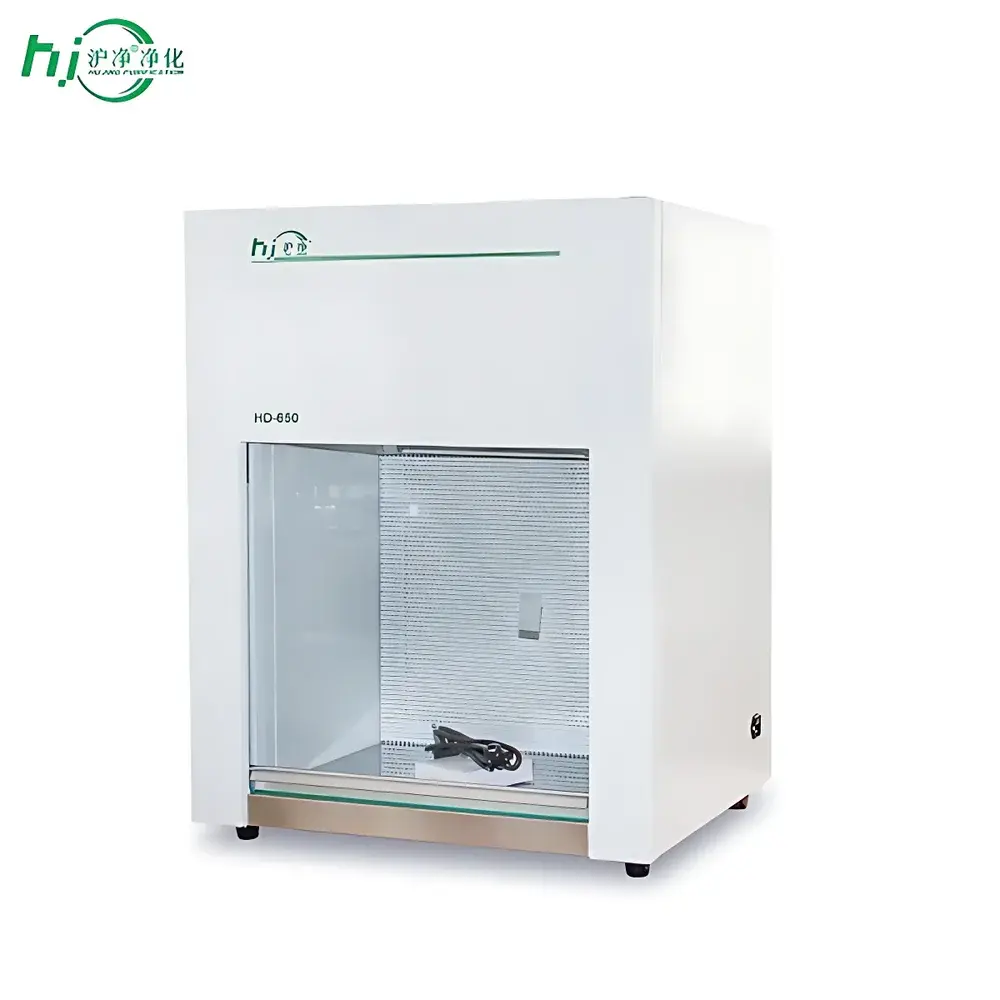
Hujing Purification HD650 Horizontal Laminar Flow Clean Bench
| Brand | Hujing Purification |
|---|---|
| Origin | Shanghai, China |
| Manufacturer Type | Direct Manufacturer |
| Product Category | Domestic |
| Model | HD650 |
| Instrument Type | Horizontal Flow Clean Bench |
| Cleanliness Class | Class 100 @ ≥0.5 µm (US Federal Standard 209E) |
| Noise Level | ≤62 dB(A) |
| User Capacity | Single-user, single-front configuration |
| Airflow Pattern | Horizontal laminar flow |
| Average Air Velocity | 0.25–0.45 m/s |
| Microbial Contamination | ≤0.5 CFU/plate·hour (Φ90 mm Petri dish) |
| Vibration (Half-Peak) | ≤5 µm (X/Y/Z axes) |
| Illumination | ≥300 lx |
| Working Area Dimensions (W×D×H) | 490 × 350 × 490 mm |
| Overall Dimensions (W×D×H) | 650 × 530 × 850 mm |
| HEPA Filter Specification | 470 × 455 × 38 mm (1 unit) |
| Fluorescent Lamp | 5 W (1 unit) |
| UV Lamp | 10 W (1 unit) |
Overview
The Hujing Purification HD650 Horizontal Laminar Flow Clean Bench is an engineered solution for maintaining ISO Class 5 (equivalent to US Federal Standard 209E Class 100) air cleanliness in low-risk, non-sterile laboratory environments. Designed specifically for horizontal unidirectional airflow, the HD650 directs filtered air across the work surface at a controlled velocity (0.25–0.45 m/s), forming a protective laminar curtain that minimizes turbulence and prevents ambient particulate ingress. Unlike vertical-flow biosafety cabinets, this clean bench does not recirculate air nor provide personnel or environmental protection—its primary function is product protection during aseptic handling of non-hazardous samples, such as cell culture media preparation, microbiological plating, semiconductor component assembly, and precision optical alignment. The system operates under positive pressure relative to the surrounding lab environment and complies with fundamental cleanroom engineering principles defined in ISO 14644-1 and IEST-RP-CC002.2 for laminar flow device performance validation.
Key Features
- Horizontally oriented laminar airflow architecture optimized for forward-facing, single-operator workflows.
- Electrostatically coated cold-rolled steel outer casing with corrosion-resistant SUS304 brushed stainless steel work surface—designed for chemical resistance, mechanical durability, and repeatable decontamination.
- Dual interlocked lighting and UV sterilization systems: fluorescent lamp (5 W) and germicidal UV lamp (10 W) operate independently with safety cutoff to prevent accidental UV exposure during operation.
- Motorized, infinitely adjustable sash window with smooth-positioning mechanism—enables precise access control while preserving laminar integrity across variable opening heights.
- Two-stage filtration system: pre-filter (G4 grade) captures coarse particulates (>5 µm), significantly extending service life of the terminal HEPA filter (rated at ≥99.99% efficiency for particles ≥0.3 µm, tested per EN 1822-1).
- Wireless remote control (operational range up to 20 m) supporting dual-speed fan modulation—facilitates ergonomic workflow without physical interaction near the sterile field.
- Vertically enclosed front aperture design generates a downward-directed air curtain at the working plane, further isolating the operator’s breathing zone from the protected area.
Sample Compatibility & Compliance
The HD650 is intended for use with non-pathogenic, non-toxic, and non-volatile materials. It is not suitable for handling biohazards, radioactive substances, or volatile organic compounds. Its Class 100 performance has been validated using particle counters calibrated per ISO 21501-4 and microbial settle plate assays (Φ90 mm TSA plates incubated at 30–35°C for 48 h), yielding ≤0.5 CFU/plate·hour—meeting requirements for low-bioburden applications under ISO 14698-1. Structural vibration levels (≤5 µm half-peak across all axes) ensure compatibility with vibration-sensitive instrumentation such as optical microscopes or balance calibrations. Electrical compliance includes CE-marked components conforming to IEC 61000-6-3 (EMC emission) and IEC 61000-6-2 (immunity), with power input rated at AC 220 V ±10%, 50 Hz.
Software & Data Management
The HD650 is a standalone, hardware-controlled instrument with no embedded firmware or digital data logging capability. All operational parameters—including fan speed selection, UV activation, and light control—are managed via tactile switches or wireless remote interface. As a Class I clean bench per ISO 14644-7, it requires periodic user-performed performance verification (e.g., airflow velocity mapping, particle count surveys, and UV intensity measurement using calibrated radiometers) in accordance with ISO 14644-3 and local GLP/GMP quality procedures. While no software integration is provided, its mechanical reliability and standardized filter dimensions support seamless inclusion in facility-wide preventive maintenance schedules compliant with ISO/IEC 17025 clause 6.4.3.
Applications
- Aseptic preparation of cell culture reagents, buffers, and diluents in academic and industrial life science laboratories.
- Handling of sterile pharmaceutical excipients and non-sterile final dosage form components during R&D formulation studies.
- Assembly and inspection of microelectronic components where electrostatic discharge (ESD)-safe but non-HEPA-classified environments are sufficient.
- Optical alignment and calibration of metrology tools requiring low particulate deposition rates on exposed lenses or sensors.
- Preparation of standard reference materials and certified reference samples in analytical chemistry labs adhering to ISO/IEC 17025 traceability requirements.
FAQ
Does the HD650 meet FDA or ISO 13485 requirements for medical device manufacturing?
The HD650 supports Class 100 environments required for certain non-sterile medical device assembly steps; however, full compliance with ISO 13485 or FDA 21 CFR Part 820 depends on facility-level validation, change control, and documented maintenance—not solely on bench specifications.
Can the HEPA filter be replaced by the end user?
Yes—the HEPA module (470 × 455 × 38 mm) is designed for field replacement using standard torx tools; filter change intervals should be determined by upstream pre-filter condition and particle challenge testing per ISO 14644-3 Annex B.
Is UV intensity monitoring required per regulatory guidance?
Per ISO 15195 and CLSI M29-A3, UV lamps must be verified for output ≥40 µW/cm² at 1 meter prior to critical use; annual radiometric validation is recommended for GxP environments.
What is the expected service life of the fan motor under continuous operation?
Rated for >20,000 hours of continuous duty at nominal voltage and ambient temperatures of 15–30°C, assuming routine cleaning of pre-filters every 3 months.
Does the HD650 support integration with building management systems (BMS)?
No—this model lacks analog/digital I/O ports or Modbus/RS-485 interfaces; BMS integration would require external relay-based status monitoring and third-party airflow sensors.



