
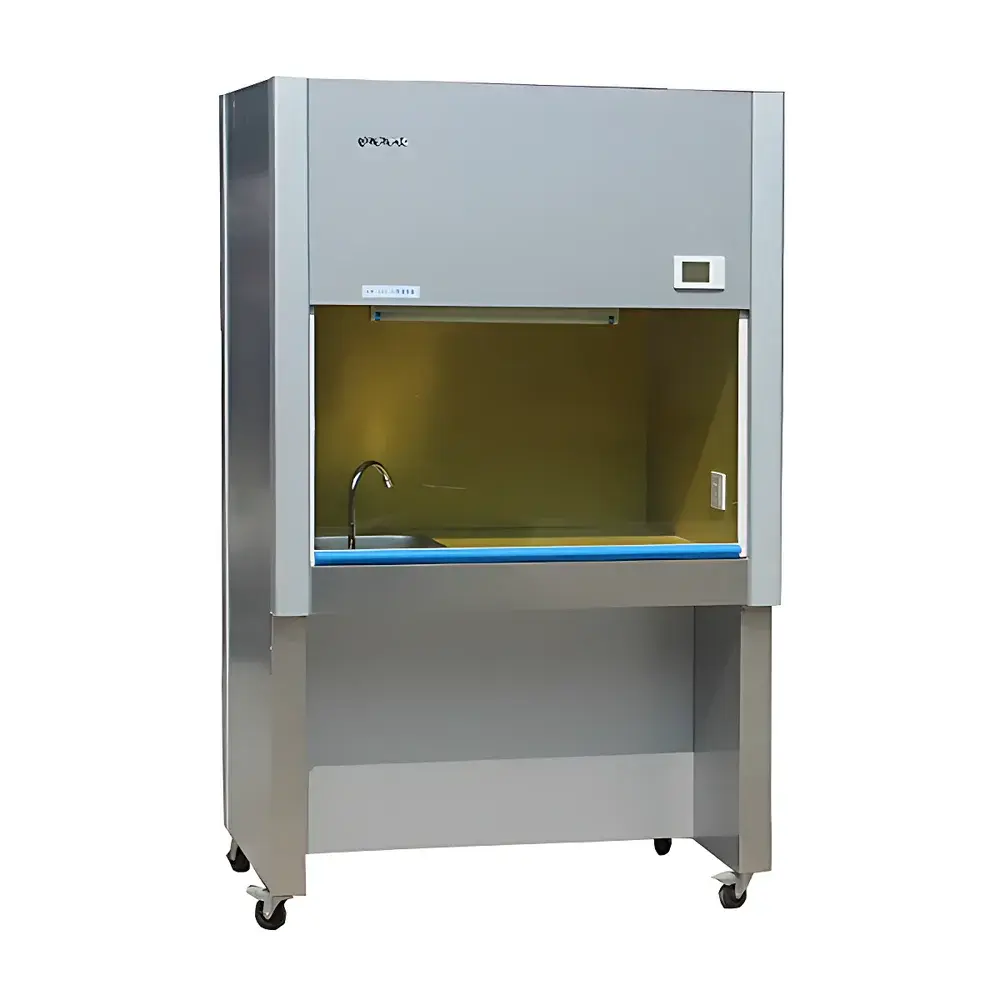
Hujing Purification SW-TFG-15PP Full-Steel Single-Face Fume Hood
| Brand | Hujing Purification |
|---|---|
| Origin | Shanghai, China |
| Manufacturer Type | Direct Manufacturer |
| Country of Origin | China |
| Model | SW-TFG-15 |
| Construction | Full-steel cabinet |
| Configuration | Single-face operation fume hood |
| Face Velocity Range | 0.25–0.45 m/s (adjustable) |
| Inlet Water Pressure Requirement | >0.5 bar |
| Electrical Supply | AC 220 V, 50 Hz |
| Max Power Consumption | 800 W |
| Net Weight | <200 kg |
| Work Area Dimensions (W×D×H) | 1300 × 700 × 600 mm |
| Overall Dimensions (W×D×H) | 1455 × 760 × 1950 mm |
| Lighting | 30 W fluorescent lamp (1 unit) |
Overview
The Hujing Purification SW-TFG-15PP is a full-steel, single-face ducted fume hood engineered for reliable containment and operator safety in general chemistry, pharmaceutical, and educational laboratory environments. It operates on the principle of constant air volume (CAV) ventilation, drawing ambient laboratory air through the sash opening at a controlled face velocity—typically maintained between 0.25 and 0.45 m/s—to capture and exhaust hazardous vapors, aerosols, and particulates generated during bench-scale chemical handling. Designed to meet fundamental performance criteria aligned with ANSI/ASHRAE Standard 110-2016 (Method of Testing Performance of Laboratory Fume Hoods), this unit ensures consistent airflow dynamics across its 1300 mm wide work surface, minimizing turbulence and cross-draft interference. Its structural integrity derives from cold-rolled steel construction with epoxy-coated interior surfaces, providing corrosion resistance against common reagents including dilute acids, bases, and organic solvents. The vertical sliding sash—fabricated from tempered safety glass—offers adjustable height positioning to optimize containment while accommodating varied procedural workflows.
Key Features
- Full-steel monocoque chassis with powder-coated epoxy finish for long-term chemical resistance and mechanical durability
- Single-face, front-access design optimized for space-constrained labs and standard bench alignment
- Integrated utility manifold: pre-wired 220 V/50 Hz power circuit with multi-outlet GFCI-protected socket panel; dedicated low-pressure water line with quick-connect valve and stainless-steel faucet
- Front-mounted vertical sash with smooth counterbalanced movement and calibrated stop positions for repeatable face velocity control
- Stainless-steel sink basin (304 grade) recessed into the work surface, sloped toward rear drain outlet with P-trap and PVC waste piping
- Top-mounted axial exhaust fan (rated for continuous duty, IP54 enclosure) with thermal overload protection and vibration-dampened mounting
- Energy-efficient 30 W T8 fluorescent lighting system with diffuser lens, delivering uniform illumination ≥300 lux across the work plane
Sample Compatibility & Compliance
The SW-TFG-15PP is suitable for routine handling of low-to-moderate volatility chemicals, including aqueous solutions, alcohols, acetone, chloroform, and diluted mineral acids or alkalis. It is not intended for perchloric acid, hydrofluoric acid, or radioactive materials without supplemental scrubber or filtration integration. While not certified to EN 14175 (European fume hood standard) or ISO 10632 (performance testing), its operational parameters—including face velocity range, sash height tolerances, and airflow uniformity—conform to baseline expectations defined in ANSI/ASHRAE 110 and referenced in U.S. OSHA Lab Standard 29 CFR 1910.1450. The unit supports GLP-compliant documentation protocols when integrated with facility-wide HVAC monitoring systems; however, it does not include built-in airflow sensors or digital logging hardware required for FDA 21 CFR Part 11 audit trails.
Software & Data Management
This fume hood operates as a standalone mechanical ventilation device with no embedded microcontroller, touchscreen interface, or network connectivity. All operational parameters—including fan speed, sash position, and electrical load—are manually managed by end users. Facility managers may integrate external airflow monitors (e.g., anemometers or differential pressure transducers) into centralized BMS platforms via analog 4–20 mA outputs (requires optional third-party retrofit). No proprietary software, firmware updates, or cloud-based data synchronization are provided or supported. Maintenance logs, calibration records, and annual performance verification reports must be retained locally per institutional EHS policy and ISO/IEC 17025 clause 8.9.
Applications
- Undergraduate and graduate teaching laboratories conducting titrations, distillations, solvent extractions, and basic synthesis procedures
- QC/QA labs performing raw material identification, pH adjustment, buffer preparation, and sample digestion using open-vessel techniques
- Hospital pharmacy compounding areas requiring containment for non-sterile admixture preparation
- Environmental testing facilities handling soil/water extracts prior to instrumental analysis (e.g., GC, ICP-OES)
- Vocational training centers emphasizing safe chemical handling fundamentals and PPE integration
FAQ
What is the recommended minimum room air exchange rate when installing this fume hood?
A minimum of 6–8 air changes per hour (ACH) is advised for general lab spaces housing CAV fume hoods; local exhaust must be balanced with make-up air to prevent negative pressure cascading.
Can this unit be retrofitted with variable air volume (VAV) control?
Yes—external VAV actuators and duct-mounted dampers may be added, but require coordination with HVAC engineers and validation per ASHRAE Guideline 12-2020.
Is the stainless-steel sink NSF-certified for food-grade use?
No—the sink meets ASTM A240 Type 304 specifications for corrosion resistance but lacks NSF/ANSI 51 certification for food equipment applications.
Does the unit include airflow alarms or sash position interlocks?
No—these are optional accessories and must be specified separately during procurement.
What maintenance intervals are recommended for the exhaust fan motor?
Biannual inspection of belt tension (if belt-driven), bearing lubrication, and impeller cleanliness is advised; refer to manufacturer’s service manual for torque specifications and replacement part numbers.



