
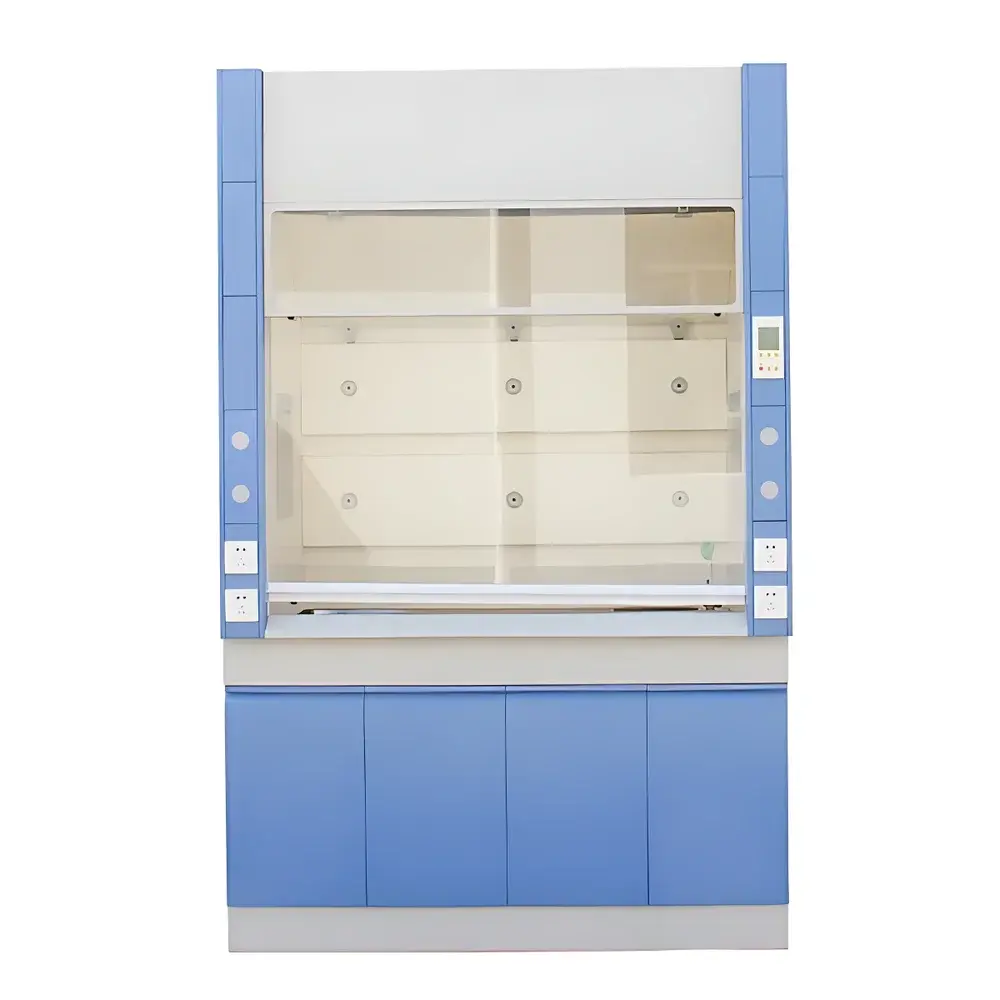
Hujing Purification ZJ-TFG-18 Full-Steel Fume Hood
| Brand | Hujing Purification |
|---|---|
| Origin | Shanghai, China |
| Manufacturer Type | Direct Manufacturer |
| Country of Origin | China |
| Model | ZJ-TFG-18 |
| Cabinet Construction | Full-steel |
| Operation Configuration | Single-face |
| Exhaust Mode | Full-exhaust (top-mounted) |
| Airflow Velocity | 0.5 m/s |
| Power Supply | 220–300 V AC |
| Max Power Consumption | 0.3 kW |
| Net Weight | 175 kg |
| Work Area Dimensions (W×D×H) | 1588 × 655 × 1200 mm |
| Overall Dimensions (W×D×H) | 1800 × 850 × 2350 mm |
| Lighting | 12 W LED lamp (1 unit) |
| Work Surface | 12.7 mm solid phenolic chemical-resistant laminate |
| Inner Liner | 5 mm gray high-pressure laminated antibacterial & corrosion-resistant board (anti-acid/alkali/organic solvent) |
| Outer Shell | 1.0 mm cold-rolled steel with epoxy powder coating (acid-phosphated and baked at high temperature) |
| Water Supply | Quick-release faucet integrated with stainless steel sink |
| Electrical Integration | Concealed multi-outlet power strip (GFCI-compatible), gas & water lines routed internally |
| Maintenance Access | Removable rear panel and service access ports on inner liner |
Overview
The Hujing Purification ZJ-TFG-18 Full-Steel Fume Hood is an engineered safety solution designed for routine chemical handling in academic, industrial, and quality control laboratories. It operates on the principle of directional airflow containment—drawing ambient air through the sash opening, capturing hazardous vapors, aerosols, and particulates generated during bench-scale chemical procedures, and expelling them via a dedicated ducted exhaust system. Its top-mounted low-speed centrifugal exhaust fan ensures consistent face velocity of 0.5 m/s across the full operational width (1588 mm), meeting baseline performance expectations aligned with ANSI/ASHRAE 110–2016 qualitative and quantitative testing protocols for fume hood containment efficiency. The cabinet’s structural integrity, material compatibility, and integrated utility routing reflect adherence to fundamental laboratory safety design principles—prioritizing operator protection, long-term durability under corrosive exposure, and compliance-ready infrastructure.
Key Features
- Full-steel monocoque construction using 1.0 mm cold-rolled steel plates, precision-cut and formed on CNC machinery, then acid-phosphated and electrostatically coated with thermoset epoxy powder for uniform corrosion resistance and mechanical robustness.
- Chemically inert interior lining composed of 5 mm thick gray high-pressure laminate (HPL) board—certified for resistance to acids, alkalis, organic solvents, and microbial growth per ISO 4586-2:2016 specifications.
- 12.7 mm solid phenolic resin work surface, non-porous and NSF/ANSI 51-compliant for food-contact adjacent applications; exhibits low leachability, thermal stability up to 135°C, and resistance to staining and etching from common reagents.
- Vertically sliding tempered glass sash with smooth counterbalanced mechanism, enabling precise height adjustment while maintaining stable face velocity across variable openings.
- Integrated utility management: concealed GFCI-protected electrical outlets (IEC 60309 compatible), quick-connect water valve with stainless steel sink basin, and standardized gas line interface points—all routed internally to minimize clutter and enhance ergonomics.
- Dual-service access architecture: removable rear service panel and dedicated inner-liner maintenance ports facilitate safe inspection and servicing of electrical circuits, plumbing, and gas lines without disassembly.
Sample Compatibility & Compliance
The ZJ-TFG-18 accommodates standard benchtop apparatus—including magnetic stirrers, hot plates, distillation setups, and volumetric glassware—within its 1588 mm wide work area. Its design supports Class I and II A1-equivalent containment scenarios when connected to a properly balanced building exhaust system. While not certified to EN 14175 or UL 1805 out-of-the-box, the unit’s material specifications, airflow consistency, and construction methodology align with foundational requirements for GLP-compliant environments. Structural finish meets ISO 9223 C3 corrosion category thresholds for indoor industrial atmospheres. Optional integration with airflow monitoring sensors and digital sash position feedback enables future alignment with ISO/IEC 17025 audit trails and internal SOP documentation.
Software & Data Management
This fume hood operates as a standalone mechanical safety device without embedded firmware or network connectivity. However, its physical design supports third-party integration: pre-drilled mounting points and conduit knockouts allow seamless coupling with building management systems (BMS), differential pressure transducers, or real-time face velocity loggers compliant with ASTM E1993–22. All electrical components meet IEC 61000-6-3 EMC emission standards. Documentation includes bilingual (English/Chinese) installation manuals, dimensional drawings, and material safety data sheets (MSDS) for coatings and laminates—facilitating traceability and regulatory review during facility qualification (IQ/OQ).
Applications
The ZJ-TFG-18 serves core functions in synthetic chemistry labs, environmental testing facilities, pharmaceutical QC suites, and university teaching laboratories. Typical use cases include open-vessel acid digestions, solvent-based extractions, amine or halogen compound handling, pH adjustment procedures, and small-scale reaction monitoring. Its full-exhaust configuration prevents recirculation, making it suitable for volatile organic compounds (VOCs), hydrogen sulfide, chlorine gas, and low-concentration formaldehyde applications—provided local exhaust ductwork terminates outdoors with appropriate stack height and dispersion modeling.
FAQ
What airflow standard does this fume hood meet?
It maintains a nominal face velocity of 0.5 m/s, consistent with minimum recommendations in ANSI/ASHRAE 110–2016 for general-purpose chemical containment.
Is the work surface resistant to hydrofluoric acid?
No—phenolic resin surfaces are not HF-resistant; users requiring HF handling must specify optional polypropylene or epoxy resin-coated stainless steel work surfaces.
Can this unit be retrofitted with airflow monitoring?
Yes—standardized knockout locations and internal cable pathways support installation of anemometers, sash sensors, or alarm modules compatible with 0–10 V or 4–20 mA BMS inputs.
Does the cabinet include ductwork or blower assembly?
No—ducting, fan selection, and static pressure calculations must be performed separately by HVAC engineers per local codes and chemical load profiles.
What certifications apply to the epoxy powder coating?
The coating conforms to ISO 20567-1 for adhesion (cross-cut test ≥5B) and ISO 6270-2 for humidity resistance (1000 h, no blistering or delamination).



