
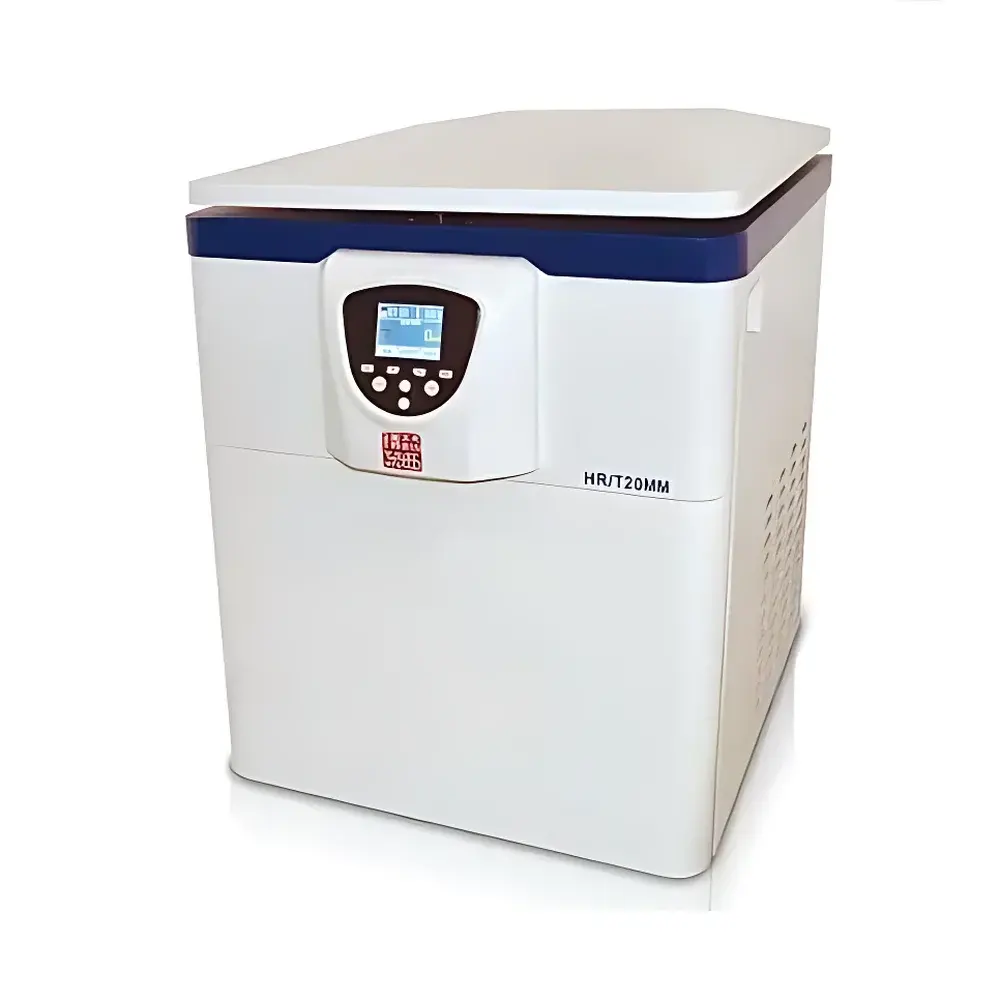
Hunan-made DD5M Vertical Low-Speed Centrifuge
| Origin | Hunan, China |
|---|---|
| Manufacturer Type | Distributor |
| Product Origin | Domestic (China) |
| Model | DD5M |
| Price | USD 1,780 (approx.) |
| Centrifuge Type | Low-Speed Centrifuge |
| Maximum Capacity | 6 × 500 mL |
| Maximum Speed | 5,000 rpm |
| Maximum RCF | 4,390 × g |
| Speed Accuracy | ±50 rpm |
| Acceleration/Deceleration Control | 10 selectable rates |
| Dimensions (L×W×H) | 740 × 620 × 900 mm |
| Weight | 85 kg |
| Noise Level | ≤65 dB(A) |
| Power Supply | AC 220 V, 50 Hz |
| Total Power | 0.8 kW |
| Display | TFT color touch LCD |
| Control System | dsPIC30F microcontroller |
| Motor | Brushless AC frequency-controlled motor |
| Safety Features | Overspeed, overtemperature, imbalance, and automatic rotor recognition protection |
| Rotor Options | Multiple horizontal rotors and microplate carriers |
Overview
The DD5M Vertical Low-Speed Centrifuge is an engineered solution for routine separation tasks requiring high sample throughput, thermal stability, and operational reliability in clinical, academic, and industrial laboratories. Designed around a brushless AC frequency-controlled motor, the system eliminates carbon brush wear and associated particulate contamination—critical for maintaining sample integrity in sensitive biological applications such as blood component separation, cell harvesting, and crude biomolecule purification. Unlike high-speed or ultracentrifuges, the DD5M operates within the low-speed range (up to 5,000 rpm), delivering controlled sedimentation forces (max. 4,390 × g) optimized for pelleting whole cells, organelles, precipitated proteins, and large particulates without inducing shear-induced denaturation or aerosol generation. Its vertical orientation maximizes floor space efficiency while enabling stable stacking of heavy-duty rotors—including 6 × 500 mL capacity configurations—making it particularly suited for batch processing in blood banks, dairy quality control labs, and bioprocessing pilot facilities.
Key Features
- Brushless AC frequency-controlled motor with integrated thermal management, ensuring consistent torque delivery across speed ranges and extending service life beyond 20,000 operating hours.
- TFT true-color touchscreen interface with dual-input capability (touch + physical keys), supporting direct RCF-based protocol initiation and real-time parameter monitoring.
- Microcontroller-based architecture using Microchip dsPIC30F series with FAIRCHILD FSBB30CH motor driver modules, providing deterministic response timing and electromagnetic interference (EMI) resilience per IEC 61326-1.
- Full stainless-steel centrifuge chamber and reinforced structural frame compliant with ISO 13485 design principles for medical device environments.
- Multi-layer safety system including automatic imbalance detection (±5 g mass differential), overspeed cutoff (105% of setpoint), real-time rotor temperature monitoring, and mechanical/electronic door interlock with silent electromechanical latch.
- Programmable operation with 20 user-defined protocols, 10-step acceleration/deceleration ramping, and point-to-point “short spin” function for rapid pellet settling verification.
- Ergonomic front-access design with optimized center-of-gravity placement and vibration-damping feet calibrated to meet ISO 10816-3 vibration severity Class A limits.
Sample Compatibility & Compliance
The DD5M accommodates a broad spectrum of sample containers—from standard 500 mL polypropylene bottles to 96-well microplates—via interchangeable horizontal rotors certified to ISO 15530-3 for dimensional repeatability and balance tolerance. Rotors are individually serialized and validated for maximum load distribution under dynamic conditions. The system supports GLP-compliant workflows through audit-trail-capable parameter logging (time-stamped speed, RCF, duration, temperature) stored onboard for ≥1,000 runs. While not a regulated medical device per FDA 21 CFR Part 820, its construction and control architecture align with ISO 13485:2016 Annex C expectations for ancillary laboratory equipment used in IVD manufacturing and clinical sample preparation. All electrical components conform to IEC 61010-1 safety standards for laboratory equipment.
Software & Data Management
No external PC software is required for basic operation; however, optional USB data export enables CSV-formatted run logs (including start/stop timestamps, actual vs. set RCF, energy consumption, and fault codes) for integration into LIMS or electronic lab notebooks (ELN). The embedded controller retains full operational history without volatile memory—data persists through power cycles. Firmware updates are performed via secure USB key with cryptographic signature verification, satisfying traceability requirements under ISO/IEC 17025 Clause 5.9.2 for measurement equipment calibration status maintenance.
Applications
- Clinical diagnostics: Separation of serum, plasma, and packed red blood cells from whole blood in hospital core labs and blood transfusion centers.
- Biopharmaceutical QC: Clarification of fermentation broths, harvest of microbial cells, and recovery of inclusion bodies prior to solubilization.
- Food & dairy testing: Fat globule isolation in milk homogenization studies, starch granule sedimentation analysis, and yeast cell concentration in brewing QA.
- Agricultural research: Extraction of plant protoplasts, soil particle size fractionation, and aquatic biomass concentration from pond water samples.
- Environmental labs: Sedimentation of suspended solids in wastewater influent/effluent characterization per ASTM D3611 and ISO 11923.
FAQ
Is the DD5M suitable for continuous operation in a GMP environment?
Yes—the unit’s sealed motor housing, non-shedding internal surfaces, and absence of lubricants contacting the chamber meet baseline cleanliness requirements for Grade C/D cleanrooms when installed with appropriate HVAC airflow validation.
Can rotor calibration certificates be provided?
Each rotor is supplied with a factory-verified balance report (±0.5 g symmetry tolerance at 5,000 rpm); third-party ISO/IEC 17025 calibration services are available upon request.
Does the system support remote monitoring via Ethernet or Wi-Fi?
No native network interface is included; however, optional RS-485 Modbus RTU output enables integration with building management systems or centralized equipment dashboards.
What is the recommended maintenance interval?
Routine inspection every 6 months includes rotor thread integrity check, door seal assessment, and vibration amplitude verification per ISO 20816-1; full service (bearing replacement, firmware update, sensor recalibration) is advised every 3 years or after 5,000 runs.
Are rotors autoclavable?
Stainless-steel horizontal rotors are autoclavable at 121°C for 20 minutes; aluminum adapters and plastic buckets require chemical sterilization only (e.g., 70% ethanol or 0.5% sodium hypochlorite).



