
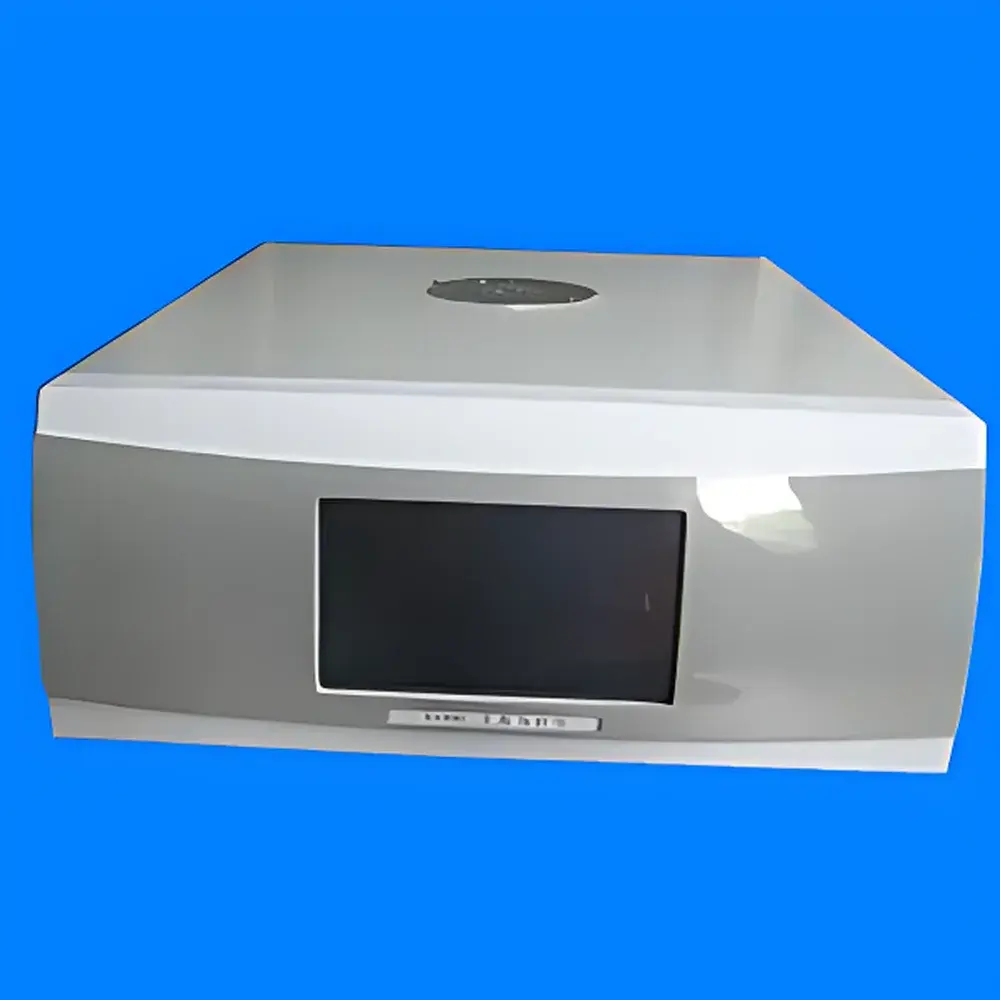
Hunan-made DSC0901 Differential Scanning Calorimeter (DSC) with Integrated Thermogravimetric Analysis (TGA) Capability
| Origin | Hunan, China |
|---|---|
| Manufacturer Type | Authorized Distributor |
| Origin Classification | Domestic (PRC) |
| Model | DSC0901 |
| Pricing | Available Upon Request |
| Differential Heat Range | ±2000 µV |
| DSC Power Range | ±10, ±20, ±50, ±100, ±160, ±200 mW (auto-switching) |
| Temperature Range Options | RT–450°C, RT–1150°C, RT–1400°C, RT–1650°C |
| Heating Rate | 0.1–30 °C/min (programmable) |
| Temperature Control Modes | Ramp, Isothermal, Cooling, PID-regulated |
| Base Resolution | 2 µg |
| Sensitivity | 10 µg |
| TGA Capacity | 1–1000 mg (selectable ranges) |
| DTG Range | 0.1–10 mg/min (selectable) |
| Gas Flow Control | Dual-channel mass flow controllers (N₂, O₂), ≤200 mL/min |
| Max Sample Load | 2 g |
| A/D Resolution | 24-bit |
| Data Output | Printer, chart recorder, PC interface |
| Power Supply | 220 V AC ±1 Hz, 50 Hz |
Overview
The DSC0901 Differential Scanning Calorimeter is a dual-mode thermal analysis instrument engineered for precision measurement of heat flow differences between a sample and inert reference under controlled temperature programs. While commonly referred to as a DSC system, this model integrates synchronized thermogravimetric analysis (TGA) functionality—enabling simultaneous acquisition of both calorimetric (heat flow) and mass-change data. Its operational principle follows the heat-flux DSC method per ISO 11357-1 and ASTM E1269, where temperature-controlled heating/cooling ramps induce endothermic or exothermic transitions, quantified via differential thermocouple voltage (±2000 µV) and calibrated power compensation. Designed in strict compliance with GB/T 17391–1998 (equivalent to ISO 11357 series) and ISO/CD 11357-6 for kinetic analysis, the DSC0901 supports rigorous thermal characterization across materials science, polymer engineering, pharmaceutical development, catalysis research, and energetic materials evaluation. The system accommodates programmable multi-segment temperature profiles—including linear ramping, isothermal holds, controlled cooling, and cyclic thermal protocols—making it suitable for determining melting points, crystallization enthalpies, glass transition temperatures (Tg), oxidative induction time (OIT), phase transformation kinetics, and decomposition onset behavior.
Key Features
- Multi-range, auto-switching DSC power detection (±10 to ±200 mW) ensures optimal signal-to-noise ratio across diverse thermal events—from subtle glass transitions to high-energy decomposition reactions.
- Selectably configurable furnace modules support extended temperature operation up to 1650 °C, validated for high-temperature ceramics, refractory metals, and advanced composites.
- PID-driven temperature control delivers stable ramp reproducibility (<±0.1 °C deviation over 10 °C/min), critical for kinetic modeling and ASTM E698-compliant activation energy calculations.
- Integrated 24-bit high-resolution analog-to-digital conversion enables baseline stability <0.1 µW over 60-minute isotherms, with real-time software-based baseline correction algorithms.
- Dual-gas mass flow control (N₂ and O₂) with independent digital regulation allows precise atmosphere switching during dynamic experiments—essential for oxidation stability testing per ASTM D3895 and ISO 11357-6.
- Microbalance subsystem offers 2 µg readability and 10 µg sensitivity, supporting quantitative mass-loss analysis concurrent with DSC signal acquisition—ideal for dehydration, volatilization, and pyrolysis studies.
Sample Compatibility & Compliance
The DSC0901 accepts standard alumina, platinum, or gold crucibles (up to 2 g maximum load) and accommodates solids, powders, films, and small-volume liquids. It meets functional equivalency requirements for ISO 11357 (all parts), ASTM E793 (enthalpy), ASTM E1356 (Tg), and ASTM E2070 (kinetics). When operated with validated calibration standards (indium, zinc, sapphire), the system supports GLP-compliant documentation workflows. Full audit trail capability—including user log, parameter change history, and raw data timestamping—is available through optional FDA 21 CFR Part 11–compliant software modules. All electrical and thermal safety designs conform to IEC 61010-1:2010 for laboratory equipment.
Software & Data Management
The instrument is controlled via Windows-based acquisition software featuring intuitive experiment sequencing, real-time signal visualization, and automated peak integration. Raw data files are stored in vendor-neutral ASCII format (.txt) and proprietary binary (.dsc) archives, ensuring long-term accessibility. Built-in analysis tools include baseline subtraction, peak deconvolution, derivative thermogravimetry (DTG), Ozawa-Flynn-Wall kinetic modeling, and ASTM E1269-compliant Cp determination. Export options include CSV, Excel, PDF reports, and direct integration with MATLAB and OriginLab for advanced statistical treatment. Data integrity safeguards include electronic signatures, password-protected method templates, and encrypted database backups.
Applications
- Thermal stability assessment of polymers, including melt processing windows, crosslink density estimation, and degradation onset under inert or oxidative atmospheres.
- Pharmaceutical solid-state characterization: polymorph screening, hydrate/anhydrate transitions, excipient compatibility, and amorphous content quantification.
- Catalyst thermal durability testing—measuring sintering onset, support decomposition, and active-phase redox behavior under programmed gas environments.
- Metallurgical phase diagram validation: eutectic temperature mapping, solidus/liquidus determination, and precipitation kinetics in aluminum, titanium, and nickel alloys.
- Energetic materials safety profiling: decomposition enthalpy, sensitivity to thermal shock, and autocatalytic behavior prediction via isoconversional methods.
- Coal and biomass characterization: proximate analysis simulation, volatile matter release profiling, and char formation kinetics.
FAQ
What standards does the DSC0901 comply with for thermal analysis?
It conforms to ISO 11357-1 through -7, ASTM E1269, E793, E1356, and GB/T 17391–1998 for DSC performance verification and calibration traceability.
Can the system perform simultaneous DSC and TGA measurements?
Yes—the DSC0901 is configured as a combined DSC-TGA instrument with synchronized data acquisition from both thermal and mass-change sensors.
Is the software compatible with LIMS or enterprise QA systems?
Standard export formats (CSV, ASCII) enable seamless LIMS integration; optional 21 CFR Part 11 modules provide electronic signature, audit trail, and role-based access control.
What calibration materials are recommended for routine verification?
Indium (melting point 156.6 °C, ΔHfus = 28.45 J/g), zinc (419.5 °C), and sapphire (for heat capacity calibration) are certified reference materials used for daily system checks.
Does the instrument support modulated DSC (MDSC®) or TOPEM techniques?
No—this is a conventional heat-flux DSC platform. MDSC requires proprietary hardware modulation not present in the DSC0901 architecture.



