
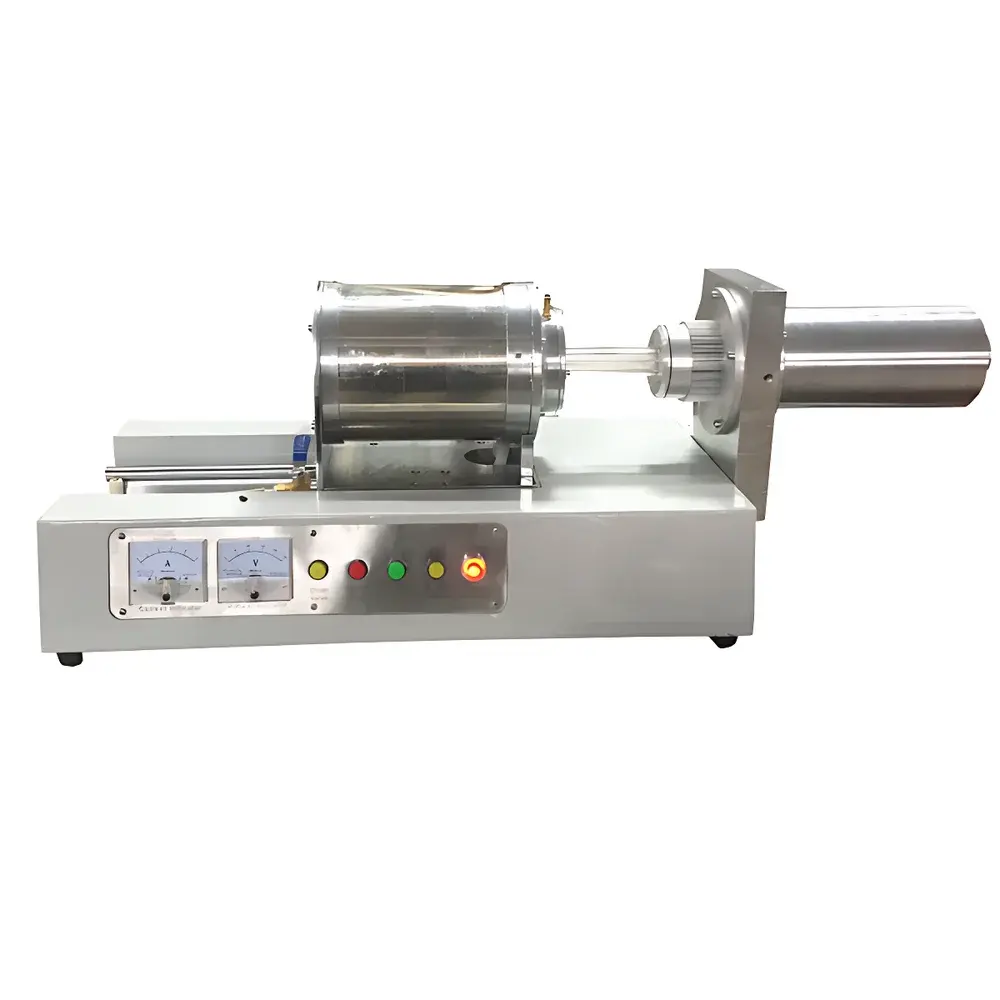
Hunan PCY-SL-30 Thermal Dilatometer for Linear Coefficient of Thermal Expansion (CTE) Testing of Polymers per GB 1036–2008
| Origin | Hunan, China |
|---|---|
| Manufacturer Type | Authorized Distributor |
| Origin Category | Domestic (PRC) |
| Model | PCY-SL-30 |
| Price Range | USD 1,400–7,000 |
| Temperature Range | −30 °C to 30 °C |
| Heating Rate | 5 °C/min |
| Temperature Accuracy | ±0.1 °C |
| Sample Diameter | 6–10 mm |
| Measurement Range | 5 mm |
| Resolution | 1 µm |
| Atmosphere Options | Air, Vacuum, Inert Gas |
Overview
The Hunan PCY-SL-30 Thermal Dilatometer is a precision-engineered instrument designed for the quantitative determination of the linear coefficient of thermal expansion (CTE) in thermoplastic and thermosetting polymers, elastomers, and composite materials. It operates on the principle of contact-based mechanical dilatometry: a calibrated quartz pushrod transmits dimensional changes of a vertically oriented cylindrical sample to a high-resolution displacement transducer (e.g., LVDT or capacitive sensor), while temperature is precisely controlled and monitored within a thermostatically regulated furnace chamber. The system complies with the metrological and procedural requirements specified in GB/T 1036–2008 *Determination of Linear Coefficient of Thermal Expansion of Plastics* and aligns with ASTM D696 *Standard Test Method for Coefficient of Linear Thermal Expansion of Plastics Between –30°C and 30°C*. Its narrow, low-temperature range (−30 °C to +30 °C) is optimized for characterizing glass transition behavior, dimensional stability near ambient conditions, and cold-weather performance of polymer components used in automotive interiors, packaging, and consumer electronics.
Key Features
- Stable dual-zone temperature control architecture with PID-regulated heating and integrated cryogenic cooling capability (via external low-temperature bath)
- High-fidelity quartz measurement train: fused silica sample holder, quartz pushrod, and reference tube—minimizing parasitic expansion artifacts
- Sub-micron displacement resolution (1 µm) ensured by factory-calibrated transducer and real-time zero-drift compensation
- Thermally isolated furnace chamber with uniform axial temperature gradient (<0.5 °C over 50 mm sample length)
- Atmosphere flexibility: configurable for ambient air, nitrogen-purged inert environment, or vacuum operation (≤10⁻² mbar) to suppress oxidation or volatilization
- Digital interface compliant with RS-232/USB protocols for integration with host PCs running Windows-based acquisition software
Sample Compatibility & Compliance
The PCY-SL-30 accommodates solid cylindrical specimens with diameters between 6 mm and 10 mm and lengths up to 50 mm—dimensions aligned with GB/T 1036–2008 specimen geometry requirements. Surface finish and parallelism are critical; samples must be machined to ≤0.02 mm flatness tolerance at both ends to ensure uniaxial load transmission. The instrument’s traceability framework includes certified quartz standard reference material (SRM) for system calibration prior to each test series. Data reporting conforms to ISO/IEC 17025 documentation standards for accredited testing laboratories. While not inherently 21 CFR Part 11-compliant, audit trails, electronic signatures, and data integrity controls can be implemented via validated third-party LIMS or custom software extensions meeting GLP/GMP documentation needs.
Software & Data Management
The included Windows-native software provides full instrument control, real-time curve visualization (ΔL vs. T), automatic CTE calculation via linear regression over user-defined temperature intervals, and export to CSV, Excel, or PDF formats. Raw time-stamped datasets include temperature, displacement, heating rate, and atmosphere status—enabling retrospective analysis and inter-laboratory comparison. All measurement sessions are timestamped and logged with operator ID, sample ID, calibration date, and environmental metadata. Software supports multi-curve overlay, derivative (dL/dT) plotting for Tg estimation, and customizable report templates compliant with internal QA protocols or client submission requirements.
Applications
- Determination of average linear CTE (αL) across defined subranges (e.g., below and above Tg)
- Identification of glass transition onset and midpoint temperatures via inflection analysis of expansion curves
- Evaluation of thermal softening behavior and dimensional stability of injection-molded parts under service-relevant thermal cycling
- Quality control of polymer blends and filled composites where filler-matrix CTE mismatch drives warpage or delamination
- Supporting material selection for precision assemblies requiring matched thermal expansion (e.g., optical mounts, MEMS packaging)
- Validation of aging effects—comparing pre- and post-thermal/UV exposure CTE profiles
FAQ
What standards does the PCY-SL-30 directly support?
GB/T 1036–2008 and ASTM D696 for linear CTE measurement of plastics in the −30 °C to +30 °C range.
Can the instrument operate above 30 °C?
No—the base configuration is strictly rated to +30 °C; higher-temperature variants (e.g., up to 200 °C) require hardware modifications not covered under this model designation.
Is vacuum capability standard or optional?
Vacuum operation is supported via external vacuum pump connection and chamber sealing kit—configured as an optional accessory at time of order.
How is thermal drift compensated during long-duration tests?
The system employs real-time baseline correction using periodic zero-point re-measurement at fixed reference temperatures and quartz reference rod thermal modeling.
Does the software support automated pass/fail criteria against specification limits?
Yes—custom tolerances can be defined per test method; the software flags out-of-spec results and generates compliance summary reports.
Related Products



