
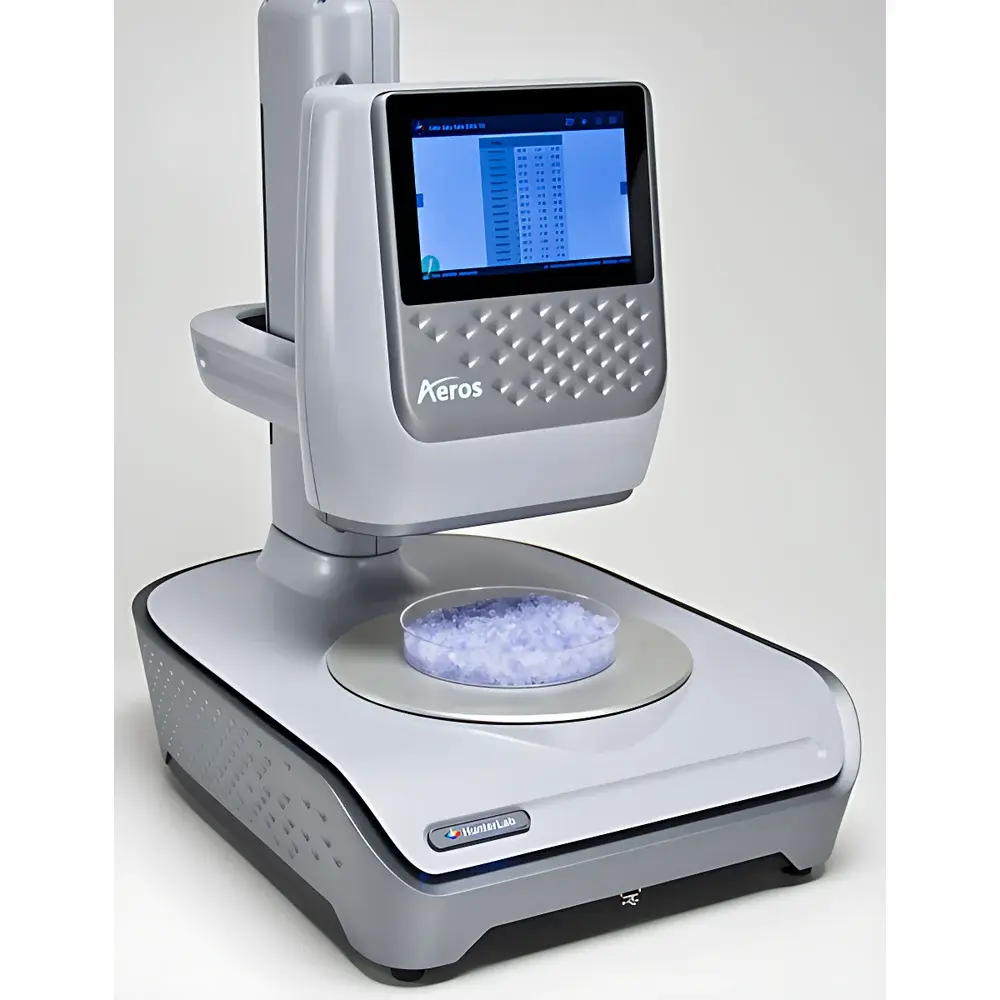
HunterLab Aeros Food Colorimeter
| Brand | HunterLab |
|---|---|
| Origin | USA |
| Model | Aeros Food Colorimeter |
| Instrument Type | Benchtop |
| Optical Geometry | 0/45° Integrating Sphere |
| Light Source | Full-Spectrum LED (Cool White) |
| Spectral Range | 400–700 nm |
| Repeatability | ≤0.03 ΔE* (CIE Lab, mean of 35 measurements) |
| Measurement Area | Up to 223.2 cm² (34.6 in²) |
| Interface | Capacitive Touchscreen Display |
| Software | EasyMatch ESSENTIAL (Standalone & PC-Connectable) |
| Connectivity | Ethernet, USB, Wi-Fi, Email Export, LIMS/SPC Integration, Remote Diagnostic Support (HunterLab Connect) |
Overview
The HunterLab Aeros Food Colorimeter is a benchtop spectral color measurement instrument engineered for high-precision, non-contact color evaluation of heterogeneous, textured, and irregularly shaped food and industrial materials. Operating on the CIE 0/45° geometry with an integrating sphere optical system, the Aeros complies with ISO 5-4:2022 and ASTM E308–22 standards for colorimetric measurement, ensuring metrological traceability and inter-laboratory comparability. Its full-spectrum LED illuminant provides stable, cool-white illumination across the visible range (400–700 nm), eliminating thermal drift and lamp aging effects common in tungsten-halogen sources. Unlike contact-based colorimeters, the Aeros employs a fixed-focus, height-sensing optical head that automatically adjusts to optimal working distance—enabling consistent measurement standoff without physical sample compression or surface deformation. This architecture is especially critical for delicate, friable, or hygroscopic food matrices such as roasted coffee beans, cheese curds, ground spices, or extruded snack pellets.
Key Features
- Non-contact measurement via integrated ultrasonic height sensor—ensures repeatable optical path length independent of sample topography or bulk density variations.
- Motorized 360° rotating test stage with programmable dwell time; captures 35 spatially distributed readings per rotation cycle (completed in <5 seconds), delivering statistically robust mean color values (L*, a*, b*, ΔE*, whiteness/yellowness indices).
- Sealed, maintenance-free optical module with long-life full-spectrum LED source (>100,000 hours rated lifetime) and dust-resistant optical train—designed for continuous operation in production-floor environments.
- Integrated 7-inch capacitive touchscreen interface with intuitive icon-driven workflow; no external PC required for routine measurement, pass/fail evaluation, or report generation.
- HunterLab Connect remote support infrastructure enables secure, encrypted technician access for real-time diagnostics, firmware updates, and guided operator training—fully compliant with FDA 21 CFR Part 11 audit trail requirements when paired with EasyMatch QC software.
Sample Compatibility & Compliance
The Aeros accommodates samples up to 223.2 cm² in planar area and up to 120 mm in height, making it suitable for whole-food units (e.g., intact fruit slices, baked goods, meat cuts), bulk particulates (e.g., cereal grains, nut fragments, plastic resin pellets), and textured surfaces (e.g., extruded snacks, fermented dairy products). Its non-contact design eliminates cross-contamination risk and preserves sample integrity—critical for microbiological or sensory testing workflows. The instrument meets IEC 61000-6-3 (EMC) and IEC 61010-1 (safety) standards. Measurement algorithms adhere to CIE Publication No. 15:2018 and ISO/CIE 11664 series for color space computation, and data export formats (CSV, XML, PDF) support GLP/GMP documentation requirements including electronic signatures and revision-controlled metadata.
Software & Data Management
EasyMatch ESSENTIAL provides embedded instrument control, statistical process monitoring (SPC), and customizable pass/fail tolerancing using CMC, DE2000, or user-defined delta-Lab limits. When connected to a networked PC, EasyMatch QC extends functionality with multi-instrument fleet management, automated calibration verification logs, and 21 CFR Part 11-compliant audit trails—including user action timestamps, parameter change history, and electronic signature capture. Raw spectral data (10-nm intervals) and derived colorimetric values are exportable directly to LIMS (e.g., Thermo Fisher SampleManager, LabVantage), MES platforms, or cloud-based SPC systems via standard TCP/IP protocols. Email reporting supports SMTP authentication and TLS encryption; print output is compatible with IPP, AirPrint, and legacy Windows drivers.
Applications
The Aeros serves quality assurance laboratories in food manufacturing, ingredient supply, and regulatory compliance settings. Typical use cases include batch-to-batch consistency validation of roasted coffee (agtron scoring correlation), color uniformity assessment of confectionery coatings, quantification of browning in minimally processed fruits, evaluation of pigment dispersion in fortified cereals, and specification conformance testing of food-grade plastics (e.g., ISO 11476-compliant packaging films). Its spatial averaging capability also supports R&D applications such as formulation optimization under varying processing conditions (e.g., drying temperature, Maillard reaction kinetics) where surface heterogeneity must be resolved without destructive sampling.
FAQ
Does the Aeros require annual recalibration by a certified lab?
No—HunterLab instruments are factory-calibrated against NIST-traceable standards. Users perform daily verification using supplied ceramic tile standards; formal recalibration is recommended every 12–24 months depending on usage intensity and internal QA policy.
Can the Aeros measure transparent or translucent liquids?
Not natively—the 0/45° geometry is optimized for opaque, diffusely reflecting solids. For liquid applications, HunterLab recommends the UltraScan VIS or MiniScan EZ with transmission cell accessories.
Is spectral data accessible for third-party chemometric modeling?
Yes—EasyMatch exports full reflectance spectra (400–700 nm @ 10-nm intervals) in CSV format, enabling integration with MATLAB, Unscrambler, or Python-based PLS regression pipelines.
What cybersecurity protocols govern remote access sessions?
HunterLab Connect uses AES-256 encryption, TLS 1.2+ handshaking, and session-limited one-time tokens; all remote connections require explicit user authorization and generate immutable audit records within the instrument’s local database.






