
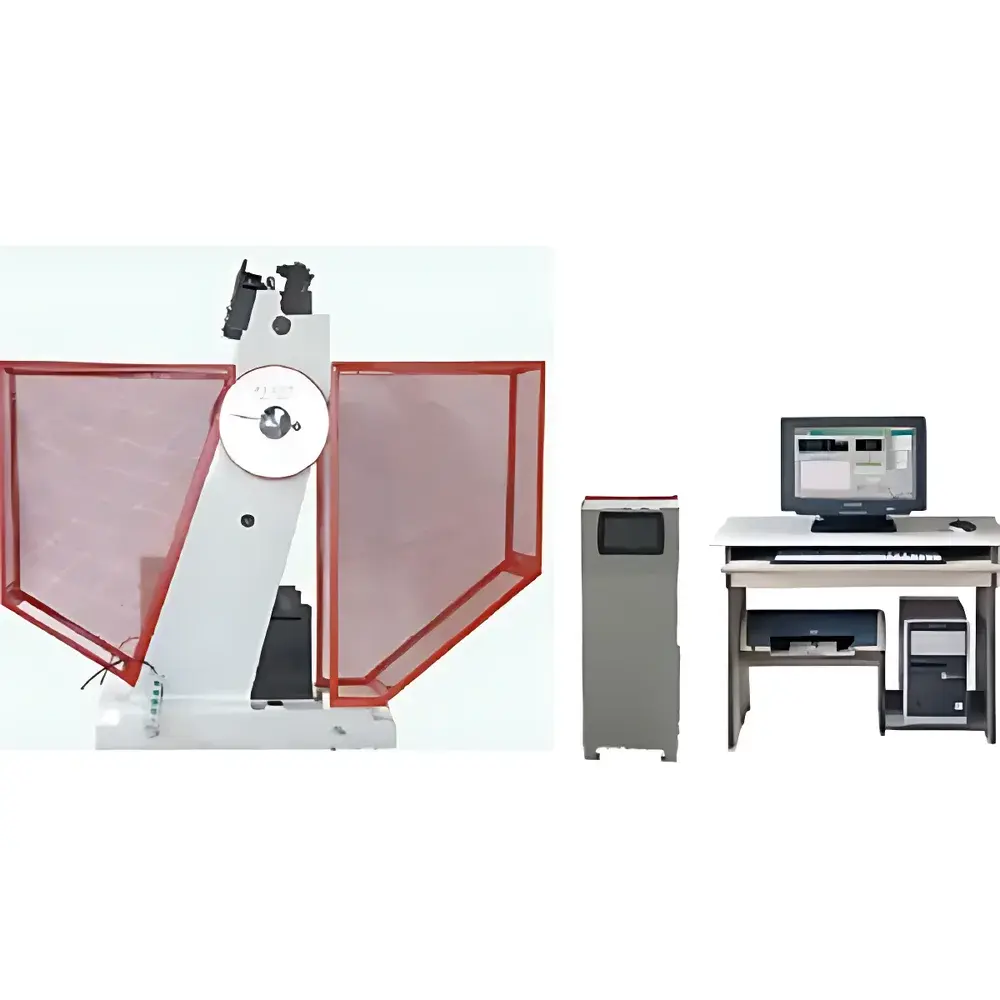
YANRUN JBW-500B Semi-Automatic Pendulum Impact Testing Machine with Microcomputer Control
| Brand | YANRUN |
|---|---|
| Origin | Shanghai, China |
| Manufacturer Type | Direct Manufacturer |
| Region of Origin | Domestic (China) |
| Model | JBW-500B |
| Instrument Type | Pendulum Impact Tester |
| Nominal Impact Energies | 250 J, 500 J |
| Impact Velocity | 5.4 m/s |
| Pendulum Arm Length (from axis to impact point) | 800 mm |
| Specimen Support Span | 40 mm |
| Anvil Radius (notch support) | R1–R1.5 mm |
| Striking Edge Radius | R2–R2.5 mm |
| Striking Blade Thickness | 16 mm |
| Angular Accuracy | ±0.1° |
| Standard Specimen Dimensions | 10 mm × 10 mm × 55 mm |
| Overall Dimensions (L×W×H) | 2300 mm × 600 mm × 1400 mm |
| Net Weight | 550 kg |
| Power Supply | 3-phase AC 380 V ±10%, 50 Hz, 5 A |
| Environmental Requirements | Non-corrosive atmosphere, vibration-free installation site, absence of strong electromagnetic interference |
Overview
The YANRUN JBW-500B Semi-Automatic Pendulum Impact Testing Machine is a precision-engineered instrument designed for Charpy and Izod impact testing of metallic and polymeric materials in accordance with international standards including ISO 148-1, ASTM E23, GB/T 229, and EN 10045-1. It operates on the principle of gravitational potential energy conversion: a calibrated pendulum is raised to a defined pre-lift angle (150°), released, and allowed to strike a notched specimen supported across a fixed span. The energy absorbed during fracture—calculated from the difference between initial and residual pendulum height—is quantified in joules and serves as a critical indicator of material toughness under dynamic loading conditions. The JBW-500B supports dual nominal impact energies (250 J and 500 J), enabling rigorous evaluation across low- to high-toughness material classes—from aluminum alloys and structural steels to engineering thermoplastics and composites.
Key Features
- Microcomputer-controlled semi-automatic operation with integrated motorized pendulum lifting, release, and braking functions—minimizing operator dependency and enhancing test repeatability.
- Dual-energy pendulum configuration: interchangeable 250 J and 500 J hammers, each dynamically calibrated and traceable to national metrological standards.
- High-precision angular measurement system with ±0.1° resolution, ensuring accurate energy calculation per ISO 148-2 requirements.
- Robust cast-iron frame with vibration-damping base and rigid 800 mm pendulum arm length—optimized for mechanical stability and minimal energy loss during impact.
- Comprehensive safety architecture: interlocked safety guard with photoelectric sensor (IEC 61496-1 compliant), mechanical overtravel limiter, and automatic pendulum arrest post-fracture.
- Standardized specimen handling accessories: alignment gauge for precise notch positioning, support span calibrator (40 mm), and blade-edge verification tools conforming to ASTM E23 geometry tolerances.
Sample Compatibility & Compliance
The JBW-500B accommodates standard Charpy V-notch (CVN) and U-notch specimens measuring 10 mm × 10 mm × 55 mm, with optional fixtures available for sub-size geometries (e.g., 7.5 mm or 5 mm square cross-sections) per ASTM E23 Annex A2. All mechanical components—including striking edge radius (R2–R2.5 mm), anvil radius (R1–R1.5 mm), and blade thickness (16 mm)—are manufactured and verified to meet ISO 148-2 dimensional specifications. The system supports full compliance with GLP documentation workflows: test parameters, operator ID, timestamp, and raw energy values are logged automatically and exportable in CSV or PDF formats for audit readiness. While not inherently 21 CFR Part 11 compliant, the software architecture permits integration with validated LIMS environments where electronic signatures and audit trails are externally managed.
Software & Data Management
The bundled impact analysis software, running on a dedicated Lenovo industrial PC, provides real-time graphical display of pendulum trajectory, energy absorption curves, and fracture classification prompts (ductile/brittle transition assessment). Test sequences are programmable with user-defined pass/fail thresholds, batch numbering, and multi-specimen statistical reporting (mean, SD, CV%). Data export supports ISO/IEC 17025-aligned reporting templates, including uncertainty estimation per GUM (Guide to the Expression of Uncertainty in Measurement) principles. Raw angular encoder data and trigger timestamps are stored at 10 kHz sampling rate, enabling retrospective waveform analysis for failure mode diagnostics. Printer output (A4) generates calibrated test certificates with embedded digital signatures and equipment calibration status metadata.
Applications
This instrument is routinely deployed in metallurgical laboratories, foundry QA departments, aerospace component certification facilities, and polymer R&D centers. Typical use cases include: monitoring ductile-to-brittle transition temperature (DBTT) shifts in pipeline steels following thermal aging; verifying impact resistance of automotive bumper substrates after UV exposure cycling; validating heat treatment efficacy in forged crankshafts; and supporting ISO 9001:2015 Clause 8.5.1 production process validation for safety-critical castings. Its 550 kg mass and rigid foundation design ensure minimal environmental coupling—making it suitable for shared lab spaces where adjacent equipment may generate low-frequency vibrations.
FAQ
What standards does the JBW-500B comply with for impact testing?
It meets the mechanical and procedural requirements of ISO 148-1, ASTM E23, GB/T 229, and EN 10045-1 for Charpy impact testing.
Can the system be upgraded to fully automatic operation?
Yes—optional robotic specimen loaders and auto-notch inspection modules are available as factory-installed retrofits.
Is calibration certification included with delivery?
Each unit ships with a factory calibration report traceable to CNAS-accredited reference standards, valid for 12 months.
What maintenance intervals are recommended?
Biannual verification of pendulum moment of inertia, bearing preload, and optical encoder linearity is advised; full recalibration every 24 months or after 5,000 impacts.
Does the software support networked data sharing?
The system features Ethernet connectivity and OPC UA-compatible drivers for seamless integration into enterprise MES or QMS platforms.



