
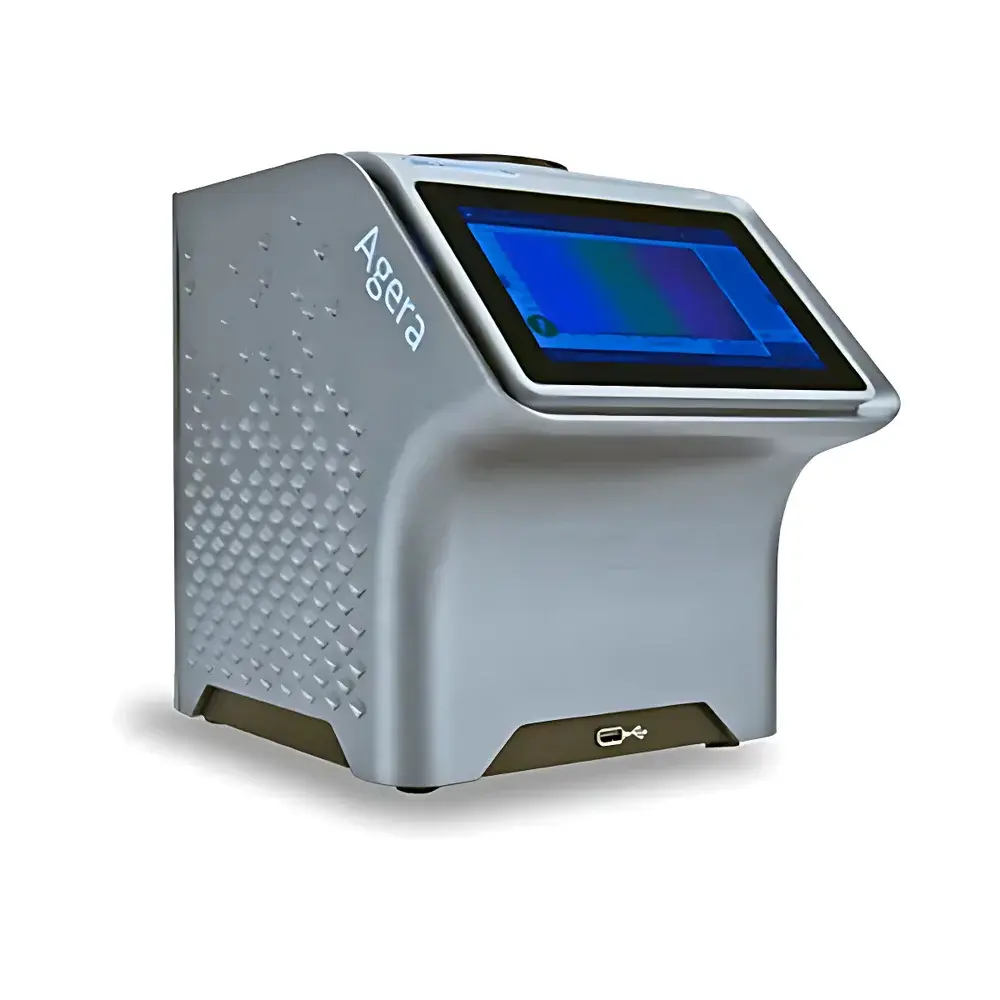
HunterLab Agera Yellow Index Analyzer
| Brand | HunterLab |
|---|---|
| Origin | USA |
| Manufacturer Type | Authorized Distributor |
| Import Status | Imported |
| Model | Agera |
| Product Category | Color Difference Meter |
| Instrument Type | Benchtop |
| Optical Geometry | 0/45° Integrating Sphere |
| Light Source | Full-Spectrum Balanced LED Array |
| Spectral Range | 400 nm – 700 nm |
| Repeatability | ΔYI ≤ 0.03 |
| Gloss Measurement | 60°, compliant with ASTM D523 and ISO 2813 |
| UV Filter Function | Switchable UV-included / UV-excluded modes with factory-calibrated UV correction |
| Aperture Sizes | 2" (50.8 mm), 1" (25.4 mm), 5/8" (15.89 mm) |
| Built-in Camera | 5 MP, 45° coaxial illumination |
| Display | High-resolution color touchscreen |
| Data Export | USB flash drive |
| Remote Support | Secure cloud-enabled diagnostic & firmware update capability |
Overview
The HunterLab Agera Yellow Index Analyzer is a precision benchtop color measurement instrument engineered for quantitative assessment of yellowing in materials where color stability, aging resistance, or fluorescence response is critical. It operates on the principle of spectrophotometric reflectance measurement using a 0/45° optical geometry — a configuration standardized for non-directional surface color evaluation and widely adopted in quality control labs across regulated industries. The instrument employs a full-spectrum balanced LED array as its primary light source, delivering stable spectral power distribution across the visible range (400–700 nm), eliminating the intensity drift and warm-up variability associated with xenon or tungsten-halogen sources. This photometric stability directly contributes to the instrument’s exceptional repeatability (ΔYI ≤ 0.03), enabling detection of subtle chromatic shifts over time — essential for accelerated aging studies, raw material qualification, and batch-to-batch consistency verification.
Key Features
- High-resolution color touchscreen interface enabling direct instrument operation, real-time data visualization, and on-device pass/fail decision support without external hardware.
- Integrated 5-megapixel camera with 45° coaxial full-spectrum illumination ensures precise sample framing and spatially consistent illumination for heterogeneous or textured surfaces.
- Dual-mode UV filtration: switchable UV-included and UV-excluded measurement modes, with traceable factory calibration against fluorescent reference standards per ASTM E308 and ISO/CIE 11664-4.
- Triple-aperture system (50.8 mm, 25.4 mm, and 15.89 mm) accommodates diverse sample geometries — from large polymer sheets to small granules or powder samples in standard cups.
- Simultaneous color + gloss measurement: integrated 60° gloss sensor complies with ASTM D523 and ISO 2813, with NIST-traceable calibration certificate supplied with each unit.
- Secure remote connectivity via encrypted cloud architecture allows authorized HunterLab service engineers to perform diagnostics, push validated firmware updates, and deliver live operator training — fully auditable and compliant with internal IT security policies.
Sample Compatibility & Compliance
The Agera supports rigid, semi-rigid, and powdered samples across industrial sectors including petrochemicals (e.g., polyolefin pellets, lubricant oils), coatings (coil-coated metals, architectural paints), plastics (PVC, polycarbonate, ABS), textiles (yarns, woven fabrics), food packaging films, and pharmaceutical excipients. Its 0/45° geometry minimizes directional bias from surface texture or specular highlights, ensuring metrological equivalence with visual assessment under controlled viewing conditions. All optical calibrations are traceable to NIST SRMs. Instrument software supports IQ/OQ documentation packages aligned with FDA 21 CFR Part 11 requirements, including electronic signatures, audit trails, and user access controls. Routine verification follows ASTM D6290 (Standard Practice for Instrumental Color Evaluation of Yellowing) and ISO 105-A02 (Textiles — Tests for Color Fastness — Grey Scale for Assessing Change in Colour).
Software & Data Management
HunterLab EasyMatch QC software (v6.0+) provides comprehensive data management: customizable test methods, statistical process control (SPC) charting, multi-instrument network synchronization, and automated report generation (PDF, CSV, XML). Raw spectral data (10 nm intervals) and derived indices — YI (ASTM E313, ASTM D1925, ISO 105-J02), whiteness (CIE Whiteness, Ganz), L*a*b*, ΔE00, and gloss values — are stored with full metadata (operator ID, timestamp, aperture, UV mode, calibration status). Data export is supported via USB mass storage class — no proprietary drivers required. Audit trail logs record all parameter changes, calibration events, and user actions, satisfying GLP and GMP documentation requirements for regulated laboratories.
Applications
- Quantifying thermal or UV-induced yellowing in polymeric materials during accelerated weathering tests (ASTM G154, ISO 4892-3).
- Monitoring oxidation stability in base oils and finished lubricants per ASTM D1500 and ASTM D5532.
- Verifying color consistency of titanium dioxide pigments and organic yellow dyes in paint formulation.
- Assessing browning reactions in food-grade packaging films exposed to heat or light.
- Validating fluorescence suppression in pharmaceutical tablet coatings where UV-excited additives may interfere with YI accuracy.
- Correlating instrumental YI values with sensory panel assessments in textile aging studies per AATCC TM183.
FAQ
What yellow index standards does the Agera support?
The instrument calculates YI per ASTM E313 (for general-purpose materials), ASTM D1925 (for plastics), and ISO 105-J02 (for textiles), with selectable illuminant/observer combinations (C/2°, D65/10°).
Is the gloss measurement certified?
Yes — the 60° gloss sensor is calibrated against NIST-traceable ceramic standards and shipped with an ISO/IEC 17025-accredited certificate of calibration.
Can UV correction be customized for proprietary fluorescent standards?
Yes — HunterLab offers optional custom UV calibration services using customer-supplied fluorescent references, documented per ISO/IEC 17025 procedures.
Does the remote support feature require permanent internet connectivity?
No — remote sessions are initiated on-demand by the user via secure TLS-encrypted handshake; no inbound ports need to be opened, and session logs are retained locally for compliance review.



