
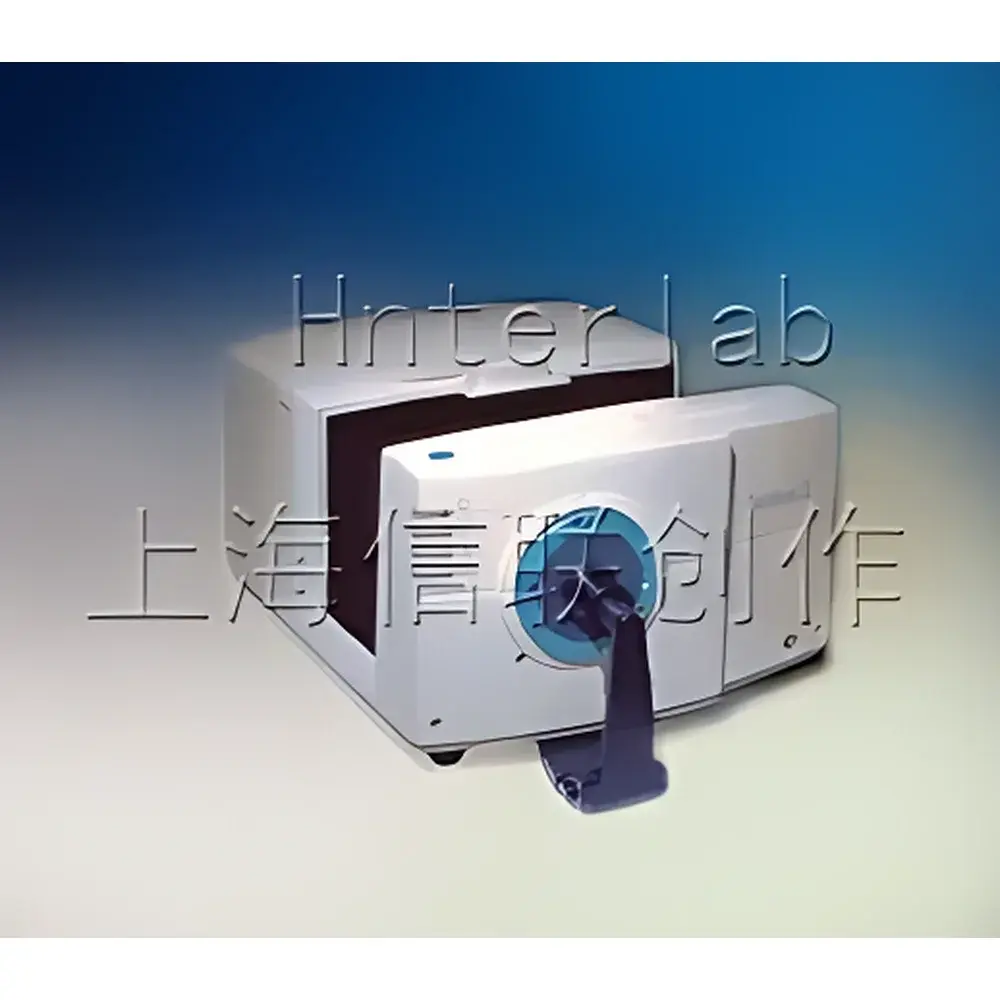
HunterLab ColorQuest XE Benchtop Spectrophotometer
| Brand | HunterLab |
|---|---|
| Origin | USA |
| Product Type | Spectrophotometric Colorimeter |
| Instrument Type | Benchtop |
| Optical Geometry | d/8° Integrating Sphere |
| Light Source | Pulsed Xenon Lamp |
| Spectral Range | 400–700 nm |
| Repeatability | ΔE*ab ≤ 0.03 |
| Spectral Resolution | < 3 nm |
| Wavelength Accuracy | ±0.1 nm |
| Effective Bandwidth | 10 nm (Triangular) |
| Integrating Sphere Diameter | 152 mm |
| Sphere Coating | Spectraflect® |
| Large Area View (LAV) | 25.4 mm illumination / 19.0 mm measurement |
| Small Area View (SAV) | 9.5 mm illumination / 6.3 mm measurement (optional) |
| Micro Area View (MAV) | 4 mm measurement (optional) |
| LAV/SAV Lens Switching | Motorized Auto-Selection |
| Specular Component | Configurable (SCI or SCE mode, motorized) |
Overview
The HunterLab ColorQuest XE is a precision-engineered benchtop spectrophotometer designed for rigorous color measurement and quantitative spectral analysis in both laboratory and production environments. Operating on the principle of dual-beam spectral photometry, it employs a high-stability pulsed xenon lamp and a 256-element diode array detector coupled with a high-resolution concave holographic grating to deliver rapid, reproducible spectral data across the visible spectrum (400–700 nm). Its d/8° integrating sphere geometry—compliant with CIE, ASTM E308, ISO 7724, and USP —ensures consistent illumination and collection of diffuse reflectance and transmittance, accommodating directional and diffuse components as required by industry-standard color evaluation protocols. The 152 mm integrating sphere, internally coated with Spectraflect®—a barium sulfate–based highly reflective, Lambertian material—provides exceptional signal-to-noise ratio and long-term photometric stability. With wavelength accuracy of ±0.1 nm and spectral resolution under 3 nm, the instrument meets the metrological requirements for method validation under GLP and GMP frameworks.
Key Features
- Motorized, software-controlled switching between Large Area View (LAV), Small Area View (SAV), and Micro Area View (MAV) apertures—enabling seamless adaptation to sample heterogeneity and size constraints without manual recalibration.
- Automated specular component inclusion/exclusion (SCI/SCE modes), supporting both total appearance (including gloss) and surface-normalized color assessment per ASTM D2244 and ISO 11664-4.
- Pulsed xenon light source eliminates thermal drift and lamp aging effects, ensuring stable spectral output over extended operational cycles—critical for long-term instrument qualification (IQ/OQ/PQ) and 21 CFR Part 11–compliant workflows.
- Integrated temperature and humidity sensors monitor ambient conditions during measurement, allowing real-time environmental correction and traceable metadata logging.
- Rugged aluminum chassis with EMI-shielded optical enclosure and vibration-damped base minimizes mechanical interference, supporting installation on production-line benches or shared lab workstations.
Sample Compatibility & Compliance
The ColorQuest XE accommodates opaque, translucent, transparent, and liquid samples—including powders, pastes, films, molded plastics, textiles, coatings, pharmaceutical suspensions, and beverage solutions—via standardized holders and optional accessories (e.g., transmission cells, powder cups, and liquid cuvette adapters). Its optical design supports measurement of reflectance, transmittance, haze (ASTM D1003), APHA/Pt-Co (ASTM D1209), Yellowness Index (ASTM E313), Whiteness Index (CIE/ISO 11475), opacity, and contrast ratio—all calculated directly from raw spectral data using NIST-traceable algorithms. The system conforms to FDA 21 CFR Part 11 requirements when deployed with HunterLab’s QualiSpect™ software suite, including electronic signatures, audit trails, user role management, and secure data archiving.
Software & Data Management
Operated via HunterLab’s QualiSpect™ v5.x platform—a Windows-based application validated for regulated environments—the instrument supports full spectral data export (CSV, XML, .qtx), custom index formulation, pass/fail tolerancing with delta-L*, delta-a*, delta-b*, and delta-E*ab limits, and statistical process control (SPC) charting. Data integrity is enforced through time-stamped audit logs, version-controlled method files, and encrypted database storage. Integration with LIMS and MES systems is achieved via OPC UA and RESTful API interfaces. All firmware and calibration files are digitally signed and checksum-verified upon upload, satisfying ALCOA+ (Attributable, Legible, Contemporaneous, Original, Accurate, Complete, Consistent, Enduring, Available) data governance principles.
Applications
The ColorQuest XE serves as a primary color measurement platform across vertically regulated sectors: in pharmaceutical manufacturing, it verifies excipient whiteness and solution clarity per USP and ; in automotive coatings, it validates batch-to-batch hue consistency against OEM color standards; in food and beverage R&D, it quantifies browning indices and pigment stability under accelerated aging; in paper and packaging, it measures brightness (ISO 2470-1) and yellowness under multiple illuminants (D65, A, F2); and in polymer compounding, it tracks thermal degradation-induced chromatic shifts via time-resolved spectral acquisition.
FAQ
Does the ColorQuest XE support compliance with ISO/IEC 17025 for accredited testing laboratories?
Yes—when operated with documented calibration procedures, annual NIST-traceable verification standards, and validated methods, the system satisfies clause 6.4.10 (measurement traceability) and 7.7 (uncertainty estimation) requirements.
Can the instrument measure APHA color in liquid samples below 100 APHA units?
Yes—its low-noise diode array and optimized path-length optics enable reliable APHA quantification down to 5 APHA with CV < 1.2% (n=10, 10-mm cell).
Is remote diagnostics and firmware update capability available?
Yes—via secure HTTPS-based connection to HunterLab’s SupportLink™ portal, enabling authenticated remote troubleshooting and version-controlled firmware deployment with rollback functionality.
What is the recommended calibration frequency for routine QC use?
HunterLab recommends daily verification with a white ceramic tile and annual full recalibration using factory-certified standards; interval adjustments may be justified per risk-based assessment per ICH Q9.
Does the system provide uncertainty budgets for color difference reporting?
Yes—QualiSpect™ generates expanded uncertainty (k=2) estimates for ΔE*ab based on repeatability, inter-instrument agreement, standard reference material uncertainty, and environmental influence factors.




