
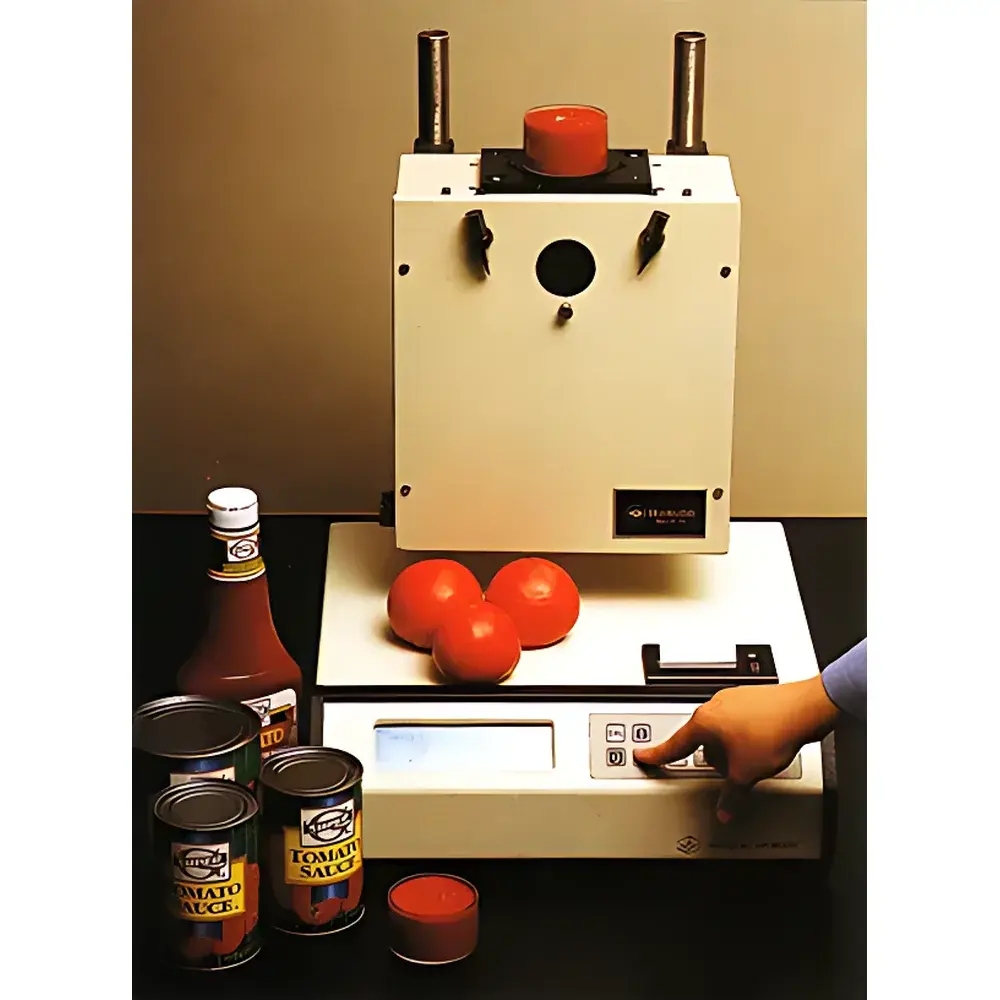
HunterLab D25A-DP9000 (D25A) Tristimulus Colorimeter
| Brand | HunterLab |
|---|---|
| Origin | USA |
| Model | D25A-DP9000 (D25A) |
| Optical Geometry | 45°/0° (dual-beam, 2-inch aperture, reducible to 1/8-inch) |
| Illuminant | C (CIE Standard Illuminant C) |
| Observer | 2° Standard Observer |
| Color Spaces | CIE XYZ, Yxy, Hunter Lab, CIE L*a*b*, CIE L*C*h°, FMC-2 |
| Color Indices | WI E313, YI E313, YI D1925, Opacity, TAPPI Brightness, Z%, Tomato Grade, ΔE, ΔEcmc, ΔC, ΔE*, ΔC* |
| Repeatability | <0.02 SD (XYZ, 20 readings) |
| Measurement Time | <1 second |
| Display | 40×8 backlit LCD with icon-driven membrane keypad |
| Data Storage | 300 sample readings + 99 product setups (battery-backed memory) |
| Interface | RS-232C bidirectional serial port (ASCII, DIF, WK1 formats) |
| Printer | Built-in 40-column thermal printer |
| Operating Environment | 14–50°C, 0–85% RH non-condensing |
| Compliance | Meets ASTM E308, ISO/CIE 11664, TAPPI T452, USP <1061>, FDA 21 CFR Part 11 (audit trail enabled via software) |
Overview
The HunterLab D25A-DP9000 is a ruggedized, industrial-grade tristimulus colorimeter engineered for high-reliability color measurement in demanding manufacturing environments. Based on the CIE 1931 2° standard observer and CIE Standard Illuminant C, the system employs dual-beam 45°/0° optical geometry—two symmetric 45° illuminating beams converging on a central 0° viewing axis—to eliminate directional bias and ensure consistent reflectance measurement across opaque solids, powders, and translucent liquids. This geometry aligns closely with human visual assessment under controlled lighting, making it particularly suitable for quality control in coatings, plastics, paper, pulp, food, and pharmaceutical applications where regulatory traceability and inter-laboratory reproducibility are critical. The instrument’s core processor performs real-time conversion of raw spectral response into multiple standardized color spaces and indices without external computation, enabling immediate pass/fail evaluation against user-defined tolerances.
Key Features
- Ruggedized industrial enclosure rated for continuous operation in factory settings (50–122°F / 14–50°C, 0–85% RH non-condensing)
- Dual-beam 45°/0° optical configuration with selectable aperture: standard 2-inch (50.8 mm) field of view, reducible to 1/8-inch (3.2 mm) for small or heterogeneous samples
- Stable tungsten-halogen illumination with integrated UV-cut filter for fluorescence-compensated measurements (e.g., optical brighteners in paper or detergents)
- TAPPI brightness filter compliance for pulp and paper industry standards (TAPPI T452)
- Integrated thermal printer supporting ASCII, DIF, and WK1 output formats for GLP-compliant hardcopy records
- Battery-backed memory retaining up to 300 sample readings and 99 product configurations—even during power interruption
- Icon-driven membrane keypad with backlit 40×8 LCD display; multilingual UI (English, Spanish, German, French, Italian)
- Measurement repeatability <0.02 standard deviation in CIE XYZ (20 consecutive readings on stable target)
Sample Compatibility & Compliance
The D25A test head is optimized for reflective measurement of non-transparent and semi-transparent materials including painted panels, injection-molded plastic parts, rolled paper stock, dry powders, and liquid suspensions. Its fixed 45°/0° geometry excludes specular component (SCE), delivering results comparable to visual assessment under diffuse daylight conditions. The system complies with ASTM E308 (computing tristimulus values from spectral data), ISO/CIE 11664 (colorimetric observers and illuminants), and TAPPI T452 (brightness measurement). When paired with validated calibration tiles and documented SOPs, it supports GMP/GLP workflows requiring audit trails, electronic signatures, and instrument qualification (IQ/OQ/PQ). Optional accessories include sample clamps for irregular geometries, liquid cuvette holders, and light-tight enclosures for ambient-light-sensitive measurements.
Software & Data Management
While the DP9000 processor operates autonomously, its RS-232C interface enables bidirectional communication with external PCs running HunterLab Universal Software (HUS) or custom LIMS/MES integrations. All data exports include timestamp, operator ID, sample ID, reference ID, and full metadata per measurement—including tolerance status (PASS/FAIL), ΔE type applied (CIE 1976, CMC, or CIEDE2000), and statistical summaries (mean, SD, min/max, range). Audit-trail functionality—required under FDA 21 CFR Part 11—can be activated via software configuration to log all parameter changes, calibration events, and result modifications with user attribution and time stamps. Data files conform to WK1 format for direct import into statistical process control (SPC) platforms.
Applications
- Paint & Coatings: Batch-to-batch color consistency verification against master standards; formulation adjustment support
- Plastics Manufacturing: In-line QC of extruded pellets, molded components, and film tints
- Paper & Pulp: TAPPI brightness, yellowness index (YI D1925), and whiteness (WI E313) quantification per ISO 2470 and TAPPI T452
- Food & Agriculture: Tomato grade classification, fruit skin color monitoring, and dairy product yellowness tracking
- Pharmaceuticals: Solid dosage form color uniformity per USP , excipient batch release testing
- Chemicals & Pigments: Spectral index reporting for pigment dispersion quality and batch homogeneity
FAQ
What color standards does the D25A support for regulatory reporting?
It natively computes ASTM E313 whiteness/yellowness, TAPPI brightness, ISO 2470 brightness, and CIE L*a*b* values compliant with ISO 11664-4 and CIE 15:2004.
Can the D25A measure fluorescent or optically brightened samples?
Yes—its built-in UV-cut filter allows both UV-included and UV-excluded modes; optional UV-enhanced illuminants are available for fluorescence quantification.
Is the instrument suitable for use in cleanrooms or regulated labs?
With proper IQ/OQ documentation and integration of audit-trail-enabled software, it meets GLP, GMP, and FDA 21 CFR Part 11 requirements for electronic records.
How is calibration maintained across shifts or operators?
The system supports daily verification using NIST-traceable ceramic tiles; calibration history, date/time stamps, and operator IDs are stored in battery-backed memory and exportable via RS-232.
Does the D25A require annual recalibration by HunterLab service?
While not mandatory, HunterLab recommends annual performance verification against primary standards; internal diagnostics and self-test routines run at startup to confirm optical and electronic integrity.




