
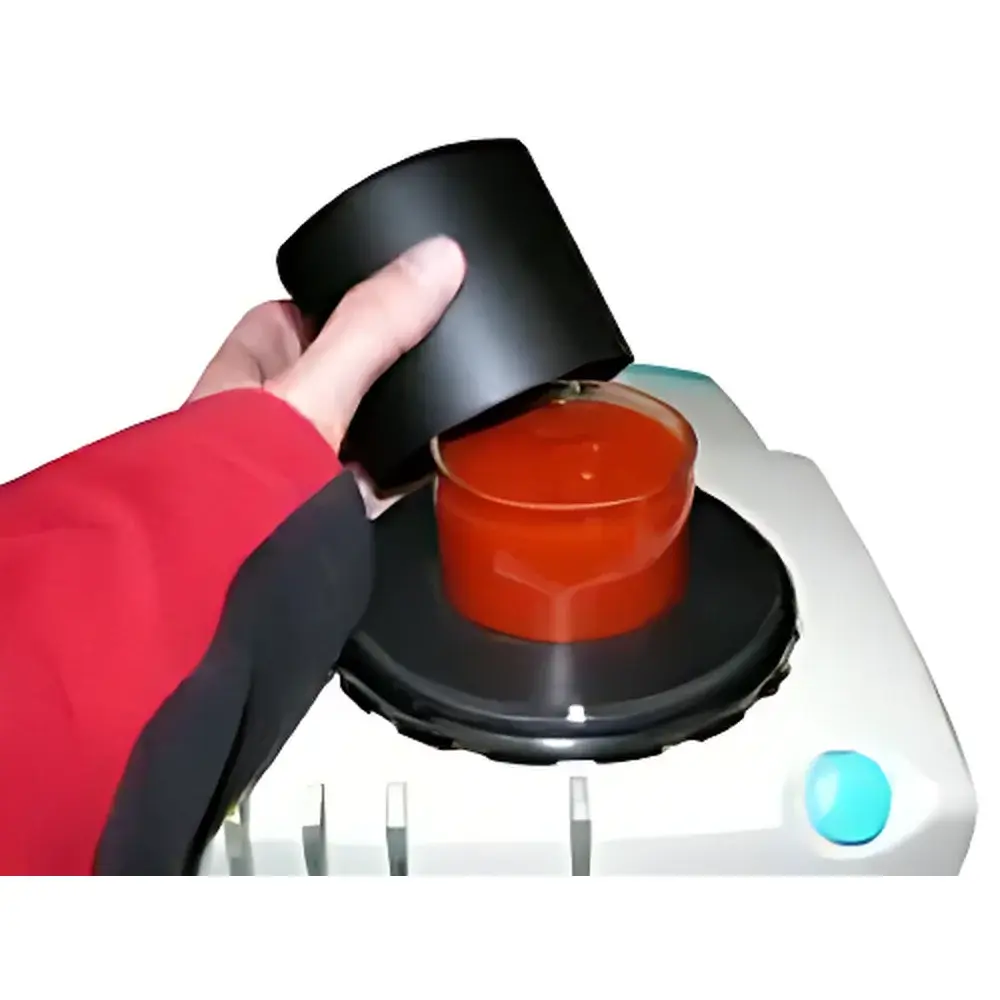
HunterLab LabScan XE Tomato Desktop Color Measurement System
| Brand | HunterLab |
|---|---|
| Origin | USA |
| Model | LabScan XE Tomato |
| Instrument Type | Benchtop |
| Optical Geometry | 0°/45° Integrating Sphere |
| Light Source | Pulsed Xenon Lamp (D65 Simulator) |
| Spectral Range | 400–700 nm |
| Reporting Interval | 10 nm |
| Detector | 256-element Silicon Photodiode Array with Holographic Diffraction Grating |
| Aperture Size | 44 mm (LAV) |
| Reflectance Mode | Yes |
| Photometric Range | 0–150% |
| Repeatability | ≤0.08 ΔE*ab (SRM Standard, 10 readings) |
| Measurement Time | ≤3 s |
| Compliance | ASTM D2244, ISO 11664-4, CIE No. 15:2018, USP <1061>, FDA 21 CFR Part 11 Ready (with EasyMatch-QC v5.0+) |
| Power Supply | 100–240 VAC, 47–63 Hz |
| Operating Temperature | 10–40 °C |
| Storage Temperature | −20–70 °C |
| Relative Humidity | 10–90% RH (non-condensing) |
Overview
The HunterLab LabScan XE Tomato is a purpose-engineered benchtop color measurement system optimized for quantitative color assessment across the full spectrum of tomato-derived products—including whole fruit, paste, sauce, purée, ketchup, and seasoned concentrates. Based on dual-beam 0°/45° optical geometry with an integrating sphere, the instrument delivers high photometric stability and eliminates directional bias inherent in directional reflectance systems. Its pulsed xenon light source closely simulates CIE Standard Illuminant D65 across the visible spectrum (400–700 nm), ensuring metrological traceability to international colorimetric standards. The system employs a holographic diffraction grating and 256-channel silicon photodiode array to resolve spectral reflectance at 10 nm intervals—enabling precise calculation of CIE L*a*b*, Hunter L,a,b, and industry-specific indices including the UC Davis Tomato Color Index (TCI), Tomato Juice Color Value (TJCV), and Tomato Paste Color Value (TPCV). Designed for routine QC environments, it operates without warm-up time and maintains repeatability of ≤0.08 ΔE*ab under controlled conditions (per ASTM D2244), making it suitable for GLP- and GMP-aligned production monitoring.
Key Features
- Dual-beam 0°/45° optical architecture with 44 mm large-area viewing (LAV) port for representative sampling of heterogeneous tomato matrices
- Pulsed xenon lamp with >1 million flash cycles and spectral output calibrated to D65 illuminant per CIE 15:2018
- Integrated UC Davis Tomato Color Index algorithm preloaded—automatically computes TCI, TJCV, TPCV, and a/b ratio per USDA-ARS and UC Davis protocols
- One-button measurement initiation via front-panel sensor; real-time status LEDs indicate calibration, sample placement, and data readiness
- RS232C serial interface standard; optional USB-to-serial adapter for legacy or modern PC integration
- Robust mechanical design with temperature-compensated optics and sealed optical path—engineered for sustained operation in ambient factory environments (10–40 °C)
Sample Compatibility & Compliance
The LabScan XE Tomato accommodates diverse physical forms without sample preparation: whole tomatoes (via custom cradle fixture), semi-solid pastes (using flat-bottom cup holders), viscous sauces (in standardized Petri dishes), and liquid extracts (in quartz cuvettes). All accessories are designed to maintain consistent 44 mm illumination/viewing geometry and minimize edge effects. The system complies with ASTM D2244 (Standard Practice for Calculating Color Tolerances), ISO 11664-4 (Colorimetry – CIE 1976 L*a*b* Colour Space), and supports audit-ready documentation per FDA 21 CFR Part 11 when used with EasyMatch-QC v5.0+ (electronic signatures, user access controls, and immutable audit trails). It also meets USP requirements for instrumental color verification in food-grade applications.
Software & Data Management
Out-of-the-box operation uses embedded firmware with intuitive menu navigation and pass/fail color judgment based on user-defined tolerances (ΔL*, Δa*, Δb*, or ΔE*ab). For advanced workflow integration, HunterLab EasyMatch-QC software provides full spectral data export (CSV, XML), SPC charting, batch reporting, and automated report generation compliant with internal QA templates. The software supports multi-user role-based access, electronic signature capture, and revision-controlled method storage—enabling alignment with ISO/IEC 17025 and ICH Q5C analytical procedure validation frameworks. All spectral scans and metadata are timestamped and stored with instrument serial number and calibration history.
Applications
- Real-time monitoring of tomato ripeness and processing consistency during harvest, sorting, and canning operations
- QC release testing of tomato paste, ketchup, and sauce against customer-specified color targets (e.g., “Grade A” USDA specifications)
- Batch-to-batch color matching in contract manufacturing of branded tomato products
- Raw material screening of tomato concentrate suppliers using UC Davis TCI thresholds
- Stability studies tracking color drift during shelf-life testing under accelerated aging conditions
- Supporting root-cause analysis of color variation linked to cultivar selection, thermal processing parameters, or storage conditions
FAQ
Does the LabScan XE Tomato support measurement of whole, uncut tomatoes?
Yes—using the optional Tomato Cradle Fixture, which positions fruit reproducibly under the 44 mm aperture while minimizing specular reflection from curved surfaces.
Can the instrument calculate both CIE and Hunter color spaces simultaneously?
Yes—spectral data is acquired once and mathematically transformed into CIE L*a*b*, Hunter L,a,b, Yellowness Index (YI E313), and custom tomato indices in real time.
Is calibration traceable to NIST standards?
Yes—HunterLab provides factory calibration certificates traceable to NIST SRM 2035 (Diffuse Reflectance Standard) and SRM 2036 (Spectral Reflectance Standard), with annual recalibration recommended.
What is the minimum sample volume required for liquid measurements?
For cuvette-based measurements, 3 mL is sufficient; for dish-based measurements of sauces, a 10 mm fill depth over the 44 mm aperture ensures full coverage and signal saturation.
Does the system meet requirements for regulated food manufacturing environments?
Yes—when deployed with EasyMatch-QC v5.0+ and configured per HunterLab’s 21 CFR Part 11 Implementation Guide, it satisfies electronic record and signature requirements for FDA-regulated facilities.




