
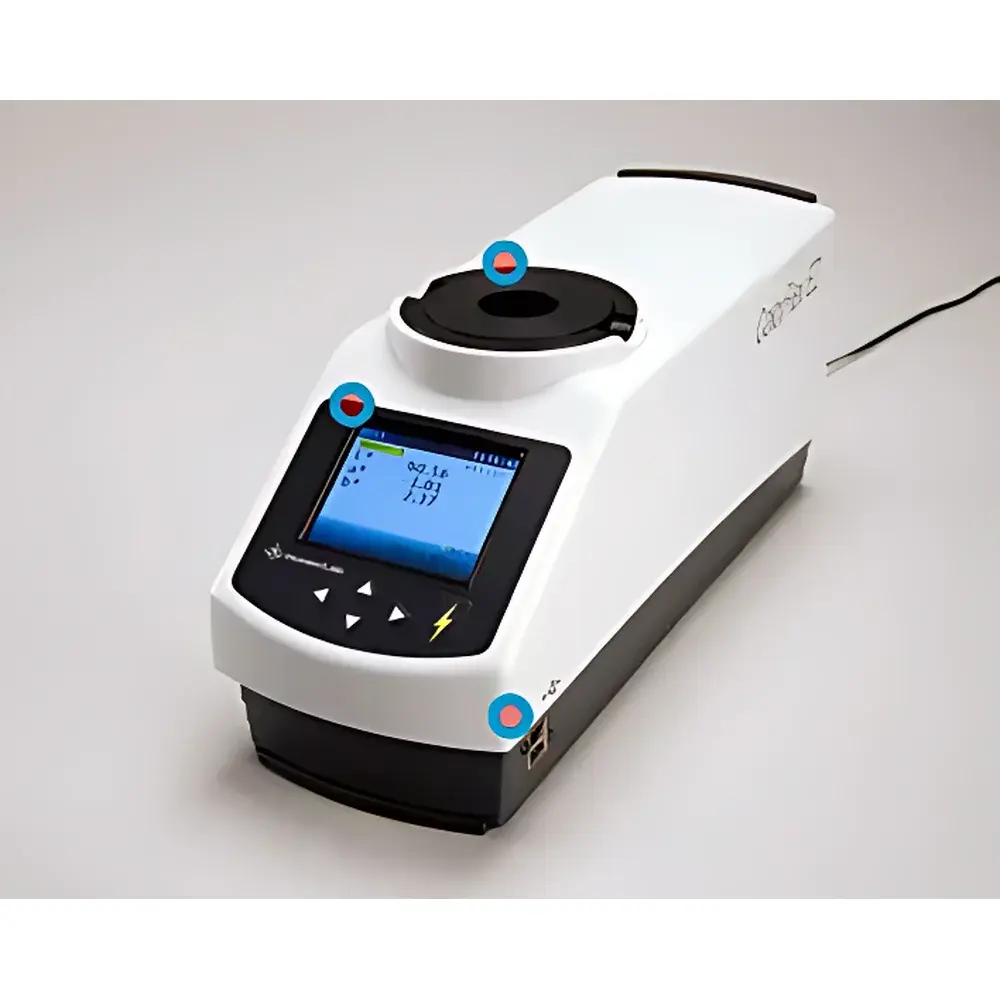
HunterLab MiniScan EZ 4000L Portable Spectrophotometer
| Brand | HunterLab |
|---|---|
| Origin | USA |
| Model | MiniScan EZ 4000L |
| Product Type | Color Difference Meter |
| Instrument Type | Portable (not online) |
| Optical Geometry | Diffuse Illumination / 8° Viewing (d/8°) |
| Measurement Aperture | 25 mm |
| View Area | 20 mm |
| Display | Backlit LCD |
| Data Storage | 100 Standards + 800 Sample Measurements |
| Averaging | Up to 20 Readings per Sample |
| Compliance | ASTM E308, ISO 7724, CIE No. 15, USP <1061>, FDA 21 CFR Part 11 (software-enabled audit trail) |
Overview
The HunterLab MiniScan EZ 4000L is a portable, high-precision spectrophotometer engineered for reliable color measurement outside the controlled environment of a laboratory. Utilizing diffuse illumination with an 8° viewing geometry (d/8°), it conforms to internationally recognized colorimetric standards—including ASTM E308, ISO 7724-1, and CIE Publication 15—ensuring traceable, repeatable reflectance-based color data across diverse industrial settings. Unlike basic colorimeters, the MiniScan EZ 4000L employs a full-spectrum silicon photodiode array detector coupled with dual-beam optical compensation, a technology traditionally reserved for benchtop instruments. This architecture minimizes drift from thermal or lamp-intensity fluctuations, delivering consistent spectral data from 400 nm to 700 nm at 10 nm intervals. Its 25 mm measurement aperture and 20 mm field-of-view enable robust sampling of textured, curved, or non-uniform surfaces while mitigating specular reflection artifacts through integrated gloss compensation algorithms.
Key Features
- Portable d/8° optical design compliant with ISO 7724-1 and ASTM E308 for standardized reflectance measurement
- 25 mm large-area aperture with 20 mm observation zone—optimized for heterogeneous, granular, or matte-finished materials
- Dual-beam spectral compensation system enhancing long-term photometric stability and inter-instrument agreement
- Ergonomic rubberized grip and one-handed operation—designed for rapid measurements in production lines, warehouses, or receiving docks
- High-contrast backlit LCD display showing real-time L*a*b*, ΔE00, spectral curves, color difference maps, and spectral deviation plots
- Onboard storage for up to 100 reference standards and 800 sample measurements with timestamping and operator ID tagging
- Configurable averaging of up to 20 consecutive scans per sample to suppress noise from surface irregularities
Sample Compatibility & Compliance
The MiniScan EZ 4000L supports measurement of opaque, translucent, and textured substrates—including plastics, paints, textiles, food products, pharmaceutical tablets, and ceramic glazes—without requiring sample preparation or calibration transfer. Its d/8° geometry with diffuse illumination ensures minimal sensitivity to surface gloss or directional texture, making it suitable for QC applications under variable ambient lighting. All color calculations adhere to CIE 1976 L*a*b* and CIEDE2000 (ΔE00) formulas. The instrument meets regulatory requirements for documented color control in GMP-compliant environments when paired with HunterLab’s EasyMatch QC software, which provides 21 CFR Part 11–compliant audit trails, electronic signatures, and role-based access control.
Software & Data Management
Data export and advanced analysis are enabled via USB or Bluetooth connectivity to HunterLab’s EasyMatch QC software (Windows-based). This platform supports method-driven workflows, statistical process control (SPC) charting, tolerance band visualization, and automated pass/fail reporting aligned with internal specifications or industry benchmarks (e.g., AATCC, RAL, Pantone, Munsell). Raw spectral data (36-point reflectance values, 400–700 nm) is exportable in CSV or XML formats for integration into LIMS or MES systems. Firmware updates and instrument configuration—including user-defined color spaces, indices (YI, WI, TCI), and custom tolerances—are managed directly through the software interface.
Applications
- Real-time color verification during raw material receipt and batch release in chemical and polymer manufacturing
- In-line quality checks of painted automotive components, powder-coated metal parts, and injection-molded housings
- Color consistency monitoring of printed packaging, labels, and flexible films across press runs
- Pharmaceutical tablet coating uniformity assessment per USP guidelines
- Food product grading (e.g., meat discoloration, fruit ripeness, coffee roast level) using calibrated spectral indices
- Textile dye lot matching and shade sorting in garment production facilities
FAQ
Is the MiniScan EZ 4000L suitable for measuring transparent or liquid samples?
No—this model is designed exclusively for reflectance measurement of solid or semi-solid opaque surfaces. For transmission or liquid applications, HunterLab recommends the UltraScan VIS or ColorFlex EZ series.
Does the instrument require annual recalibration by a certified lab?
While factory calibration is NIST-traceable, routine verification using supplied ceramic tile standards is recommended before each shift. Full recalibration is advised every 12 months or after physical impact, per ISO/IEC 17025 quality management practices.
Can measurement data be synchronized with enterprise ERP or SAP systems?
Yes—via EasyMatch QC’s ODBC-compliant database export or REST API integration, enabling bidirectional data flow with SAP QM, Oracle Quality, or custom MES platforms.
What is the typical inter-instrument agreement for MiniScan EZ units?
When measured against the same standard under identical conditions, typical ΔE00 agreement between units is ≤0.15 for white tiles and ≤0.25 for colored standards (per HunterLab’s Inter-Instrument Agreement Report, Rev. 2023).




