
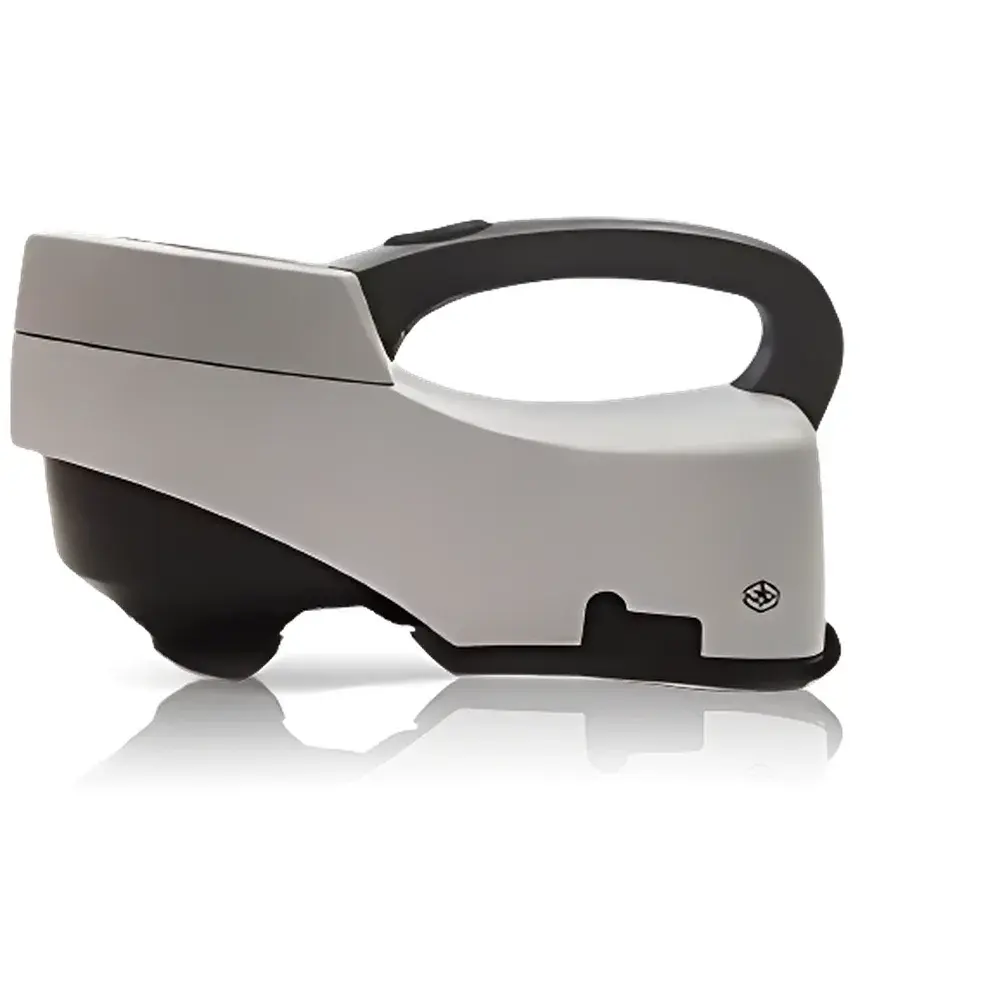
HunterLab MiniScan EZ 4000S Portable Spectrophotometer
| Brand | HunterLab |
|---|---|
| Origin | USA |
| Model | MiniScan EZ 4000S |
| Product Type | Color Difference Meter |
| Instrument Type | Portable (not online) |
| Optical Geometry | d/8° (diffuse illumination / 8° viewing, with 0/45° alternative mode per ASTM E308 & CIE 15) |
| Measurement Aperture | 14.3 mm |
| View Area | 8 mm |
| Display | Backlit LCD with graphical spectral visualization |
| Data Storage | 100 standards + 800 sample measurements |
| Averaging | Up to 20 scans per sample |
| Compliance | ASTM D2244, ASTM E308, ISO 7724-1, CIE No. 15, DIN 5033, JIS Z 8722 |
| Software Interface | USB and Bluetooth connectivity for EasyMatch QC software |
Overview
The HunterLab MiniScan EZ 4000S is a high-precision portable spectrophotometer engineered for reliable color measurement outside the controlled environment of the laboratory. Utilizing diffuse illumination with an 8° viewing angle (d/8° geometry), it conforms to internationally recognized colorimetric standards including ASTM E308, ISO 7724-1, and CIE Publication 15. This optical configuration ensures robust suppression of surface texture and gloss effects—critical for accurate reflectance-based color evaluation across heterogeneous or structured surfaces such as textured plastics, painted metals, textiles, and coated papers. Unlike basic tristimulus colorimeters, the MiniScan EZ 4000S captures full spectral data across the visible range (typically 400–700 nm, with 10 nm bandwidth), enabling calculation of all major color spaces (CIELAB, CIELCH, XYZ, Yxy), color difference metrics (ΔE*ab, ΔE00, ΔEcmc), and derived indices (Yellowness Index, Whiteness Index, Tint, Strength). Its dual-beam optical architecture—rare in handheld instruments—compensates for lamp drift and thermal variation in real time, delivering laboratory-grade repeatability even under variable ambient conditions.
Key Features
- Compact, ergonomic design with rubberized grip for stable one-handed operation in production, warehousing, or field environments
- 14.3 mm measurement aperture with 8 mm effective viewing area—optimized for small or irregularly shaped samples while minimizing edge effects
- High-contrast backlit LCD supporting simultaneous display of color coordinates, ΔE values, spectral curves, spectral difference plots, and chromaticity diagrams
- Dual-beam optical system enhancing photometric stability and long-term calibration integrity
- On-device averaging of up to 20 consecutive readings to improve statistical confidence for non-uniform materials
- Internal memory stores 100 reference standards and 800 sample measurements—fully traceable with timestamp and operator ID (when integrated with EasyMatch QC)
- USB 2.0 and Bluetooth 4.2 interfaces for seamless synchronization with HunterLab’s EasyMatch QC software
Sample Compatibility & Compliance
The MiniScan EZ 4000S is validated for reflective color measurement of opaque, translucent, and semi-gloss surfaces. It accommodates flat, curved, granular, and textured substrates—including injection-molded parts, extruded profiles, printed packaging, ceramic tiles, and fabric swatches—without requiring sample preparation beyond standard conditioning (per ASTM D6290). Its d/8° geometry meets requirements for quality control in regulated industries: compliant with FDA-recommended practices for color consistency in pharmaceutical packaging (USP ), supports GLP/GMP audit trails when paired with EasyMatch QC (21 CFR Part 11–enabled), and satisfies automotive OEM specifications (e.g., GMW14872, Ford FLTM BI 101-05). Calibration verification is performed using NIST-traceable ceramic tiles; instrument performance is documented per ISO/IEC 17025–aligned internal procedures.
Software & Data Management
HunterLab EasyMatch QC software provides comprehensive data governance: method templates, tolerance setting by color space or index, SPC charting (X-bar/R, Cp/Cpk), and automated report generation (PDF/CSV/XLSX). All instrument transactions—including calibrations, measurements, and user actions—are logged with electronic signatures, timestamps, and change history—meeting 21 CFR Part 11 requirements for electronic records and signatures. The software enables cross-instrument comparison, spectral database management, and integration with LIMS or MES platforms via ODBC or REST API. Firmware updates and spectral library expansions are delivered through secure, version-controlled channels.
Applications
- Real-time batch release verification on production lines for paints, coatings, and plastics
- Supplier color conformance checks at receiving docks without lab turnaround delay
- In-process monitoring of extrusion, molding, and printing processes
- Quality assurance of food packaging, cosmetic containers, and medical device housings
- R&D color formulation support with spectral difference analysis and metamerism assessment
- Field service validation of touch-up paint matches in automotive and architectural restoration
FAQ
Is the MiniScan EZ 4000S suitable for measuring transparent or translucent liquids?
No—it is designed exclusively for reflectance measurements of solid or semi-solid surfaces. For liquid transmission measurements, HunterLab recommends the UltraScan VIS or ColorFlex EZ series.
Does the instrument require annual recalibration by a certified lab?
While factory recalibration is recommended every 12 months for metrological traceability, daily verification using supplied calibration tiles satisfies most internal QA protocols per ISO 9001 and IATF 16949.
Can spectral data be exported for third-party analysis?
Yes—full 10 nm interval spectral reflectance data (360–780 nm) is exportable in CSV format, compatible with MATLAB, R, Python (NumPy/Pandas), and commercial chemometrics packages.
What environmental conditions affect measurement stability?
Operating temperature range is 10–40°C; relative humidity must remain below 80% non-condensing. Avoid direct sunlight on the aperture during measurement to prevent stray light interference.





