
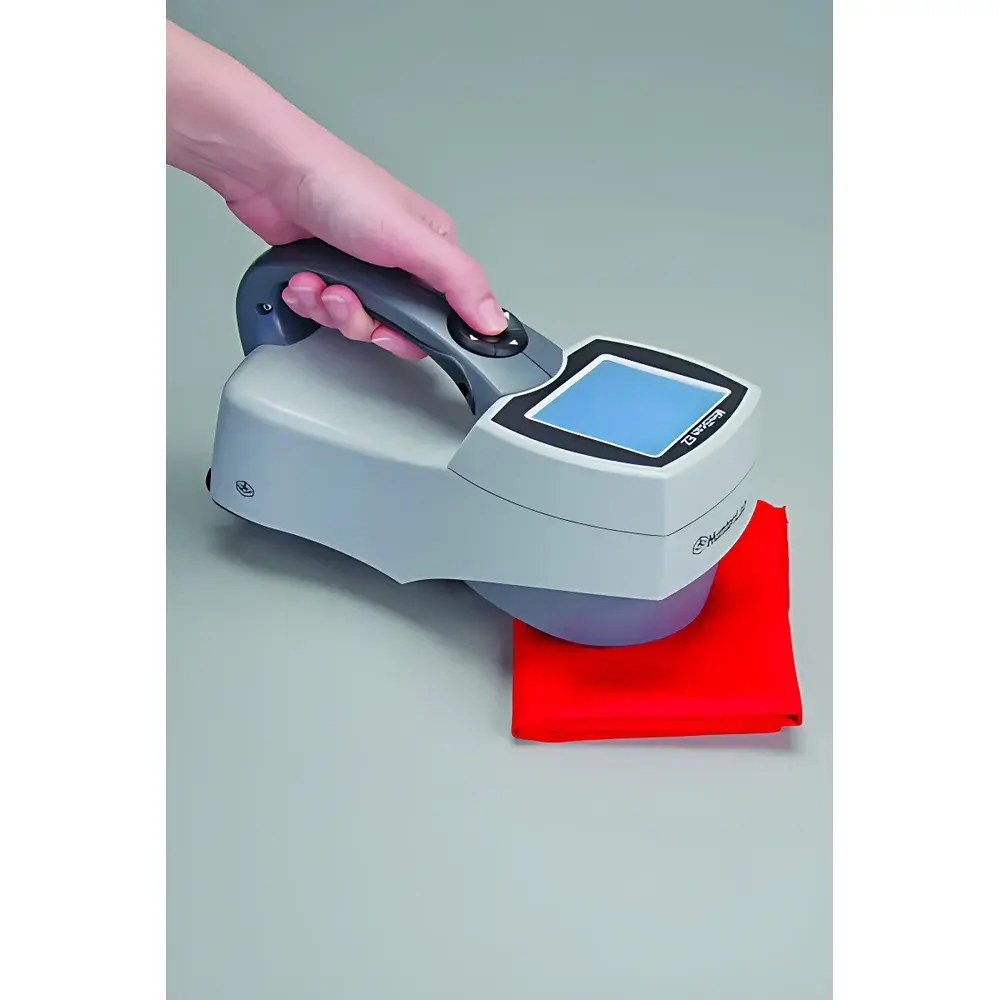
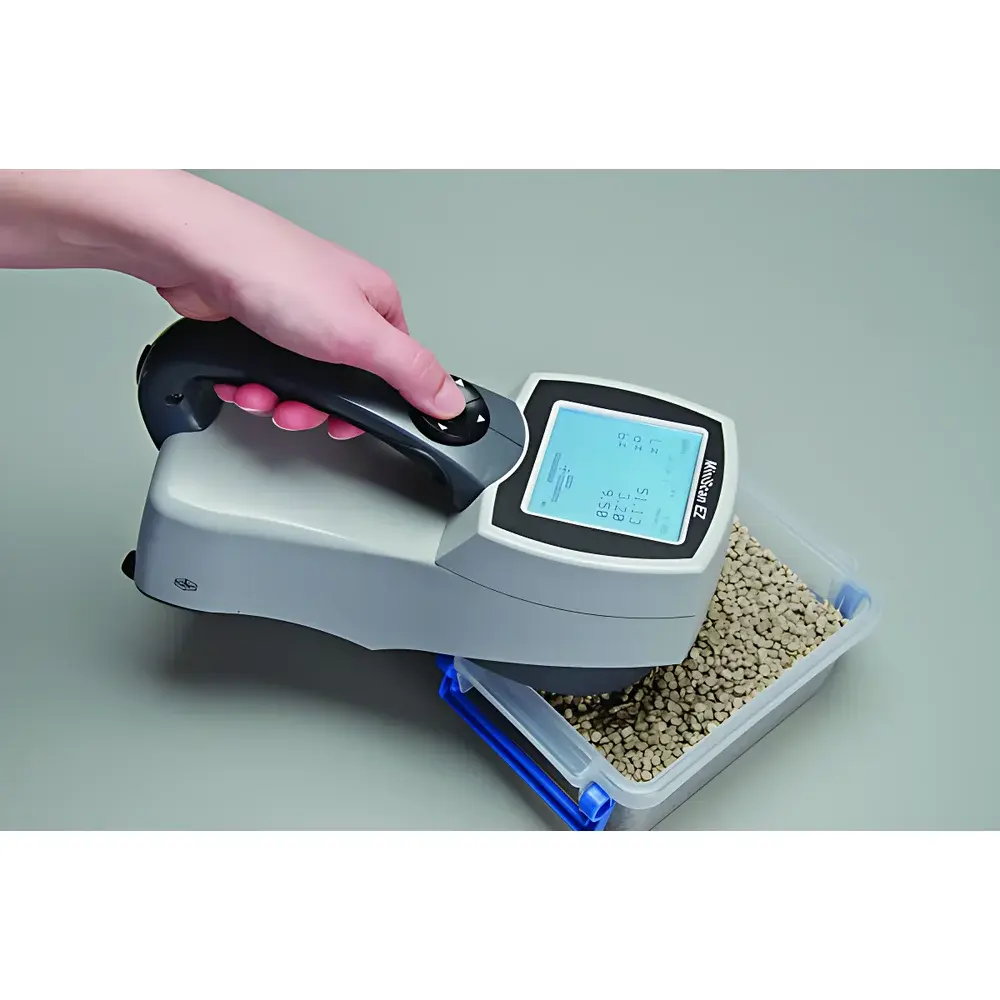
HunterLab MiniScan EZ Portable Spectrophotometer
| Brand | HunterLab |
|---|---|
| Origin | USA |
| Model | MiniScan EZ |
| Instrument Type | Portable |
| Optical Geometry | d/8° integrating sphere |
| Light Source | Pulsed Xenon Lamp |
| Spectral Range | 400 nm – 700 nm |
| Repeatability | ΔE* < 0.05 (CIE L*a*b* on white tile) |
| Product Category | Spectrophotometric Colorimeter |
| Weight (with batteries) | 1.0 kg (2.25 lbs) |
| Display | Rotatable LCD matrix screen (0°, 90°, 180°, 270°) |
| Wavelength Interval | 10 nm |
| Data Output | Color values (L*a*b*, L*C*h), color differences (ΔE*ab, ΔE*cmc, ΔE*94, ΔE*00), spectral reflectance curves, spectral difference plots |
| Software Compatibility | EasyMatch QC (≥100 user-defined methods stored onboard) |
| Calibration | Built-in wavelength and photometric calibration tools |
| Aperture Options | Large and small ports available for d/8° and 45°/0° geometries |
Overview
The HunterLab MiniScan EZ is a portable spectrophotometric colorimeter engineered for precision, repeatability, and field-deployable robustness in industrial color quality control. Operating on the CIE standard d/8° integrating sphere geometry—compliant with ASTM E308, ISO 7724-1, and CIE Publication No. 15—it captures diffuse reflectance across the full visible spectrum (400–700 nm) using a stable pulsed xenon lamp. This optical architecture eliminates directional bias and ensures consistent measurement of textured, matte, glossy, and structured surfaces without requiring sample repositioning. Unlike filter-based tristimulus meters, the MiniScan EZ acquires full spectral data at 10 nm intervals, enabling post-acquisition calculation of multiple color spaces (CIE L*a*b*, L*C*h, Yxy), color difference formulas (ΔE*ab, ΔE*cmc, ΔE*94, ΔE*00), and spectral comparisons—critical for R&D validation, supplier qualification, and regulatory documentation under GLP/GMP frameworks.
Key Features
- True portable spectrophotometry: 1.0 kg mass with integrated rechargeable battery support enables >2,000 measurements per charge—ideal for production line audits, warehouse inspections, and cross-facility benchmarking.
- Dual-aperture system: Interchangeable large (12.7 mm) and small (6 mm) ports accommodate both bulk materials (e.g., carpet, tile, sheet metal) and localized features (e.g., printed labels, injection-molded connectors).
- Rotatable high-contrast LCD: Four-axis (0°/90°/180°/270°) viewing angle adjustment ensures ergonomic readability under variable lighting conditions—including factory floor ambient glare or low-light storage environments.
- Onboard pass/fail evaluation: Configurable tolerance limits (ΔL*, Δa*, Δb*, or composite ΔE*) trigger immediate visual and audible feedback—reducing operator dependency and supporting IATF 16949-compliant inspection workflows.
- Calibration traceability: Factory-calibrated against NIST-traceable standards; includes built-in wavelength verification tool and photometric drift compensation to maintain accuracy over time and temperature fluctuations (15–30°C operating range).
Sample Compatibility & Compliance
The MiniScan EZ measures opaque, translucent, and semi-transparent solids—including painted panels, extruded thermoplastics, ceramic glazes, woven textiles, laminated packaging films, and food products (e.g., beef patties, fish fillets, cheese blocks). Its d/8° geometry with specular component included (SCI) mode accommodates high-gloss finishes (automotive clearcoats, anodized aluminum), while SCI/SCE toggle allows differentiation between surface appearance and inherent pigment performance. The instrument meets ISO 13655:2017 for spectral measurement uncertainty and supports audit-ready documentation through EasyMatch QC’s 21 CFR Part 11-compliant electronic signatures, audit trails, and method locking—enabling compliance with FDA-regulated manufacturing (e.g., pharmaceutical packaging, medical device labeling) and automotive OEM color release protocols (e.g., GM 6091M, Ford CETP).
Software & Data Management
EasyMatch QC software provides centralized method management, statistical process control (SPC) charting, and automated report generation (PDF, CSV, XML). Each MiniScan EZ stores ≥100 user-defined test methods onboard—including custom illuminants (D65, A, F2), observers (2° or 10°), tolerancing schemes, and pass/fail logic trees. Spectral data export supports third-party analysis in MATLAB, Python (via HunterLab SDK), or enterprise QMS platforms (e.g., ETQ Reliance, MasterControl). All firmware updates and spectral library imports are performed via USB-C or Bluetooth 5.0—eliminating dependency on proprietary cables or legacy serial interfaces.
Applications
- Automotive: Paint chip verification, interior trim consistency, headlamp lens yellowness index (YI) tracking.
- Plastics & Polymers: Color batch release for injection-molded components, extrusion profile homogeneity assessment, UV degradation monitoring via spectral shift analysis.
- Food & Agriculture: Objective color grading of meat, seafood, fruits, and dairy; shelf-life stability studies correlating hue angle (h°) drift with oxidation markers.
- Building Materials: Ceramic tile shade matching, architectural coating formulation validation, glass tint uniformity mapping.
- Packaging: Print color fidelity (CMYK spot color deviation), foil lamination gloss impact, label substrate metamerism screening.
FAQ
What optical geometry does the MiniScan EZ use—and why is d/8° preferred for industrial QC?
The MiniScan EZ employs a d/8° integrating sphere with diffuse illumination and 8° viewing, conforming to ISO/CIE standards for diffuse-diffuse measurement. This geometry minimizes texture and directional effects, delivering high inter-instrument agreement (<0.15 ΔE*ab) across multi-site operations.
Can the MiniScan EZ measure transparent or liquid samples?
No—it is designed exclusively for solid and semi-solid specimens. For transmission measurements (e.g., beverages, filters), HunterLab recommends the UltraScan VIS or Agera spectrophotometers with dedicated transmission cells.
Is spectral data export supported—and in what formats?
Yes: full 31-point spectral reflectance (400–700 nm @ 10 nm) exports as CSV or XML. EasyMatch QC also supports direct integration into LabVIEW and SQL-based data lakes via ODBC drivers.
How often does the instrument require recalibration?
Annual NIST-traceable recalibration is recommended for ISO/IEC 17025 accredited labs; routine verification using the included white tile and wavelength check standard is required before each shift or measurement session.
Does the MiniScan EZ comply with FDA 21 CFR Part 11 requirements?
When used with EasyMatch QC v5.0+, it supports electronic signatures, audit trails, role-based access control, and data integrity safeguards—meeting core Part 11 criteria for regulated environments.




