
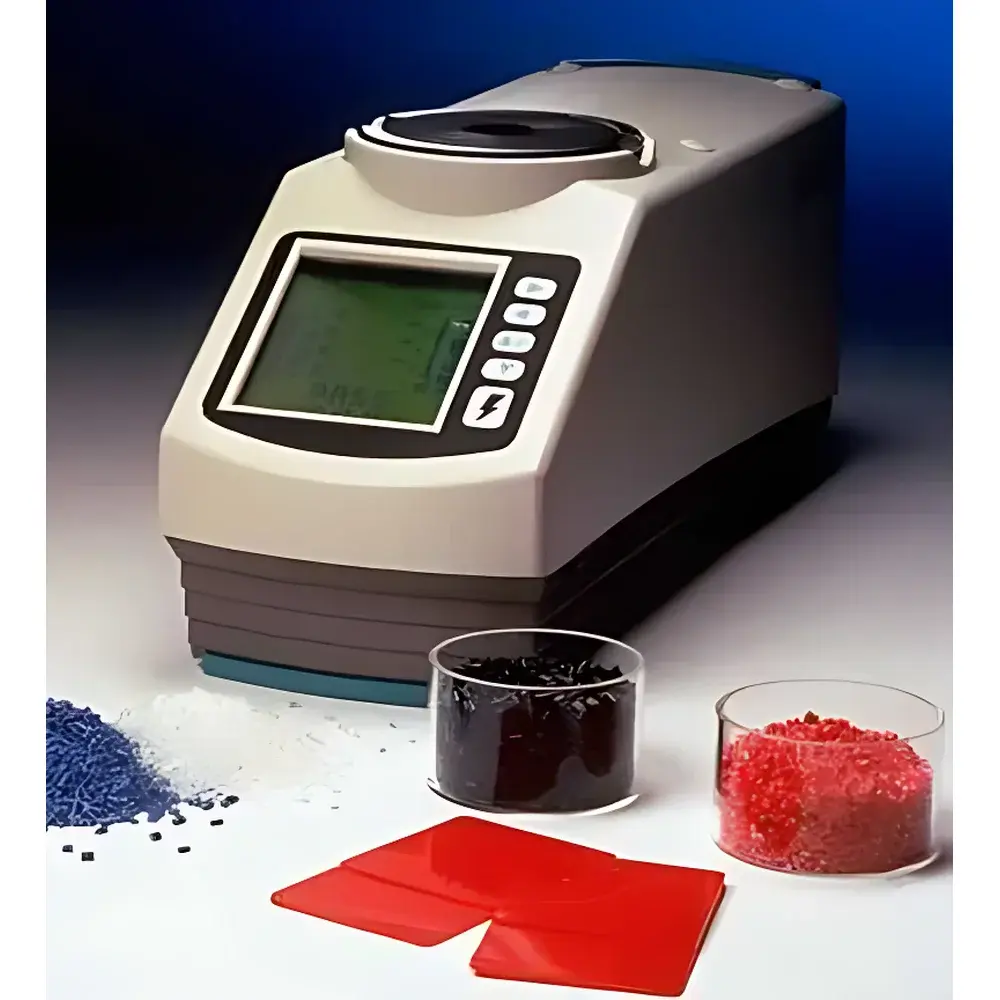
HunterLab MiniScan XE Plus (MSXEPlus) Portable Colorimeter & Color Difference Meter
| Brand | HunterLab |
|---|---|
| Origin | USA |
| Model | MiniScan XE Plus (MSXEPlus) |
| Geometry | 45°/0° integrating sphere |
| Aperture Options | LAV (31.8 mm), SAV (6.0 mm), VSAV (25.0 mm), LAV (14.3 mm), SAV (6.0 mm) |
| Measured Area | 25.0 mm, 5.0 mm, 20.0 mm, 8.3 mm, 4.0 mm |
| Repeatability (BCRA II tile set, avg ΔE*) | 0.05 / 0.25 / 0.15 / 0.15 / 0.15 |
| Spectral Range | 400–700 nm |
| Spectral Bandpass | <12 nm |
| Wavelength Accuracy | ±1 nm |
| Spectral Resolution | 10 nm |
| Light Source | Pulsed Xenon Lamp (>500,000 flashes) |
| Display | 6.4 cm × 6.4 cm LCD |
| Viewing Angles | 0°, 90°, 180°, 270° |
| Illuminants | A, C, D65, F2, F7, F11 (TL84), F12 |
| Observers | 2° and 10° standard observer |
| Color Spaces | CIE L*a*b*, L*C*h°, XYZ, Yxy, Hunter L,a,b |
| Color Difference Metrics | ΔE*, ΔE(CMC), ΔE(ISO 11664-4), ΔL*, Δa*, Δb*, ΔC*, ΔH*, ΔE00 (optional via software), ΔE(FMC II), Z%, Metamerism Index (MI), Gray Scale (ISO 105-A02/A03/A04/A05) |
| Sample Types | Opaque solids, translucent solids, powders, pastes, fluorescent materials, metallics, transparent films (with optional accessories) |
| Dimensions | 10.2 cm × 12.7 cm × 25.4 cm |
| Weight | 1.3 kg (3 lbs) |
| Power | Rechargeable NiCd battery pack or external 120/220 V AC adapter |
Overview
The HunterLab MiniScan XE Plus (MSXEPlus) is a portable, high-precision colorimeter engineered for industrial color quality control in dynamic production environments. It operates on the 45°/0° optical geometry—compliant with ASTM E308, ISO/CIE 15, and CIE 116—where light is directed onto the sample at 45° incidence and reflected light is collected at 0° by an integrating sphere. This configuration minimizes directional reflectance artifacts and ensures robust measurement of textured, glossy, and structured surfaces without requiring specular component exclusion (SCI) or inclusion (SCE) mode switching. Unlike spectrophotometers, the MiniScan XE Plus uses a fixed-filter photodiode array with pulsed xenon illumination, delivering stable, flash-based spectral sampling across the visible range (400–700 nm) at 10 nm resolution. Its design prioritizes field-deployable reliability: sealed optics, shock-absorbing housing, and >500,000-lifetime lamp flashes enable consistent operation on factory floors, loading docks, warehouses, and R&D labs without recalibration drift under thermal or mechanical stress.
Key Features
- Multi-aperture capability: Five interchangeable apertures (LAV 31.8 mm, SAV 6.0 mm, VSAV 25.0 mm, LAV 14.3 mm, SAV 6.0 mm) support flexible sampling—from large-area batch verification to small-part validation—without compromising geometric compliance.
- High repeatability: Achieves ΔE* ≤ 0.05 (average over BCRA Series II tiles) under LAV 31.8 mm mode, meeting stringent intra-instrument precision requirements for QC pass/fail thresholds per ISO 13655 and ASTM D2244.
- Fluorescence and metamerism handling: Built-in UV-enhanced xenon source and dual 2°/10° observer selection allow accurate assessment of optically brightened materials (OBAs) and metamerism index (MI) calculation per ISO 2720 and CIE 15:2018.
- Real-time angular display rotation: LCD supports 0°, 90°, 180°, and 270° orientation—critical for ergonomic use on vertical surfaces, curved substrates, or confined spaces where traditional handheld alignment is impractical.
- Regulatory-ready data architecture: Firmware supports audit-trail logging, user-access levels, and timestamped measurement records—aligning with GLP/GMP documentation expectations and FDA 21 CFR Part 11 principles when paired with HunterLab’s QualiColor SQ software.
Sample Compatibility & Compliance
The MiniScan XE Plus accommodates opaque solids (e.g., injection-molded plastics, painted panels), semi-transparent films (with backside masking), granular powders (via compression cups), viscous pastes (in standardized petri dishes), and fluorescent textiles or paper. Metallic and pearlescent samples are measurable using the included SAV 6.0 mm aperture to minimize spatial averaging errors. All measurements adhere to ISO 11664-4 (CIE colorimetry), ASTM D2244 (color difference calculation), and ISO 13655 (spectral measurement standards). For food-grade applications, the instrument meets FDA-recommended practices for color consistency monitoring in processed meats, confectionery, and dairy packaging—though direct contact with consumables requires validated cleaning protocols per HACCP guidelines.
Software & Data Management
QualiColor SQ software (Windows-based, optional) provides full traceability: instrument calibration history, spectral data export (CSV, XML), custom tolerance setting (ellipsoidal ΔE(CMC), rectangular ΔLΔaΔb), and statistical process control (SPC) charting (X-bar/R, Cp/Cpk). Raw spectral curves are not stored onboard but can be reconstructed from tristimulus values during software sync. The device supports USB 2.0 and RS-232 connectivity; no cloud dependency or subscription licensing is required. All firmware updates are delivered as signed binaries with SHA-256 checksum verification—ensuring integrity in regulated manufacturing environments subject to internal IT security policies.
Applications
- Plastics: In-line color verification of extruded profiles, blow-molded containers, and thermoplastic elastomers against masterbatch standards.
- Textiles & Apparel: Shade matching of dyed fabrics, printed knits, and nonwovens across dye lots—validated against AATCC Evaluation Procedure 1 and ISO 105-J03.
- Coatings & Paints: Batch-to-batch consistency checks for automotive OEM coatings, architectural paints, and coil-coated metal—aligned with SAE J1545 and ISO 2813 gloss compensation workflows.
- Paper & Packaging: Whiteness (CIE Whiteness, Ganz), brightness (ISO 2470-1), and print contrast (ISO 13660) assessment for corrugated board, folding cartons, and label stock.
- Food & Beverage: Objective quantification of browning (ΔE* in roasted coffee), ripeness (L*a*b* shift in tomatoes), and additive dispersion uniformity (e.g., annatto in cheese).
FAQ
Does the MiniScan XE Plus support SCI/SCE measurement modes?
No—it implements fixed 45°/0° geometry only. For applications requiring specular-included or specular-excluded data, a benchtop spectrophotometer (e.g., HunterLab UltraScan VIS) is recommended.
Can it measure transparent liquids or films?
Yes—with optional transmission accessories (e.g., liquid cell holder, film clamp) and appropriate backing (white tile or black trap) to control path length and scatter conditions.
Is NIST-traceable calibration provided with the instrument?
Each unit ships with a Certificate of Conformance and a factory-calibrated ceramic tile set traceable to NIST Standard Reference Materials (SRMs) 2010, 2011, and 2012.
What is the battery life per charge under typical usage?
Approximately 1,200 measurements per full NiCd charge cycle; runtime varies with flash frequency and display backlight usage.
How frequently must the instrument be recalibrated?
Annual verification against certified standards is recommended for ISO/IEC 17025-accredited labs; daily zero/white calibration is performed automatically on startup and before each measurement session.




