
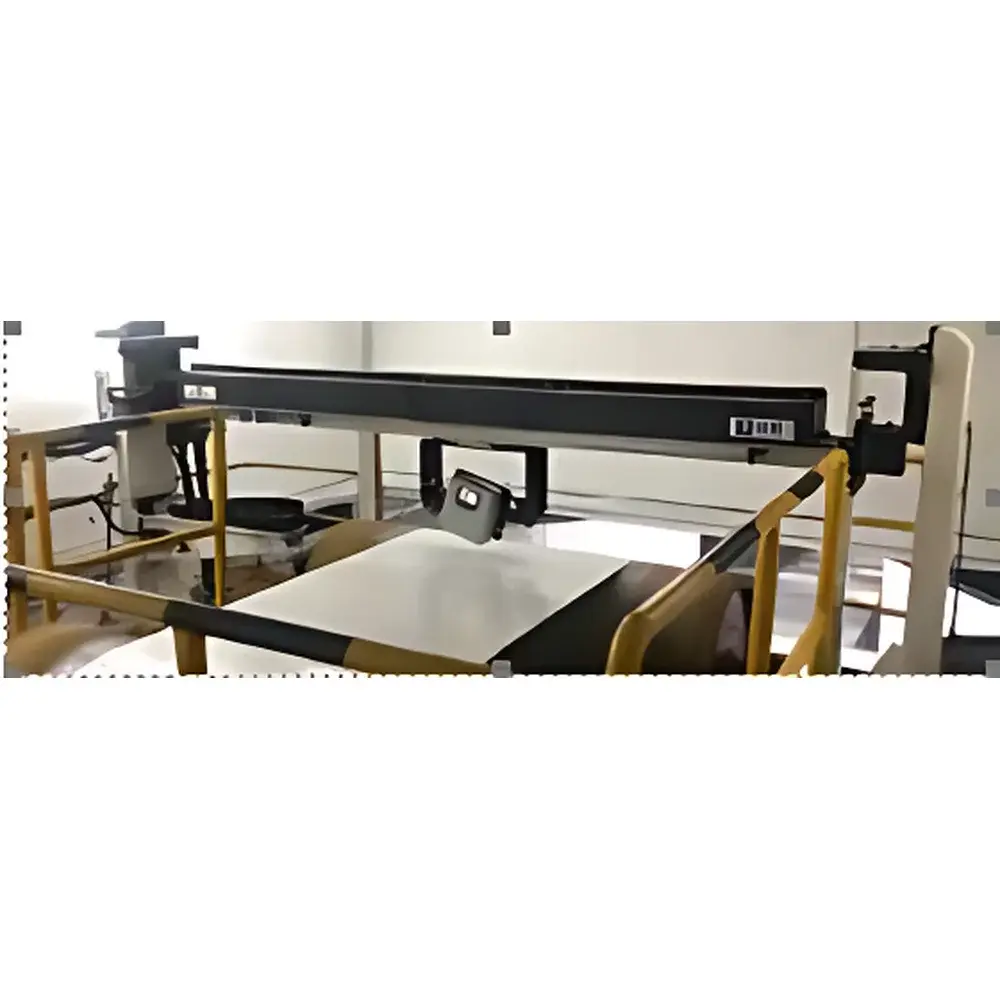
HunterLab SpectraTrend HT In-Line Textile Color Measurement System
| Brand | HunterLab |
|---|---|
| Origin | USA |
| Model | SpectraTrend HT |
| Product Type | Spectrophotometric Colorimeter |
| Instrument Type | In-Line |
| Optical Geometry | 0/45° Integrating Sphere |
| Light Source | Full-Spectrum Balanced Solid-State LED System |
| Spectral Range | 400–700 nm |
| Repeatability | ΔE*ab ≤ 0.03 |
| Compliance | LQM, PAT, Six Sigma, DMAIC, GMP-aligned |
| Data Consistency | Traceable to lab-grade HunterLab benchtop instruments (e.g., UltraScan VIS, MiniScan EZ) |
Overview
The HunterLab SpectraTrend HT is an industrial-grade, in-line spectrophotometric color measurement system engineered for continuous, non-contact color and height monitoring of moving textile webs, yarns, and finished fabrics during high-speed manufacturing. Operating on the principle of diffuse reflectance spectroscopy within the CIE-standard visible spectrum (400–700 nm), the system employs a precision 0/45° optical geometry with an integrating sphere to eliminate directional bias and ensure metrologically robust color data under variable surface texture, gloss, and weave structure. Unlike handheld or benchtop colorimeters, the SpectraTrend HT integrates directly into production lines—mounted above or beside conveyors, stenter frames, or dyeing ranges—to deliver real-time spectral reflectance data at user-defined sampling intervals (e.g., every 100 ms to 5 s). Its solid-state LED illumination provides stable, flicker-free, and thermally invariant spectral output across decades of operation—critical for long-term calibration stability in textile finishing environments where ambient temperature, humidity, and airborne lint pose persistent challenges.
Key Features
- Non-contact, in-line spectral acquisition with simultaneous color (CIELAB, CMC, DIN99, etc.) and surface height profiling—enabling detection of dye penetration anomalies correlated with fabric thickness variation.
- Full-width automated traverse mechanism with programmable lateral scanning (±150 mm range), ensuring representative across-web coverage without mechanical interference with moving substrates.
- Integrated probe retraction and audible/visual alarm system triggered by proximity sensors or process deviation thresholds—enhancing operator safety and minimizing unplanned line stoppages.
- Auto-calibration scheduler with configurable intervals (e.g., hourly, per shift, or event-driven), eliminating manual intervention and reducing human error risk in regulated textile quality workflows.
- Ruggedized IP65-rated enclosure with anti-static coating and sealed optics—designed for sustained operation in humid dye houses, thermal setting ovens, and high-lint spinning environments.
- Factory-traceable spectral agreement (ΔE*ab ≤ 0.03) with HunterLab’s reference-grade benchtop instruments (UltraScan VIS, MiniScan EZ), enabling seamless correlation between R&D, QC lab, and production floor measurements.
Sample Compatibility & Compliance
The SpectraTrend HT accommodates diverse textile morphologies—including woven, knitted, nonwoven, and filament-based materials—across natural (cotton, wool, silk), synthetic (polyester, nylon, acrylic), and blended fibers. Its 0/45° geometry mitigates specularity artifacts common in glossy or calendered finishes, while spectral normalization compensates for minor substrate translucency (e.g., sheer voiles or lightweight synthetics). The system supports ASTM D2244 (Standard Practice for Calculation of Color Tolerances), ISO 11664-4 (CIE colorimetric standards), and AATCC Evaluation Procedure 1 (Color Difference Assessment). Data audit trails comply with GLP/GMP documentation requirements, and optional 21 CFR Part 11–compliant software modules support electronic signatures, role-based access control, and immutable change logs for regulated textile supply chains serving medical textiles, automotive interiors, or apparel brands with strict sustainability certifications.
Software & Data Management
SpectraTrend HT operates with HunterLab’s proprietary EasyMatch QC software suite, featuring real-time dashboard visualization, SPC charting (X-bar/R, CUSUM), and automatic flagging of out-of-spec regions based on user-defined tolerances (e.g., ΔE*ab > 0.8 for critical fashion shades). All spectral data (31-point reflectance per nm) are stored in vendor-neutral .qtx format and exportable to LIMS, MES, or ERP systems via OPC UA or CSV/Excel APIs. Batch-level reporting includes time-stamped color maps overlaid on web-position coordinates, enabling root-cause analysis of streaks, banding, or edge-to-center variation. Firmware updates and spectral recalibration files are delivered via secure HTTPS portal—no local USB dependency—ensuring version consistency across global manufacturing sites.
Applications
This system is deployed across textile value chain stages: real-time shade verification post-dyeing or printing; closed-loop feedback control for digital inkjet dosing systems; consistency monitoring of spun-dyed polyester filaments; batch-to-batch matching for denim indigo reduction processes; and incoming inspection of dyed yarn lots prior to weaving. It is also validated for non-textile applications requiring simultaneous color and topography assessment—including extruded plastic profiles (PVC, PP), coated paperboard, baked food surfaces (crust browning uniformity), and metal-coated foils—where spatially resolved color fidelity directly impacts functional performance or consumer perception.
FAQ
What spectral resolution does the SpectraTrend HT provide?
It captures reflectance data at 10-nm intervals across 400–700 nm (31 data points), sufficient for CIE 1931 XYZ tristimulus calculation and all major color difference formulas.
Can it measure wet or steam-exposed textiles?
Yes—the optical head is rated IP65 and features heated lens elements to prevent condensation fogging during continuous operation near steaming units or wash boxes.
How is traceability to NIST standards maintained?
Each unit ships with a factory-issued calibration certificate referencing NIST-traceable ceramic tile standards; annual verification can be performed using HunterLab’s certified CR-200 calibration kit.
Is integration with PLC-based production control systems supported?
Yes—digital I/O signals (alarm, ready, fault) and Modbus TCP protocol enable direct interfacing with Allen-Bradley, Siemens, and Mitsubishi PLCs for automated line response to color excursions.
Does it require periodic lamp replacement?
No—solid-state LED illumination has a rated lifetime exceeding 100,000 hours with <0.1% spectral drift over 5 years, eliminating consumable lamp costs and downtime.



