
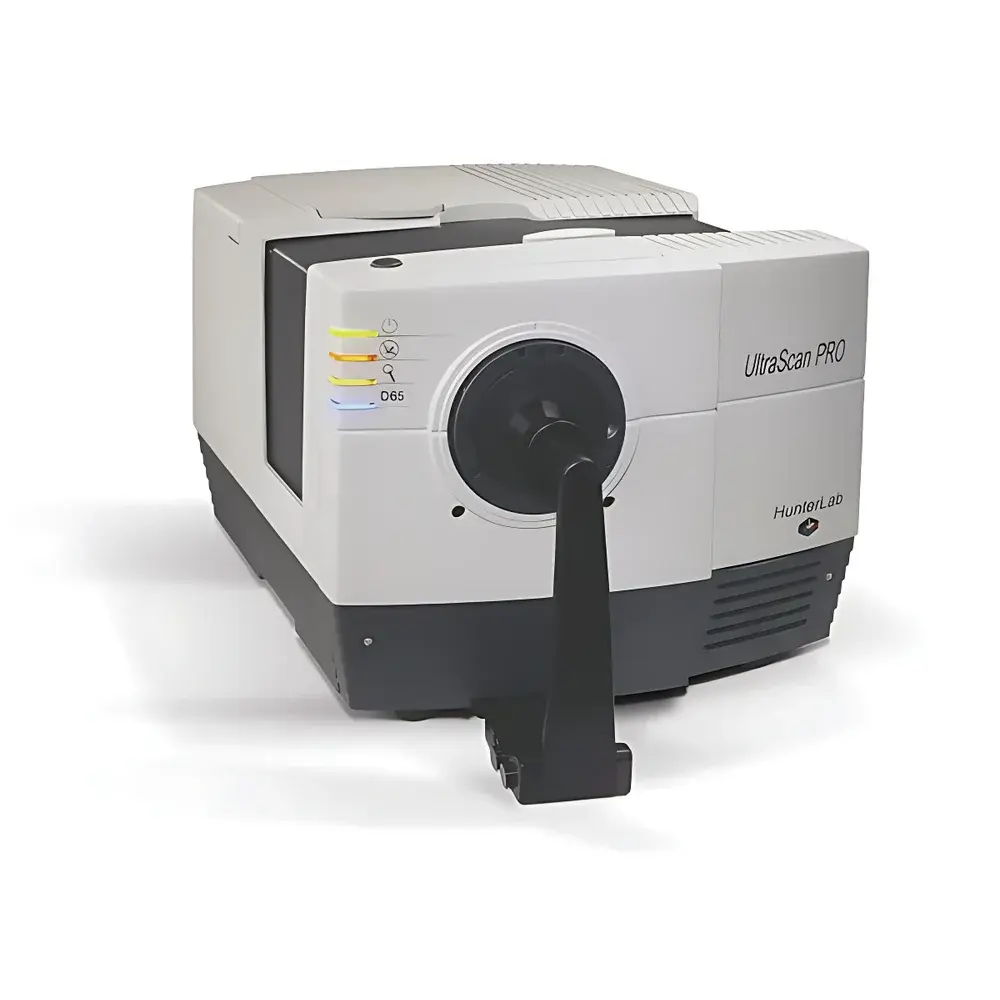
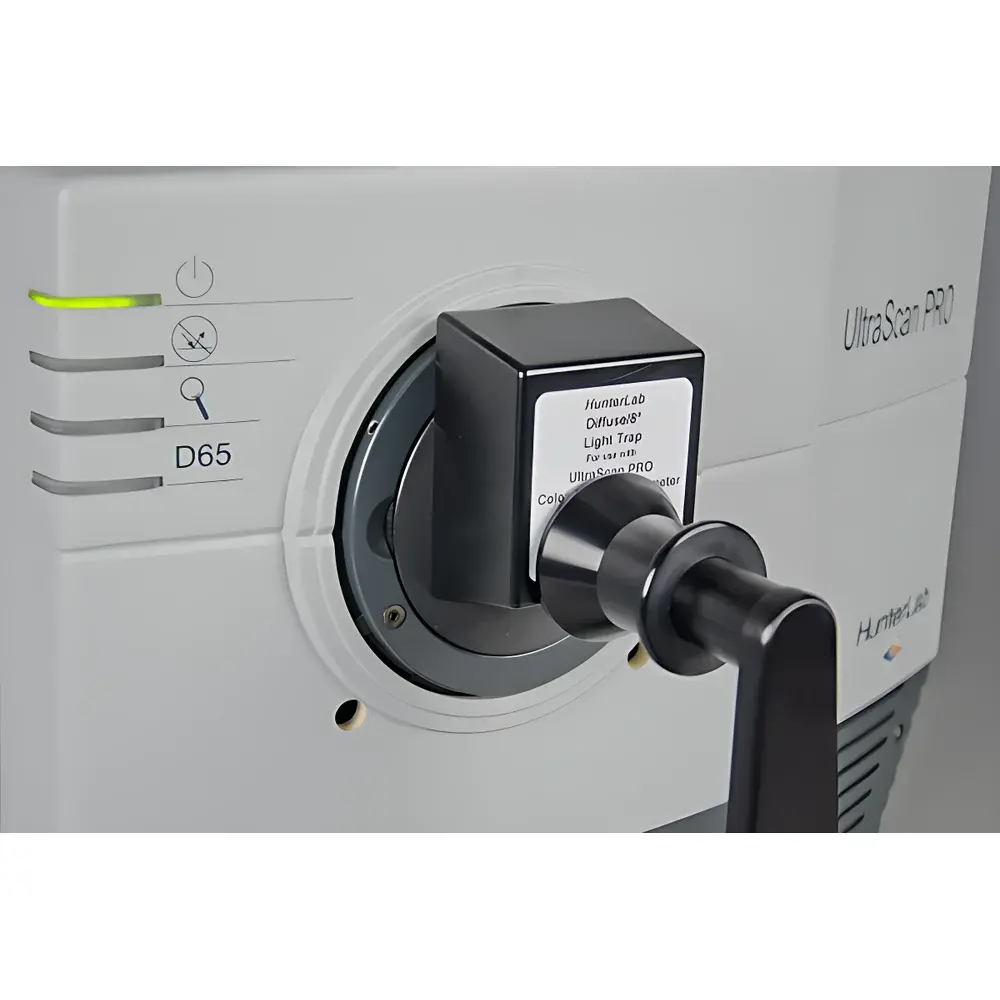
HunterLab UltraScan PRO Benchtop Spectrophotometer
| Brand | HunterLab |
|---|---|
| Origin | USA |
| Model | UltraScan PRO |
| Instrument Type | Benchtop |
| Optical Geometry | 8°/diffuse (d/8°) with integrated sphere |
| Light Source | Pulsed Xenon Lamp |
| Spectral Range | 350 nm – 1050 nm |
| Spectral Interval | 2 nm (acquisition), 5 nm (reporting) |
| Optical Bandwidth | 5 nm |
| Repeatability | ΔE*₀₀ ≤ 0.03 |
| Detector | 512-element silicon photodiode array with extended NIR sensitivity |
| Compliance | CIE No. 15, ASTM E308, ASTM D2244, ASTM D6290, USP <631>, ISO 7724, ISO 11664, FDA 21 CFR Part 11 (via EasyMatch QC software) |
Overview
The HunterLab UltraScan PRO is a high-precision benchtop spectrophotometer engineered for rigorous color measurement, spectral reflectance/transmittance analysis, and haze quantification across solid, liquid, translucent, and transparent samples. It operates on a dual-beam, d/8° (8° illumination / diffuse collection) optical architecture with a 150 mm integrating sphere—optimized for compliance with CIE, ASTM, and USP standards governing colorimetric instrumentation. Its pulsed xenon light source delivers stable, cold illumination without thermal drift or warm-up delay, enabling rapid acquisition of full-spectrum data from 350 nm to 1050 nm at 2 nm intervals (reported at 5 nm). The instrument’s 5 nm effective optical bandwidth, coupled with a high-resolution 512-element diode array detector covering both visible and near-infrared regions, ensures metrological traceability and high spectral fidelity—critical for applications requiring UV-fluorescence correction (e.g., fluorescent whitening agents under D65 illumination) and multi-parameter optical characterization.
Key Features
- Dual-beam optical design with real-time reference compensation for enhanced long-term stability and signal-to-noise ratio
- 150 mm integrating sphere with barium sulfate–coated interior and precision-machined stainless-steel mechanical structure to minimize stray light and geometric distortion
- Three selectable measurement apertures: Large Area View (LAV, 25 mm), Small Area View (SAV, 13 mm), and Extra Small Area View (XSAV, 7 mm)—enabling spatially resolved color assessment on heterogeneous or patterned surfaces
- Automated specular component included/excluded (SCI/SCE) modes with motorized gloss trap for independent evaluation of surface texture and specular reflectance effects
- Transmittance compartment with adjustable sample holder clearance—accommodates oversized specimens up to 50 mm thick and volumes as low as 0.4 mL for liquid cuvettes
- Integrated status indicator LEDs and ergonomic front-panel trigger button for hands-free, repeatable operator interaction
- UV-corrected D65 simulation with spectral irradiance control below 400 nm—essential for accurate fluorescence compensation in detergents, textiles, and optical brighteners
Sample Compatibility & Compliance
The UltraScan PRO supports an extensive range of physical forms: opaque solids (e.g., tiles, metal panels, molded plastics), translucent materials (films, lenses, gels), clear liquids (oils, solvents, pharmaceutical solutions), and structured surfaces (carpets, fibers, embossed polymers). Its large transmittance port enables direct measurement of coated glass, solar filters, UV-blocking eyewear, and laminated substrates without disassembly. All optical components—including the sphere interior coating, aperture baffles, and detector housing—are chemically and thermally stabilized to maintain calibration integrity over time. The system complies with ISO/IEC 17025-relevant performance criteria and meets regulatory requirements for color release testing under USP , ASTM D2244 (color difference tolerancing), and ASTM D6290 (haze measurement). When paired with validated EasyMatch QC software, it satisfies audit-ready documentation needs per FDA 21 CFR Part 11 for electronic records and signatures in GMP/GLP environments.
Software & Data Management
UltraScan PRO is fully integrated with HunterLab’s EasyMatch QC software—a validated, configurable platform supporting method-driven workflows, statistical process control (SPC), and automated pass/fail reporting. The software provides full spectral data export (CSV, XML), CIE-compliant color space conversions (CIELAB, CIELCH, CMYK, Munsell), and advanced metrics including Yellowness Index (ASTM E313), Whiteness Index (CIE/ASTM E313), Haze (ASTM D1003), and Transmittance % at user-defined wavelengths. Audit trail functionality logs all user actions, parameter changes, and calibration events with timestamps and operator IDs—ensuring full traceability for quality assurance departments and regulatory submissions. Remote instrument monitoring, firmware updates, and method synchronization across multi-site laboratories are supported via secure network deployment.
Applications
Designed for cross-industry metrology, the UltraScan PRO serves critical roles in R&D, formulation, incoming inspection, and final product release. Key application domains include: optical filter and lens manufacturing (transmittance uniformity, UV cutoff verification); polymer and packaging development (color consistency of PET preforms, multilayer films, and barrier coatings); pharmaceuticals (solution clarity, excipient color, tablet film-coating homogeneity); paints and coatings (metallic flake orientation, pearlescent effect quantification); food and beverage (juice browning index, dairy whiteness, sauce opacity); and textile dyeing (batch-to-batch shade matching, photostability assessment under UV exposure). Its ability to simultaneously report spectral reflectance, transmittance, and haze makes it uniquely suited for evaluating anti-reflective coatings, smart windows, and medical device transparency specifications.
FAQ
Does the UltraScan PRO support fluorescence correction for materials containing optical brighteners?
Yes—the instrument uses a spectrally stabilized D65 illuminant with calibrated UV output and real-time spectral subtraction algorithms in EasyMatch QC to isolate and quantify fluorescence contributions, ensuring accurate CIELAB values per ASTM D6290 and ISO 11664-6.
Can it measure very small or irregularly shaped samples?
Yes—through interchangeable apertures (7 mm XSAV for micro-samples), custom fixtures (e.g., powder cells, fiber holders), and motorized SCI/SCE switching to decouple texture from intrinsic color.
Is wavelength calibration traceable to NIST standards?
Yes—factory calibration includes NIST-traceable holmium oxide and didymium glass standards; users may perform routine verification using optional calibration validation kits.
What level of software validation support is provided for regulated industries?
HunterLab supplies IQ/OQ documentation templates, 21 CFR Part 11 configuration guides, and on-site validation assistance for pharmaceutical and medical device customers operating under GxP frameworks.





