
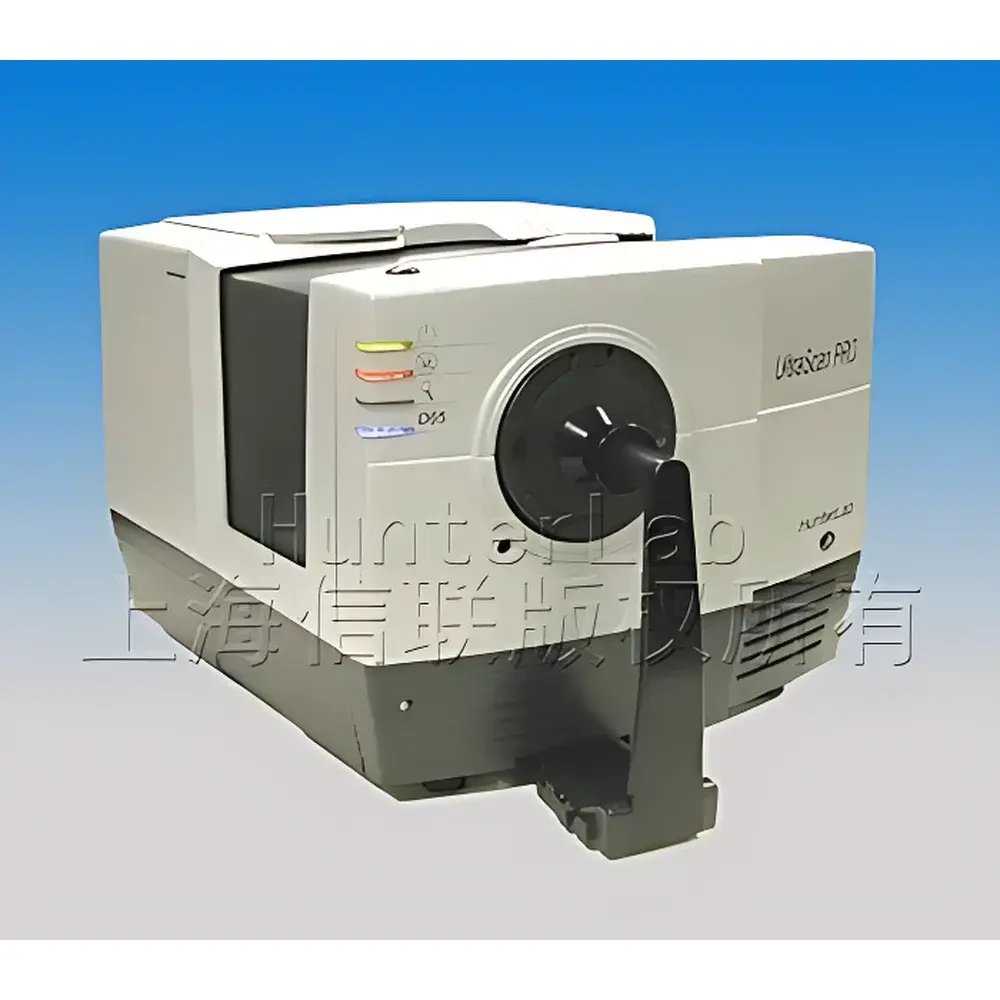
HunterLab UltraScan PRO Spectrophotometer
| Brand | HunterLab |
|---|---|
| Origin | USA |
| Model | UltraScan PRO |
| Product Type | Spectrophotometric Color & Transmittance Analyzer |
| Instrument Type | Benchtop |
| Optical Geometry | d/8° Integrating Sphere |
| Light Source | Pulsed Xenon Lamp |
| Spectral Range | 350–1050 nm |
| Wavelength Interval | 5 nm |
| Wavelength Accuracy | ±0.1 nm |
| Wavelength Repeatability | <2 nm (1.37 nm FWHM) |
| Photometric Range | 0–200% |
| Photometric Resolution | 0.003% (display resolution: 0.01%) |
| Transmittance Repeatability | ≤0.03 ΔE*ab (for standard white tile, 10 readings) |
| Measurement Time | ≤2 s |
| Aperture Options | 19 mm (LAV), 9 mm (MAV), 4 mm (SAV) |
| Transmission Chamber | Triple-side open, accommodates up to 80 mm path-length cuvettes |
| Compliance | ASTM E308, ISO/CIE 11664, CIE No. 15, USP <857>, FDA 21 CFR Part 11 (with EasyMatch-QC audit trail enabled) |
Overview
The HunterLab UltraScan PRO is a high-precision benchtop spectrophotometer engineered for rigorous optical measurement of color, transmittance, haze, and spectral reflectance/transmittance across transparent, translucent, and opaque materials. Operating on the CIE-compliant d/8° integrating sphere geometry with dual-beam compensation, it delivers traceable, reproducible photometric data in compliance with international standards including ASTM E308, ISO/CIE 11664, and CIE Publication No. 15. Its 350–1050 nm spectral range—spanning ultraviolet through near-infrared—enables comprehensive characterization of optical transmission behavior in architectural glass, automotive glazing, optical filters, ophthalmic lenses, packaging films, and coated substrates. The instrument employs a pulsed xenon lamp with spectral filtering to emulate CIE Standard Illuminant D65, ensuring metrological consistency across global R&D, QC, and regulatory testing environments.
Key Features
- Dual-beam d/8° optical architecture with automatic specular component exclusion (SCI/SCE mode switching) for accurate color and transmittance evaluation under both total and diffuse conditions.
- 15.2 cm (6″) integrating sphere coated with Spectraflect®—a highly stable, near-Lambertian reflective material certified for long-term spectral uniformity and minimal drift.
- High-resolution spectral acquisition using a holographic diffraction grating and 512-element silicon photodiode array, delivering 5 nm effective bandwidth and 1.37 nm full-width half-maximum (FWHM) wavelength resolution.
- Three user-selectable measurement apertures (19 mm LAV, 9 mm MAV, 4 mm SAV) optimized for sample heterogeneity control and spatial averaging in large-area or textured specimens.
- Triple-side-open transmission compartment accommodating cuvettes up to 80 mm path length—critical for evaluating low-absorbance glass, liquid coatings, and polymer sheets per ASTM D1003 and ISO 14782.
- On-device measurement trigger button and intuitive status LEDs streamline operator workflow in high-throughput production labs.
- Comprehensive connectivity via USB 2.0 and RS-232C interfaces, supporting seamless integration into automated QA systems and LIMS environments.
Sample Compatibility & Compliance
The UltraScan PRO supports rigid, flexible, and liquid samples—including float glass, laminated safety glass, tempered panels, optical-grade polymers, dyed resins, and solvent-based coatings. Its large transmission chamber and configurable aperture system ensure reliable measurement of both sheet materials (e.g., architectural glazing per EN 1096 and ISO 10218) and solution-phase standards (e.g., USP transmittance validation). The instrument meets GLP/GMP requirements when paired with EasyMatch-QC software, which provides electronic signatures, full audit trails, and 21 CFR Part 11–compliant data integrity controls. All spectral data are traceable to NIST-certified reference standards, and calibration verification follows ISO/IEC 17025–aligned procedures.
Software & Data Management
HunterLab’s EasyMatch-QC software serves as the primary platform for instrument control, method development, statistical process monitoring (SPC), and report generation. It supports multi-instrument network deployment, custom pass/fail tolerancing (ΔE*, ΔT%, ΔHaze%), and automated compliance reporting against ASTM D2244, ISO 11664-4, and DIN 6174. Optional EasyMatch-Coatings extends functionality for film-thickness-corrected color prediction and batch-to-batch matching in architectural and automotive coating applications. Raw spectral data export is supported in CSV, XML, and CIE .cie formats, enabling third-party analysis in MATLAB®, Python (SciPy), or JMP® environments.
Applications
- Transmittance and color consistency verification of automotive windshields and side windows (per SAE J2522 and ISO 13406-2).
- Haze and clarity assessment of tempered and laminated glass per ASTM D1003 and ISO 14782.
- UV-blocking efficacy quantification in solar-control and low-emissivity (low-E) coated glass.
- Batch release testing of optical filters, ophthalmic lenses, and display cover glass (e.g., Gorilla Glass®).
- Regulatory submission support for FDA-listed medical device packaging and ISO 11607–compliant barrier films.
- Research-grade spectral fingerprinting of nanocomposite coatings and interference thin films.
FAQ
What is the difference between SCI and SCE measurement modes?
SCI (Specular Component Included) captures total reflectance, including mirror-like reflections—ideal for appearance matching of textured or coated surfaces. SCE (Specular Component Excluded) measures only diffuse reflectance, simulating human visual perception under typical viewing conditions.
Can the UltraScan PRO measure UV transmittance below 350 nm?
No—the instrument’s spectral cutoff is 350 nm due to optical path limitations and detector sensitivity; for sub-350 nm UV analysis, a dedicated UV-VIS spectrophotometer with deuterium lamp source is recommended.
Is calibration traceable to national standards?
Yes—each unit ships with NIST-traceable calibration certificates for reflectance, transmittance, and wavelength accuracy, and annual recalibration services follow ISO/IEC 17025–accredited protocols.
Does the system support Good Manufacturing Practice (GMP) documentation requirements?
When configured with EasyMatch-QC and enabled audit trail features, the system complies with FDA 21 CFR Part 11, EU Annex 11, and ICH GCP guidelines for electronic records and signatures.
How is sample positioning controlled for repeatable transmittance measurements?
The triple-side-open transmission stage includes precision-machined cuvette guides and optional sample holders with mechanical stops to ensure consistent path-length alignment and minimize edge-scatter artifacts.







