
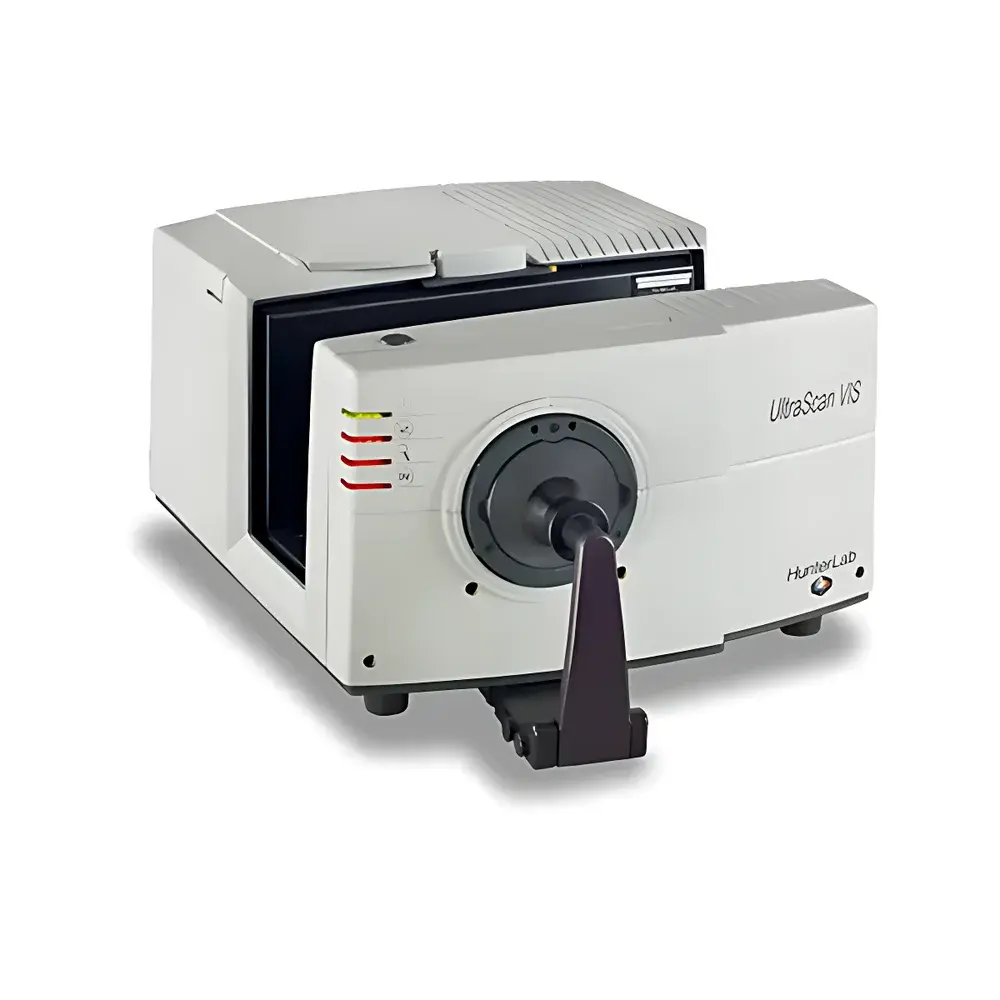
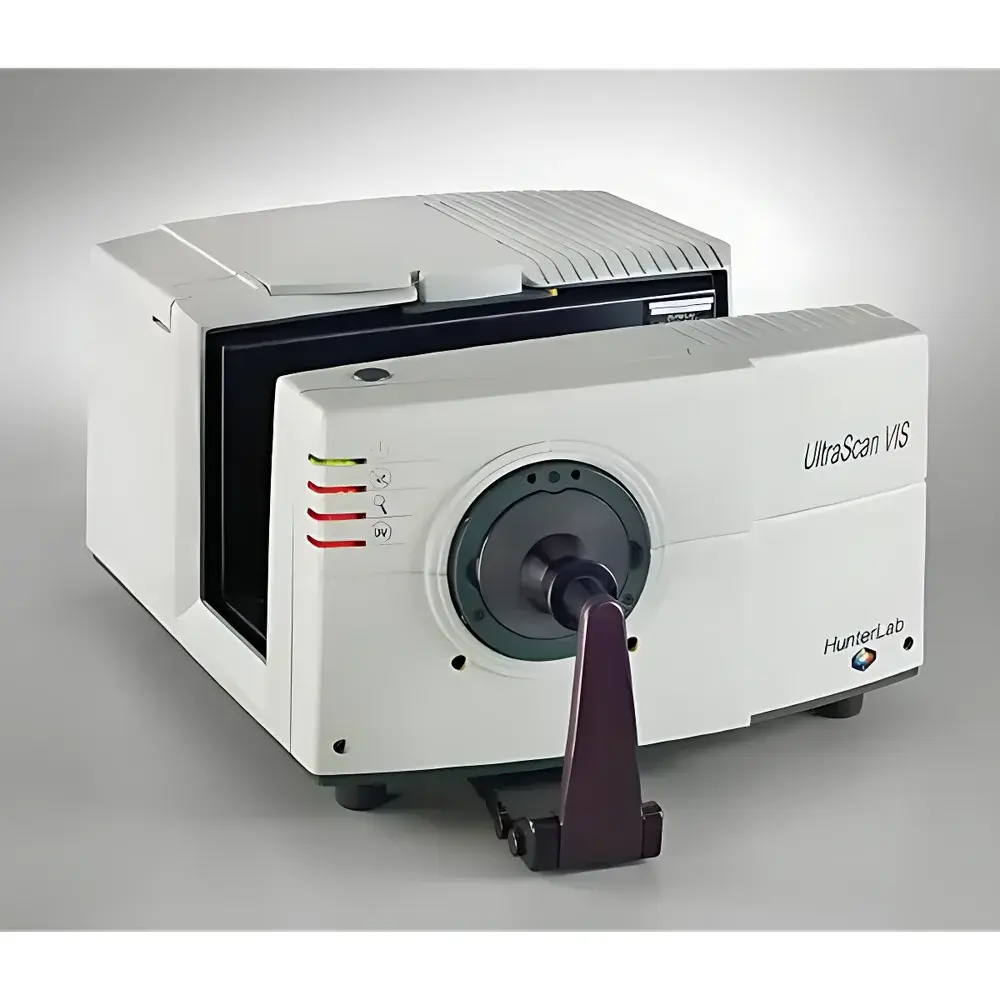
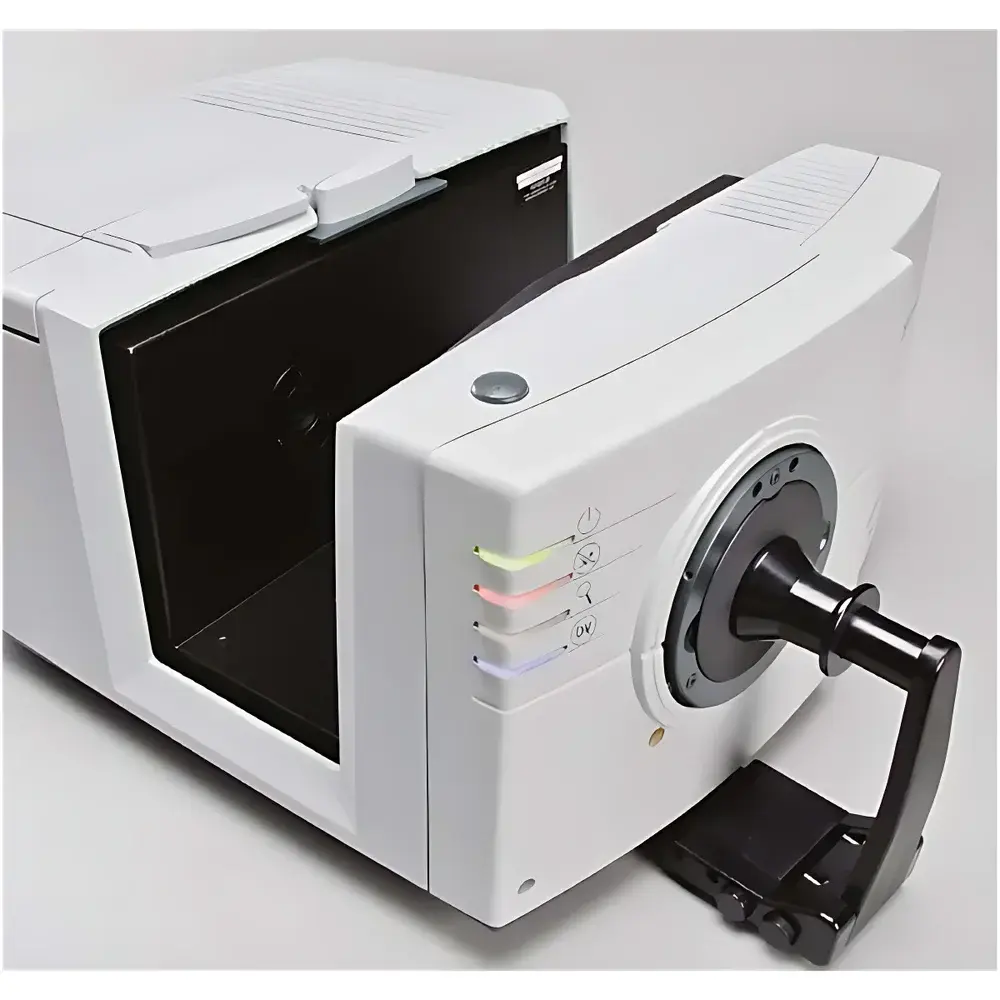
HunterLab UltraScan VIS Yellowness Index Analyzer for PV EVA Encapsulant Films
| Brand | HunterLab |
|---|---|
| Origin | USA |
| Model | UltraScan VIS Yellowness Index Analyzer |
| Product Type | Spectrophotometric Color & Transmittance Meter |
| Instrument Type | Benchtop |
| Optical Geometry | d/8° integrating sphere |
| Light Source | Pulsed Xenon Lamp |
| Spectral Range | 360–780 nm |
| Spectral Resolution | 10 nm |
| Repeatability (ΔYI) | ≤0.03 |
| Measurement Modes | Reflectance (with/without specular component), Transmittance, Yellowness Index (YI E313, YI ASTM D1925), L*a*b*, ΔE*ab, %T, %R |
Overview
The HunterLab UltraScan VIS Yellowness Index Analyzer is a precision benchtop spectrophotometer engineered specifically for quantitative optical evaluation of ethylene-vinyl acetate (EVA) encapsulant films used in photovoltaic (PV) module manufacturing. It operates on the principle of diffuse/transmitted light measurement using a d/8° integrating sphere geometry, enabling accurate determination of yellowness index (YI), total transmittance (%T), reflectance (%R), and CIE color space coordinates (L*a*b*) across the visible spectrum (360–780 nm). Unlike general-purpose colorimeters, this instrument is calibrated and validated to meet ASTM D1925 and ASTM E313 standards for yellowness index calculation—critical parameters defined in GB/T 29848–2018 for PV encapsulant qualification. The pulsed xenon lamp provides stable, repeatable D65-illuminant simulation without thermal drift, ensuring high reproducibility during accelerated aging assessments (e.g., UV exposure at 83°C for 1000 h, damp heat at 85°C/RH90% for 1000 h). Its design addresses the core reliability challenge in PV modules: early discoloration of EVA due to UV-induced oxidation and hydrolysis, which directly correlates with reduced photon transmission and long-term power degradation.
Key Features
- Compliant d/8° optical geometry with automated specular component inclusion/exclusion (SCI/SCE), essential for measuring both surface-scattered and bulk-transmitted light from laminated EVA films.
- Pulsed xenon illumination ensures spectral stability over time and eliminates lamp aging effects—critical for longitudinal aging studies requiring multi-year data consistency.
- High-precision transmittance measurement capability with oversized transmission port (19 mm standard aperture; optional 6.3 mm for small-area or edge-characterization testing).
- Real-time YI calculation per ASTM D1925 (for plastics) and ASTM E313 (for general materials), supporting pass/fail evaluation against industry thresholds: ΔYI ≤ 1 after UV aging (83°C, 1000 h), ΔYI ≤ 2 after thermal or damp-heat aging (85°C/1000 h or 85°C/RH90%/1000 h).
- Integrated UV control module allows adjustable UV energy output—enabling correlation of yellowing kinetics with specific UV-B exposure profiles per IEC 61215-2 MQT10.
- Automated macro-button operation and status-indicating LEDs minimize operator error during high-throughput QC workflows in module production lines.
- Robust mechanical architecture with temperature-stabilized optics, suitable for continuous operation in Class 10,000 cleanroom environments typical of PV cell lamination facilities.
Sample Compatibility & Compliance
The UltraScan VIS accommodates rigid and flexible EVA film samples up to 2 mm thick, including laminated glass/EVA/silicon stacks when measured in transmittance mode. Its large transmission chamber supports standard 100 × 100 mm test coupons as specified in GB/T 29848–2018 and IEC 62788-7-2. The instrument meets ISO/IEC 17025 requirements for measurement traceability when operated with NIST-traceable calibration tiles and certified reference standards. Data outputs comply with FDA 21 CFR Part 11 when integrated with HunterLab’s EasyMatch QC software (v5.0+), providing electronic signatures, audit trails, and user-access controls required for GLP/GMP-aligned quality systems in Tier-1 module manufacturers.
Software & Data Management
HunterLab EasyMatch QC software delivers full instrument control, method-based SOP execution, and automated reporting aligned with internal QA protocols and external certification bodies (TÜV Rheinland, UL, CSA). It supports batch-level trending of YI, %T, and ΔE*ab across multiple aging cycles, with built-in statistical process control (SPC) charts (X-bar/R, Cp/Cpk). Raw spectral data (360–780 nm at 10 nm intervals) is exportable in CSV or XML format for integration into LIMS or MES platforms. All measurement events—including operator ID, timestamp, calibration status, and environmental metadata (optional via external hygrothermograph input)—are logged with immutable audit trails compliant with ISO 9001:2015 clause 7.1.5.2.
Applications
- Quantitative validation of EVA encapsulant yellowing resistance per GB/T 29848–2018, IEC 62788-7-2, and UL 1703 Annex G.
- Correlation of optical degradation (ΔYI, %T loss) with crosslink density (FTIR or DSC), moisture uptake (Karl Fischer), and acetic acid evolution (ion chromatography).
- Anti-reflective coating performance verification on front-glass substrates—measuring %R reduction at 550 nm and broadband %T enhancement across 360–780 nm.
- Root-cause analysis of field-failed modules by comparing YI profiles of recovered EVA films against baseline reference spectra.
- Supplier qualification testing for EVA resin batches, including lot-to-lot consistency assessment of initial yellowness and aging kinetics.
FAQ
What yellowness index standard does the UltraScan VIS use for EVA film testing?
It calculates YI per both ASTM D1925 (optimized for plastic films) and ASTM E313 (broad-material application), with configurable weighting functions and default D65/10° observer settings.
Can the instrument measure EVA films laminated between glass panes?
Yes—using the large transmittance port and appropriate sample positioning jigs, it measures total system transmittance and derived YI for encapsulated structures per IEC 62788-7-2 Annex A.
Is spectral data export supported for third-party aging model development?
Yes—full 360–780 nm reflectance/transmittance spectra are exportable in ASCII-compatible formats for use in MATLAB, Python, or custom degradation modeling tools.
How is instrument calibration maintained in high-humidity production environments?
The system includes automated self-diagnostic routines and supports daily verification with sealed ceramic calibration tiles; annual NIST-traceable recalibration is recommended per ISO/IEC 17025.
Does the software support multi-user permission levels for regulated manufacturing sites?
Yes—EasyMatch QC v5.0+ implements role-based access control (RBAC), electronic signatures, and 21 CFR Part 11-compliant audit logs for FDA-auditable environments.





