
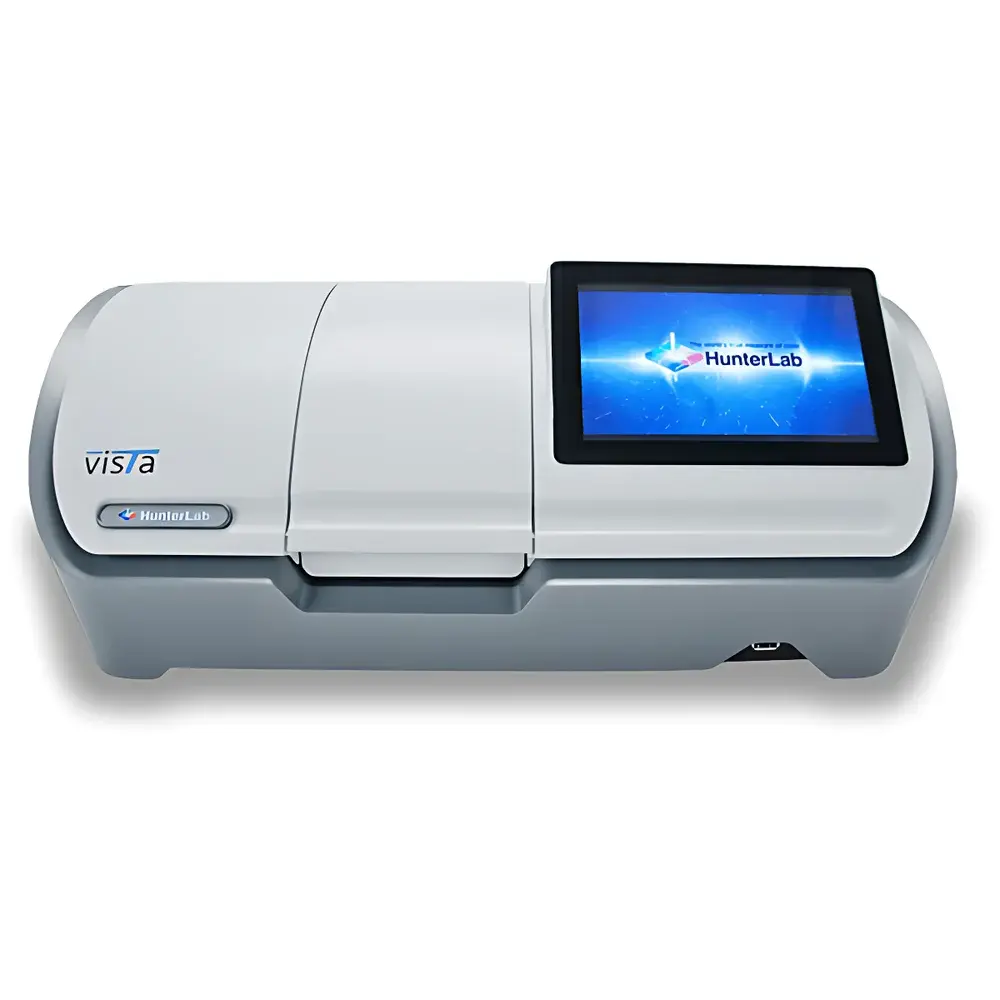
HunterLab Vista Spectrophotometer for Photoresist Resins
| Brand | HunterLab |
|---|---|
| Origin | USA |
| Model | Vista |
| Instrument Type | Benchtop |
| Optical Geometry | d/8° Integrating Sphere |
| Light Source | Full-Spectrum LED Array |
| Spectral Range | 400–700 nm |
| Repeatability | < 0.02 ΔE* |
| Compliance | ASTM E1164, CIE 15:2004, ASTM D1003, ISO 11475, JIS Z 8722 Condition E, DIN 5033 Teil 7 |
| Illuminant/Observer | D65/10°, C/2° |
| Color Scales | CIE L*a*b*, Hunter Lab, CIE LCh, CIE Yxy, CIE XYZ |
| Color Difference Indices | ΔE*, ΔE₀₀ (CIEDE2000), ΔE CMC (2:1), ΔL*a*b*, ΔL*C*h* |
| Haze Measurement | Yes (ASTM D1003 compliant) |
| Transmission Modes | Total Transmission (TTRAN), Regular Transmission (RTRAN), Haze |
| Measurement Time | < 2.5 s (color), < 5 s (haze) |
| Aperture | 18.5 mm (illumination) / 9.1 mm (measurement) |
| Integration Sphere Diameter | 76 mm |
| Spectral Resolution | < 3 nm |
| Effective Bandwidth | 10 nm |
| Photometric Range | 0–150% |
| Spectral Repeatability | SD < 0.1% |
| Inter-instrument Agreement | ΔE* (D65/10°) < 0.15 (avg), < 0.25 (max) for transmission filters |
| Display | 1280 × 800 color touchscreen |
| Power | 100–240 VAC, 47–63 Hz, 60 W |
Overview
The HunterLab Vista Spectrophotometer is an engineered solution for precise, repeatable color and haze quantification of transparent and semi-transparent photoresist resins used in semiconductor lithography, display manufacturing, and advanced packaging processes. Operating on dual-beam spectrophotometric principles with a 256-element diode array detector and high-fidelity concave holographic grating, the Vista delivers traceable spectral data across the full visible range (400–700 nm). Its d/8° integrating sphere geometry ensures compliance with major international standards—including ASTM E1164, CIE 15:2004, and JIS Z 8722 Condition E—for both reflectance and transmission measurements. Unlike conventional tristimulus meters, the Vista captures full spectral reflectance/transmittance curves in under 2.5 seconds, enabling rapid assessment of batch-to-batch consistency, resin aging effects, and solvent residue impact on chromaticity. The system’s optical architecture is optimized for low-scatter, high-clarity samples—critical when evaluating UV-curable acrylate or epoxy-based resins where minor spectral deviations correlate directly with lithographic performance.
Key Features
- Dual-mode transmission capability: Simultaneous measurement of total transmission (TTRAN), regular transmission (RTRAN), and ASTM D1003-compliant haze—essential for characterizing optical clarity and scattering behavior in spin-coated resist films.
- Full-spectrum LED illumination with 5-year rated lifetime: Stable, cool-running, and free of mercury or xenon degradation—ensuring long-term photometric integrity without recalibration drift.
- Auto-calibrating optical path: Integrated reference tile and real-time dark current compensation eliminate manual zeroing and reduce operator dependency.
- Compact benchtop footprint (W × D × H: 32 × 36 × 24 cm): Designed for cleanroom-adjacent lab spaces and QC stations with limited bench area.
- Spill-resistant sample compartment with precision aperture alignment: Prevents resin overspill during liquid or gel-state analysis while maintaining strict 18.5 mm illumination / 9.1 mm measurement geometry.
- High-resolution 1280 × 800 capacitive touchscreen interface: Supports glove-compatible operation and intuitive workflow navigation without external PC dependency.
Sample Compatibility & Compliance
The Vista accommodates a broad range of photoresist-related sample forms: liquid monomer blends, filtered resin solutions (e.g., PGMEA-diluted novolac or chemically amplified resists), cured thin films on quartz or silicon wafers (via transmission mode), and bulk resin pellets. Its 100 mm optical path length enables accurate haze evaluation of low-absorbance formulations. All measurement protocols align with regulatory expectations for analytical instrumentation in controlled environments: instrument inter-compatibility data meets ASTM E2535 requirements; spectral repeatability supports GLP audit trails; and firmware logging complies with FDA 21 CFR Part 11 electronic record criteria when paired with optional networked software. Certification documentation—including NIST-traceable calibration reports and ISO/IEC 17025-accredited verification—is provided with each unit.
Software & Data Management
Vista ships with Vision Pro™ software—a validated platform supporting method-driven workflows, multi-user permission tiers, and automated report generation (PDF, CSV, XML). Raw spectral data export preserves full 10 nm interval resolution for post-acquisition analysis in MATLAB or Python-based QA pipelines. Audit trail functionality records every parameter change, measurement event, and user login with timestamp and IP address. For enterprise integration, the instrument supports OPC UA and RESTful API interfaces—enabling direct ingestion into LIMS (e.g., LabVantage, Thermo Fisher SampleManager) and MES systems. All color difference calculations—including ΔE₀₀, YI E313, APHA, and Gardner—adhere to published standard algorithms without proprietary interpolation.
Applications
- Raw material qualification: Quantifying APHA/PtCo yellowness index shifts in epoxy novolac resins to detect thermal degradation prior to synthesis.
- Batch release testing: Verifying ΔE* < 0.02 against master standards for KrF or ArF photoresist formulations before wafer coating.
- Haze correlation studies: Linking measured % haze (ASTM D1003) to particle count data from DLS or SEM to optimize filtration protocols.
- Process stability monitoring: Tracking CIE L*a*b* drift across multiple dispensing cycles to identify pump wear or temperature-induced viscosity changes.
- Regulatory submission support: Generating GMP-compliant color stability reports per ICH Q5C guidelines for biopharmaceutical photoresist-coated devices.
FAQ
Does the Vista support measurement of uncured liquid photoresists in cuvettes?
Yes—standard 10 mm pathlength quartz cuvettes are compatible; the system automatically corrects for cuvette refractive index and meniscus height via built-in geometry compensation.
Can haze and color be measured simultaneously in a single scan?
Yes—the Vista acquires full spectral data in one acquisition cycle and computes both CIE color coordinates and ASTM D1003 haze from the same dataset, eliminating sequential measurement error.
Is firmware validation documentation available for FDA-regulated environments?
Yes—HunterLab provides IQ/OQ documentation packages, 21 CFR Part 11 configuration files, and periodic requalification templates upon request.
What is the maximum allowable sample thickness for transmission mode?
Up to 25 mm for low-absorbance resins (OD < 1.5 at 450 nm); thicker samples require pathlength adjustment using calibrated neutral density filters.
How frequently must the instrument be recalibrated?
Annual NIST-traceable recalibration is recommended; however, daily verification with supplied ceramic tile and air reference ensures ongoing metrological confidence between service intervals.



