
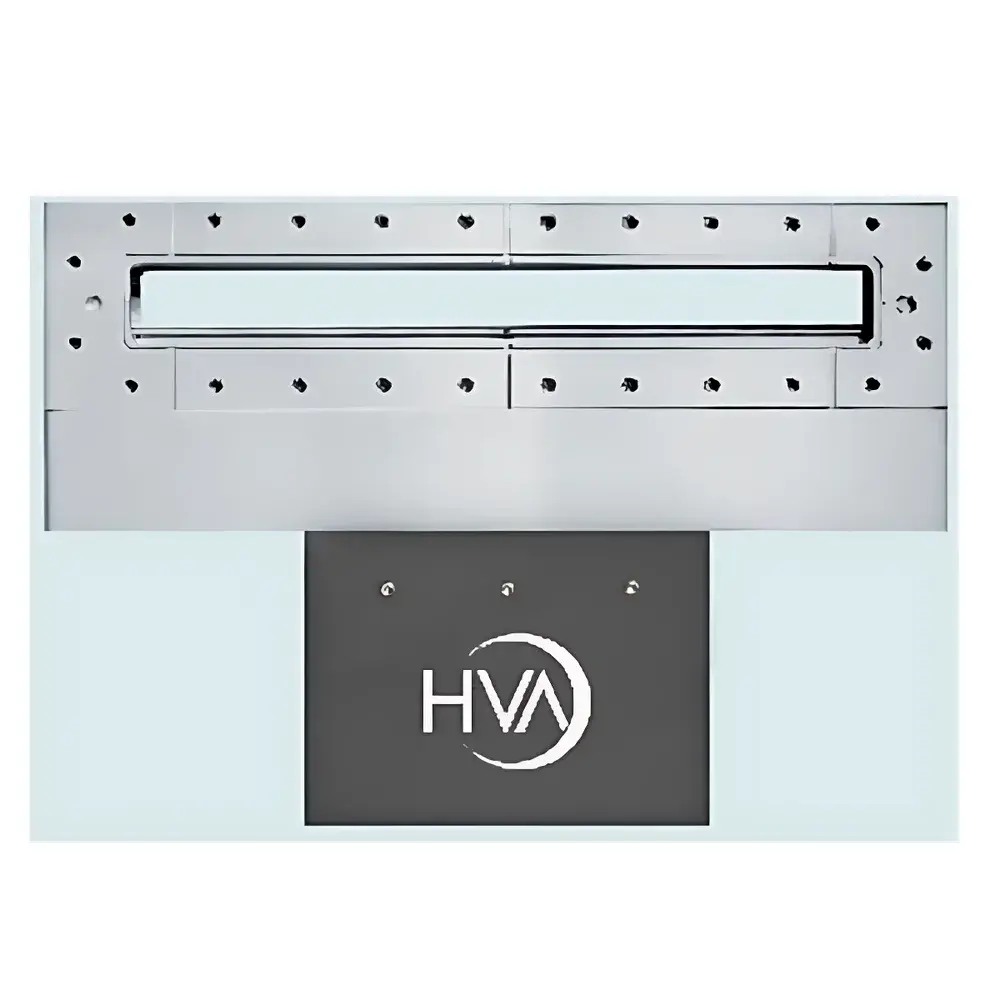
HVA 88200 Series Rectangular Gate Valve (Vacuum Isolation Valve)
| Brand | HVA |
|---|---|
| Origin | USA |
| Model | HVA 88200 Series Rectangular Gate Valve (Gate-Type Vacuum Isolation Valve) |
| Baking Temperature (Elastomer Seal) | 150°C |
| Baking Temperature (Actuator) | 60°C |
| Ultimate Pressure Range | 1×10⁻⁹ mbar |
| Helium Leak Rate | <2×10⁻⁹ mbar·L/s |
| Differential Pressure Rating (Bidirectional Closure) | ≤1 bar |
| Max Inlet Pressure Prior to Opening | <30 mbar |
| Pneumatic Supply Pressure | 80 psig |
| Solenoid Power Consumption | 4.3 W (Latching Type) |
| Supply Voltage Options | 120 VAC, 50/60 Hz (Standard) |
| Optional | 24/200/240 VAC, 50/60 Hz or 12/24 VDC |
| Position Indicator Max Rating | 115 VAC or 28 VDC, 20 mA |
| Body & Gate Material | 6061-T6 Aluminum |
| Bellows Material | AM-350 Stainless Steel |
| Stem & Pin Material | Hardened Stainless Steel |
| Seal Material | Viton® Elastomer |
| Cycle Life | ≥1,000,000 cycles (process-dependent) |
| Vacuum Compatibility | Certified for 1×10⁻⁹ mbar base pressure |
| High-Temp Vacuum Processing | Qualified for continuous operation at 200°C under 1×10⁻⁹ mbar |
Overview
The HVA 88200 Series Rectangular Gate Valve is a high-integrity, pneumatically actuated vacuum isolation valve engineered for ultra-high vacuum (UHV) and extreme clean environments. Designed around a linear gate mechanism with direct-coupled actuation, it provides hermetic sealing between process chambers and transfer lines in semiconductor fabrication, thin-film deposition, vacuum metallurgy, and analytical instrumentation systems. Its rectangular cross-section enables optimal integration into load-lock architectures and cassette-handling modules where space-constrained mechanical interfaces are critical. The valve operates on the principle of positive mechanical shut-off: a precision-machined aluminum gate moves perpendicularly across the flow path, compressing a Viton® elastomer seal against a hardened stainless steel seat—ensuring repeatable leak-tightness without particle generation. All wetted surfaces undergo vacuum-brazing at 1100°C under 1×10⁻⁶ Torr conditions, eliminating outgassing pathways and ensuring long-term dimensional stability under thermal cycling.
Key Features
- Proven mechanical endurance: Rated for ≥1,000,000 operational cycles under nominal UHV conditions (1×10⁻⁹ mbar), validated via accelerated life testing per ASTM F2437.
- Zero particulate generation: Fully non-lubricated design with hardened stainless steel stems, AM-350 bellows, and static elastomeric sealing—eliminating wear debris that compromises chamber cleanliness.
- Thermally optimized construction: Valve body and gate fabricated from 6061-T6 aluminum (anodized per MIL-A-8625 Type II) for low thermal mass and compatibility with bake-out up to 150°C; actuator rated to 60°C ambient.
- Compact footprint: Narrow-profile actuator and integrated controller enable mounting directly at central load-lock ports without adapter plates or alignment spacers.
- Bidirectional differential pressure tolerance: Capable of reliable closure against ≤1 bar pressure differential in either direction—critical for rapid pump-down sequences and fault-tolerant chamber isolation.
- Latching solenoid architecture: Consumes power only during state transition (4.3 W), retaining position during power loss—compliant with SEMI S2 and ISO 13849-1 PL e safety requirements.
Sample Compatibility & Compliance
The 88200 Series is qualified for use with aggressive process chemistries including halogen-based plasmas (Cl₂, NF₃), oxygen radicals, and metalorganic precursors common in CVD and ALD tools. All elastomeric seals meet ASTM D1418 classification for fluorocarbon elastomers and demonstrate ≤0.5% volume swell after 72-hour immersion in IPA, acetone, and perfluoropolyether (PFPE) lubricants. Materials of construction comply with ASTM E595 low-outgassing specifications (<1.0% TML, <0.1% CVCM). The valve conforms to ISO 286-2 (Geometric tolerances), ISO 10110-7 (Optical surface finish for viewports), and is documented per ASME BPE-2021 Annex A for vacuum system components. Full traceability documentation—including material certifications (MTRs), helium leak test reports, and vacuum bake records—is provided with each unit.
Software & Data Management
While the 88200 Series is a hardwired, analog-controlled valve, its interface supports integration into supervisory control systems via standard dry-contact position feedback (NO/NC) and optional 4–20 mA analog position verification. For facilities operating under FDA 21 CFR Part 11 or EU Annex 11 requirements, HVA provides configurable I/O modules with audit-trail-capable PLC interface cards (e.g., Siemens SIMATIC S7-1500 compatible) that log valve state transitions, cycle count, and actuation timing with microsecond timestamp resolution. Firmware updates and diagnostic routines adhere to IEC 62443-3-3 security levels for industrial automation devices.
Applications
- Semiconductor front-end: Load-lock isolation valves in cluster tools, ion implanters, and etch platforms requiring sub-10⁻⁹ mbar base pressure and >10⁶ cycle reliability.
- Thin-film coating: Chamber-to-chamber isolation in multi-source sputtering and electron-beam evaporation systems operating at 200°C substrate temperatures.
- Research infrastructure: Beamline shutters and sample exchange gates in synchrotron and neutron scattering facilities demanding ultra-low magnetic permeability and minimal RF interference.
- Space simulation: Thermal-vacuum test chamber isolation where vibration sensitivity and thermal shock resistance are mission-critical.
- High-energy physics: Cryogenic vacuum interlocks in superconducting magnet systems requiring non-magnetic materials and helium-leak integrity below 1×10⁻¹⁰ mbar·L/s.
FAQ
What vacuum level is the 88200 Series certified to maintain?
The valve is tested and certified to maintain ≤2×10⁻⁹ mbar·L/s helium leak rate per ISO 15848-2, supporting base pressures down to 1×10⁻⁹ mbar in properly baked systems.
Can the valve be installed in inverted or horizontal orientations?
Yes—mechanical design permits installation in any orientation without performance degradation; gravitational effects on gate positioning are mitigated by spring-assisted return and dual-side sealing geometry.
Is the Viton® seal compatible with oxygen plasma environments?
Viton® A-class elastomers exhibit acceptable resistance to atomic oxygen exposure up to 100 W/cm² fluence; for extended plasma duty, HVA offers optional Kalrez® 7075 seals upon request.
Does the valve support remote diagnostics?
Standard configuration includes mechanical position indicators; optional digital position sensors (Hall-effect or potentiometric) provide real-time feedback compatible with Modbus RTU and EtherNet/IP protocols.
What is the maximum allowable temperature gradient across the valve during bake-out?
Per HVA engineering specification, thermal gradients exceeding 50°C/cm across the gate assembly must be avoided; uniform heating ramp rates ≤20°C/hour are recommended to prevent differential expansion-induced seal distortion.



